
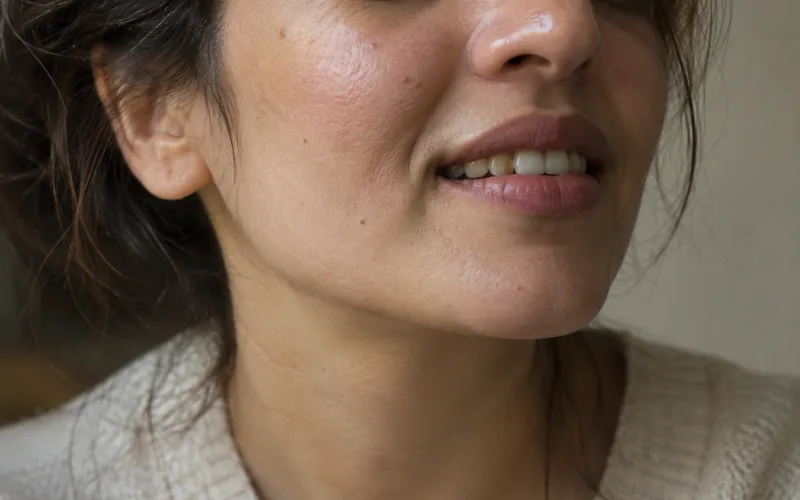
Teeth grinding, lip licking, mouth breathing, staining foods, plaque left sitting on the gum line and using your teeth as tools all change the lower third of your face. Grinding thickens the jaw muscle and squares the jawline. Staining shifts tooth shade warmer. Lip licking leaves a red ring around the mouth. Some of it reverses. Some of it does not.
Skincare gets the budget and the attention. The mouth almost never does, right up until someone notices their jaw looks wider in photos than it did three years ago, or that their teeth suddenly read yellow against a lipstick that used to look fine on them.
Six habits do most of that work. Here is what each one actually changes, and where a beauty routine stops being enough.
1. Grinding squares off the lower third of your face
Bruxism is clenching or grinding outside of chewing and talking. Sleep bruxism affects 8% to 10% of adults and awake bruxism affects 22.1% to 31% of people, according to StatPearls at the NIH National Library of Medicine. Most of them have no idea they are doing it.
The cosmetic side of this gets far less coverage than the dental side. Clenching trains the masseter, the muscle that runs from the cheekbone down to the angle of the jaw. Trained muscle gets thicker. Over a few years that thickening widens the jaw angle and squares the lower face, which is why some people find their face reads heavier in photographs without having gained any weight.
The teeth take the rest. Attrition flattens the biting edges, so front teeth lose their natural curve and start reading short and blunt. Waking up with a sore jaw, temple headaches or teeth that look shorter than they used to is the point to act on. A dentist can confirm bruxism from the wear pattern alone and fit a night guard. The guard does not stop the clenching. It gives the force something else to grind down.
2. Coffee, tea and red wine move your tooth shade off your undertone
Chromogens are the pigment molecules in coffee, tea, red wine, dark sodas, berries and soy sauce. They bind to the protein film sitting on enamel, which is how common foods dull a smile over time. Acidity makes it worse by roughening the enamel surface so pigment has more to hold onto.
Here is the part nobody connects. Tooth shade sits directly beside your skin and your lipstick in every photograph of you. Teeth that have drifted two or three shades warmer will fight a cool blue-red lipstick and flatter a warm brick or coral instead. It is the same undertone logic behind which colors look good on you, applied to a surface most people have never thought of as a color at all. If your lipsticks have quietly stopped working, run the color analysis quiz and then look at your teeth in the same daylight.
Surface stains lift with a professional clean and respond to peroxide whitening. The yellowing that comes with getting older does not, because enamel thins with age and the dentin underneath it is naturally yellow. No whitening strip reaches that.
3. Lip licking draws a ring around your mouth
Dry lips make people lick. The saliva evaporates and takes a little more moisture with it, the lips get drier, and the cycle tightens.
Repeated saliva contact macerates the skin and strips the sebaceous oils that hold the barrier around the mouth together, per a case review published in PubMed Central. What you get is lip licker’s dermatitis: a sharply defined red, scaly ring that stops exactly where the tongue can reach. On deeper skin tones it often leaves pigmentation that outlasts the rash by months.
The fix is a plain occlusive balm reapplied often enough that the lips never feel tight. Flavoured balms, menthol and anything with salicylic acid keep the licking going.
4. Mouth breathing dries the lips and swells the gum line
Breathing through the mouth overnight runs dry air across the gums and lips for hours. Saliva is what buffers acid and clears bacteria, so a dry mouth means more plaque collecting at the gum margin and puffier gums by morning. It is also one of the quieter drivers of the lip licking above.
Chronic nasal blockage deserves a medical opinion rather than a skincare workaround. In the meantime a bedroom humidifier and a heavier overnight balm handle the visible part.
5. Plaque makes teeth look dull and gums look angry
Plaque is soft bacterial film. Left alone it mineralises into calculus, which is porous, picks up pigment quickly, and settles as a yellow-brown band along the gum line that brushing will not touch.
Gums carry the other half of the look. The NIH National Institute of Dental and Craniofacial Research puts total periodontitis among US adults aged 30 and over at 42.2%, rising to 62.4% among current smokers. Inflamed gums read red and swollen instead of firm and pale pink, and they recede, which makes teeth look longer and exposes the darker root surface underneath.
Two minutes of brushing twice a day and flossing once is the American Dental Association baseline, and it is enough for most people. The teeth protection tips guide covers the rest of the routine.
6. Using your teeth as tools chips the edges you show most
Tearing packaging, biting thread, chewing pen caps and crunching ice all load the incisal edges, which are the thinnest part of the tooth. Chips there show in every single photo, because those are the edges a smile puts on display.
Oral piercings add a second route to the same damage. Metal jewellery knocking against enamel chips it, and the constant rub against tissue behind the lower front teeth pulls the gum back.
What reverses and what does not
| Habit | What it changes about your face | Does it reverse? |
| Grinding and clenching | Squares the jaw angle, flattens the edges of the front teeth | Muscle bulk softens once clenching stops. Enamel wear does not come back. |
| Staining foods and drinks | Pushes tooth shade several steps warmer and duller | Surface stains lift. Age yellowing does not. |
| Lip licking | Red, scaly ring around the mouth, sometimes darker pigment | Rash clears in weeks. Pigment takes months. |
| Mouth breathing | Cracked lips, swollen gum margin by morning | Yes, once the breathing itself is sorted. |
| Plaque left in place | Dull, yellow teeth, red gums, gums that pull back | Tartar and inflammation yes. Recession no. |
| Teeth used as tools | Chips on the edges you show whenever you smile | No. Chips need bonding. |
Questions people ask about this
Can teeth grinding really change your face shape?
Yes. Grinding thickens the masseter muscle at the jaw angle, which widens and squares the lower third of the face over time. The change is slow, and it tends to show up in photographs long before anyone notices it in the mirror.
Do coffee stains on teeth go away?
Surface coffee stains come off with a professional clean and respond well to peroxide whitening. Yellowing caused by enamel thinning with age does not, because that color is coming from the dentin underneath rather than from anything sitting on the surface.
How long does lip licker’s dermatitis take to clear?
The rash usually settles within two to four weeks once the licking stops and a bland emollient goes on consistently. Darker pigment left behind can take several months longer.
Does a night guard stop teeth grinding?
No. It does not stop the clenching itself. It puts a replaceable layer between the teeth so the guard takes the wear instead of the enamel, and it usually cuts down morning jaw soreness as a side effect.
Which oral habit damages appearance fastest?
Lip licking shows up quickest, often within a week of cold weather starting. Grinding is the slowest and the hardest to undo, because it changes both muscle bulk and tooth height over a period of years.
The short version
Every one of these is a habit, which is the useful part, because habits are adjustable in a way that bone structure is not. Start with whichever one you recognised while reading, and treat it the way you would treat any of the other small beauty habits that compound quietly over years.
How this was checked: prevalence figures come from the NIH National Library of Medicine and the National Institute of Dental and Craniofacial Research rather than from dental practice blogs. Staining mechanism and brushing guidance follow Colgate’s oral health library and the American Dental Association. Claims about jaw muscle change are kept to what appears in the clinical literature. None of this replaces an in-person examination.

BeautyLiesTruth publishes hair and personal color guidance built on primary research. Color claims are tested by draping under controlled daylight, and every figure is traced to a published source rather than to another blog.