
A skin tone chart reads in two directions. Depth runs down the chart, from fair through light, medium and tan to deep, and describes how light or dark your skin appears. Undertone runs across it, warm, cool, neutral or olive, and describes the color direction beneath the surface. Your position needs both. Two people at the same depth can need completely different foundation and clothing colors because their undertones differ.
Find your depth first, then your undertone. Doing it the other way round produces the wrong answer roughly as often as the right one.
Once you have your reading, use it to find the colors that suit you or take the free color season quiz.
How Do I Identify My Skin Tone?
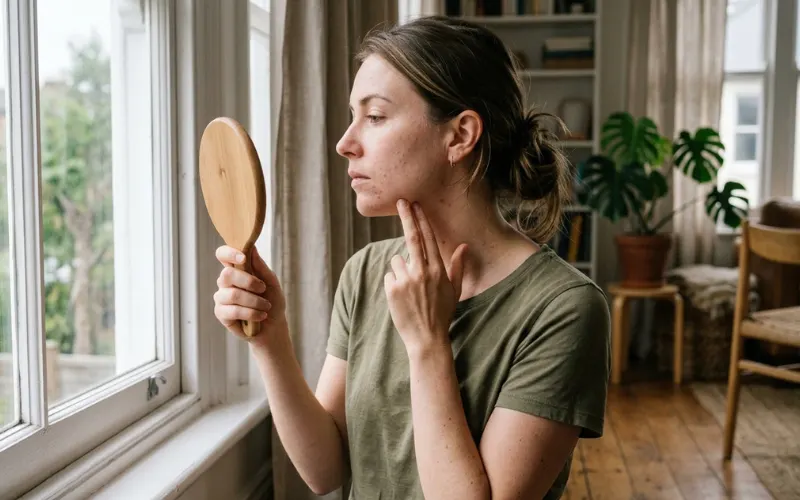
Clean your face, stand beside a window with no direct sun on you, and switch off every artificial light in the room. Compare the chart against your lower cheek, jaw, neck and upper chest, not your hand or wrist, which get different sun exposure.
Make two passes. On the first, ignore undertone entirely and match depth alone. Pick the closest band, then check the band above and below it. The correct band is the one that looks least separate from your neck. On the second pass, compare the warm, cool, neutral and olive versions within that band only.
If the result changes every time you move rooms, the lighting is deciding it rather than your skin.
Skin Tone Chart With Names, Numbers and Hex Codes
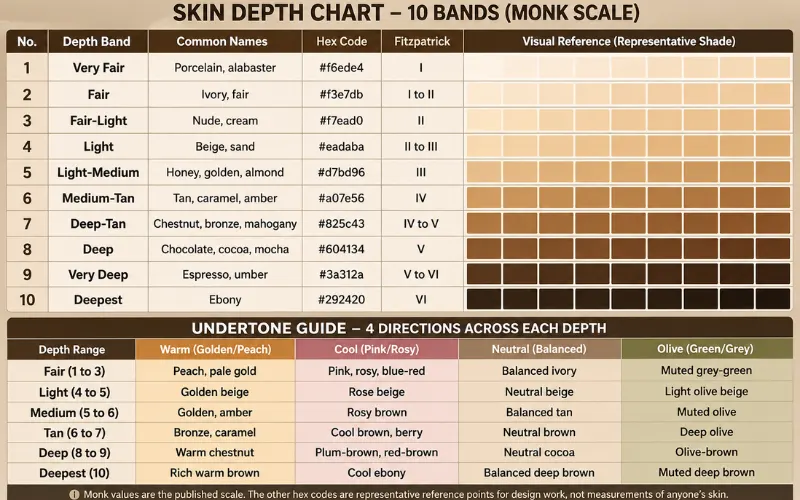
Ten depth bands, numbered to match Google’s Monk Skin Tone Scale, with the common shade name and a representative hex code for each.
| No. | Depth band | Common names | Hex | Fitzpatrick |
| 1 | Very fair | Porcelain, alabaster | #f6ede4 | I |
| 2 | Fair | Ivory, fair | #f3e7db | I to II |
| 3 | Fair-light | Nude, cream | #f7ead0 | II |
| 4 | Light | Beige, sand | #eadaba | II to III |
| 5 | Light-medium | Honey, golden, almond | #d7bd96 | III |
| 6 | Medium-tan | Tan, caramel, amber | #a07e56 | IV |
| 7 | Deep-tan | Chestnut, bronze, mahogany | #825c43 | IV to V |
| 8 | Deep | Chocolate, cocoa, mocha | #604134 | V |
| 9 | Very deep | Espresso, umber | #3a312a | V to VI |
| 10 | Deepest | Ebony | #292420 | VI |
Now find your column. Each depth band contains all four undertone directions.
The shade words in that middle column overlap heavily, and the full list of skin color names sets out what each one means and where the boundaries blur.
| Depth | Warm | Cool | Neutral | Olive |
| Fair (1 to 3) | Peach, pale gold | Pink, rosy, blue-red | Balanced ivory | Muted grey-green |
| Light (4 to 5) | Golden beige | Rose beige | Neutral beige | Light olive beige |
| Medium (5 to 6) | Golden, amber | Rosy brown | Balanced tan | Muted olive |
| Tan (6 to 7) | Bronze, caramel | Cool brown, berry | Neutral brown | Deep olive |
| Deep (8 to 9) | Warm chestnut | Plum-brown, red-brown | Neutral cocoa | Olive-brown |
| Deepest (10) | Rich warm brown | Cool ebony | Balanced deep brown | Muted deep brown |
Monk values are the published scale. The other hex codes are representative reference points for design work, not measurements of anyone’s skin.
What Are the Four Types of Skin Tones?
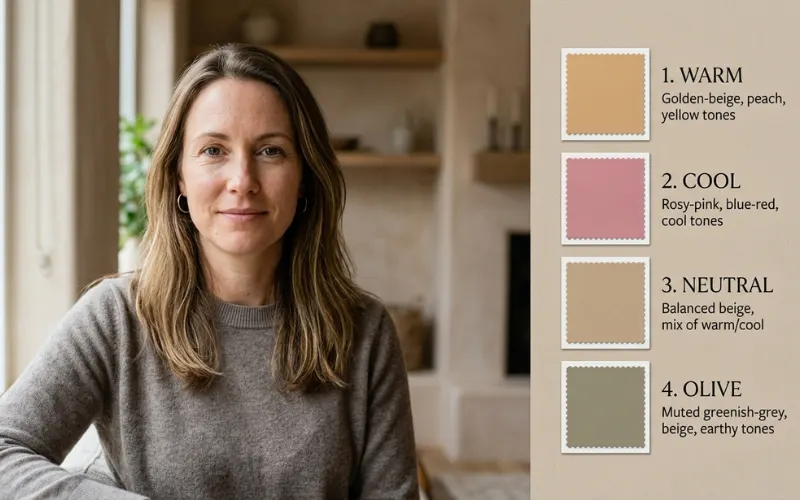
The four-type model refers to undertones, not depths: warm, cool, neutral and olive. Warm reads golden, yellow or peach. Cool reads pink, rosy or slightly blue. Neutral sits between the two. Olive carries a muted green or grey-green cast.
Depth is a separate axis with five to ten bands depending on the chart. When someone says there are four skin tones, they mean four undertones, and each one occurs at every depth. Olive is the one people misplace most often, because charts frequently show it as a single medium-tan box when it actually runs from very fair to very deep.
How Do I Find My Undertone With the Vein Test?
Look at the veins on the inside of your forearm in daylight. Blue or purple veins suggest a cool undertone. Green veins suggest warm. A mix of both suggests neutral.
Treat it as one input, not the answer. The test reads the light scattering through your skin as much as your pigment, so it becomes unreliable on deeper complexions where veins are harder to see, on very fair skin where everything looks blue, and under any artificial light. It also says nothing about olive.
Two better checks. Hold plain gold and plain silver under your chin and watch which one settles the shadows along your jaw. Then alternate pure white fabric against cream, where cool skin looks clearer in white and warm skin looks healthier in cream. When two tests agree, you have your answer. When they disagree, your undertone is probably neutral or olive.
Skin Tone Chart for Clothes

For clothing, undertone matters more than depth. Warm undertones suit camel, coral, olive, rust and tomato red. Cool undertones suit emerald, cobalt, raspberry, blue-red and true white. Neutral undertones suit soft teal, medium navy and dusty rose. Olive suits terracotta, warm ivory and mid-tone teal, and tends to go sallow in ashy greys.
Depth changes the version rather than the family. Higher melanin density supports higher saturation, which is why bright white and jewel tones tend to be assets on deep complexions rather than risks, despite a lot of published advice saying otherwise.
Contrast is the third variable and the one charts leave out entirely. Convert a photo of yourself to greyscale and look at the gap between your skin, hair and eyes. A wide gap carries clear saturated color; a narrow gap suits softer, closer shades. Two people at the same depth and undertone can suit different colors purely on contrast.
What Is the Most Attractive Skin Undertone?
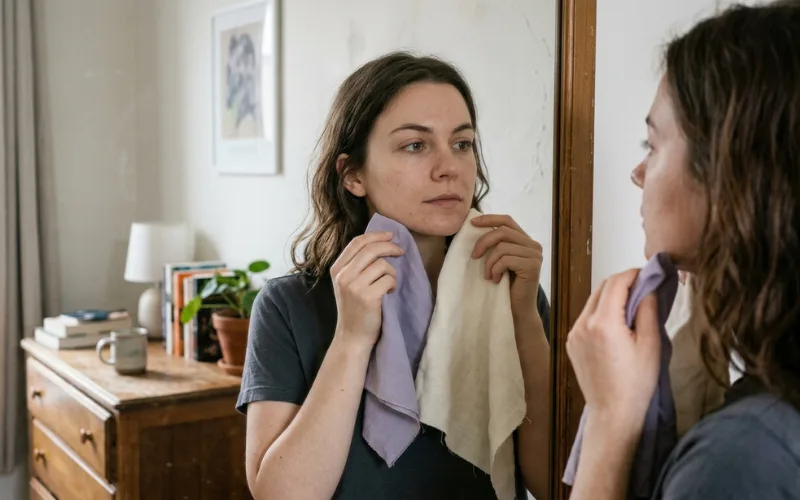
There isn’t one. Attractiveness preferences around skin tone vary enormously across cultures and historical periods, they track social status rather than any property of the skin, and they reverse within a single culture inside a few generations. No undertone is objectively more attractive than another.
What does change how a face reads is whether the colors near it agree with the undertone. A cool complexion in mustard and a warm complexion in icy lilac will both look tired, and the same two people look rested in colors matched to their own direction. That effect is real and it is what a chart is for. The question of which undertone is best has no answer, and any page that gives you one is selling something.
How Does the Chart Compare to Fitzpatrick and Monk Scales?
Three systems, three different jobs.
A skin tone chart measures visible color across depth and undertone. It is the right tool for foundation and clothing.
The Fitzpatrick scale classifies six phototypes by how skin reacts to UV, not by color. It is a dermatology tool. Reference material from the National Center for Biotechnology Information records Type III as the most common phototype in the United States at 48%, with Types I and II together at 35%. Two people at Type III can sit several shades apart, and a Type VI can be warm or cool, so it should never be read as a color scale.
The Monk Skin Tone Scale classifies ten shades by color, each with a fixed hex value. It was developed by Harvard sociologist Dr. Ellis Monk and released openly by Google in 2022 after computer vision researchers found Fitzpatrick under-represented deeper skin. It is the most reliable numbering system available, which is why the chart above uses it.
None of the three tells you anything about race or ethnicity. Pigmentation varies widely within every population group, and a 2024 dermatology review indexed on PubMed cautions explicitly against conflating phototype with skin color, race or ethnicity.
Is the Skin Tone Chart Different for Men and Women?

No. Depth and undertone work identically regardless of sex, and the chart above applies unchanged.
The difference is commercial. Foundation ranges are marketed to women and carry granular shade names and numbers, while men’s grooming products use broad bands or skip naming altogether. Anyone looking for a men’s reading can use the same two-pass method and the same chart.
Why Does My Result Change Under Different Lights?
Because light sources emit different spectra, and two properties decide how yours treats skin. Correlated color temperature, measured in kelvins, sets whether light appears warm or cool. Color Rendering Index, scored 0 to 100, sets how accurately it reproduces color.
The U.S. Department of Energy sets the CRI floor for ENERGY STAR bulbs at 80. The Energy Information Administration notes that CRI specifically measures how well a light source renders objects, materials and skin tones, and that lamps around 2,500K to 3,500K carry the orange cast of incandescent light. A 2,700K bulb at CRI 80 and indirect daylight near 6,500K will render one complexion as two different readings.
There is a formal name for what you are seeing. Metamerism describes two colors that match under one light source and visibly diverge under another. It is why a foundation matched in a store clashes in your bathroom. Any chart comparison made under mixed lighting is producing a metameric result rather than a reading of your skin.
Common Skin Tone Chart Mistakes
Matching under one strong artificial light is the most frequent error, and it invalidates everything downstream. Sampling a single pixel from a phone selfie is the second, since cameras apply white balance and exposure correction before the image reaches your screen.
Using the wrist or the back of the hand is a third. Those areas take different sun exposure and often sit a full band away from the face. Treating the nearest swatch as permanent is a fourth. Depth shifts with sun exposure across a year while undertone stays put, so a summer reading and a winter reading should differ on one axis only.
The last one is subtler. A chart match is not a product match. Two foundations both labelled medium neutral can be visibly different colors, because coverage, finish and oxidation all change the result after dry-down. Narrow with the chart, then confirm on the jaw in daylight.
Frequently Asked Questions (FAQ’s)
How do I identify my skin tone?
Compare the chart against your lower cheek, jaw, neck and upper chest in indirect daylight with artificial lights off. Match depth first while ignoring undertone, then compare warm, cool, neutral and olive versions within that depth band only. Avoid the wrist and the back of the hand.
What are the four types of skin tones?
Warm, cool, neutral and olive. These are undertones rather than depths, and each one occurs at every depth from very fair to deepest. Warm reads golden or peach, cool reads pink or blue, neutral sits between, and olive carries a muted green cast.
What is the most attractive skin undertone?
None is objectively more attractive. Preferences vary widely across cultures and eras and track social status rather than any property of the skin. What genuinely changes how a face reads is whether the colors worn near it match the undertone.
How do I find my undertone with the vein test?
Blue or purple veins suggest cool, green suggests warm, and a mix suggests neutral. The test is unreliable on deep complexions where veins are hard to see, on very fair skin where everything reads blue, and under artificial light. Confirm with a gold-against-silver comparison.
How many skin tones are there?
There is no fixed number, because pigmentation varies continuously. Charts divide the range for a purpose: Fitzpatrick uses six phototypes based on sun response, the Monk Skin Tone Scale uses ten shades based on color, and foundation ranges commonly use 20 to 50.
Is olive a skin depth or an undertone?
An undertone. Olive skin occurs at every depth from very fair to very deep and can lean warm, cool or neutral. Charts that place olive in a single medium-tan box are oversimplified, which is why “medium olive” communicates more than “olive.”
Is the Fitzpatrick scale a skin tone chart?
No. Fitzpatrick classifies how skin responds to UV exposure, not what color it is. Two people at the same phototype can sit several shades apart on a color chart, and appearance alone cannot reliably assign a phototype.
Does my skin tone chart result change after tanning?
Your depth band may move, but your undertone will not. A tan alters facultative pigmentation, the temporary UV-driven darkening, rather than constitutive pigmentation, your genetic baseline. Re-check depth seasonally and leave undertone alone.
BeautyLiesTruth publishes hair and personal color guidance built on primary research. Color claims are tested by draping under controlled daylight, and every figure is traced to a published source rather than to another blog.