
Hair types are grouped into four families by curl pattern: type 1 straight, type 2 wavy, type 3 curly, type 4 coily. Each family splits into A, B and C by how tight the pattern is, giving twelve types from 1A at the straightest to 4C at the tightest.
Key Takeaways
- The chart measures one thing: the shape your hair dries into with no product in it.
- The number is the curl family. The letter is how tight the pattern is inside that family.
- Curl pattern is genetic. Variants in TCHH, EDAR and FGFR2 are associated with hair texture and strand thickness (MedlinePlus Genetics, NIH).
- Most heads carry two or three patterns. Type by the dominant one.
- Type gives you the shape. Porosity and density decide your products.
What are the 12 Hair Types?
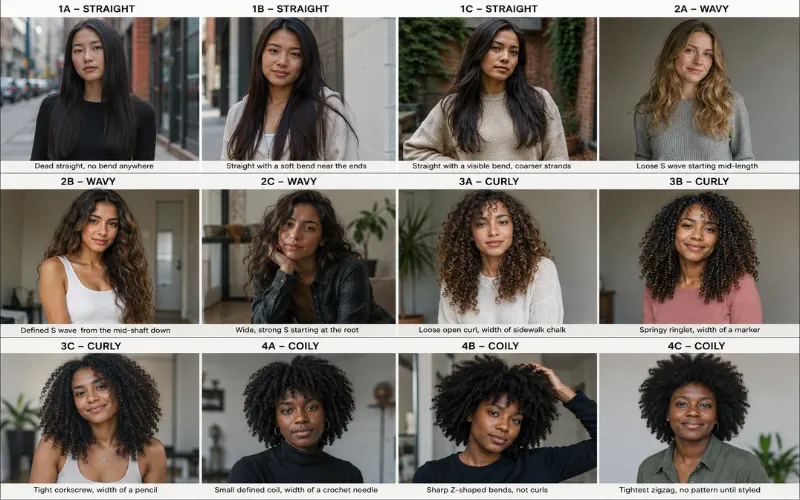
The twelve hair types are 1A, 1B and 1C (straight), 2A, 2B and 2C (wavy), 3A, 3B and 3C (curly), and 4A, 4B and 4C (coily).
| Code | Pattern | How to spot it | Main care issue |
| 1A | Dead straight, no bend anywhere | Falls flat within minutes of being pushed around | Rapid sebum migration |
| 1B | Straight with a soft bend near the ends | Holds a ponytail crease for hours | Flat roots |
| 1C | Straight with a visible bend, coarser strands | Kinks at the nape and behind the ears | Frizz in humidity |
| 2A | Loose S wave starting mid-length | The wave combs out and does not return | Waves dropping by midday |
| 2B | Defined S wave from the mid-shaft down | The wave survives combing | Frizz through the crown |
| 2C | Wide, strong S starting at the root | A few strands close into full loops | Root and ends behaving differently |
| 3A | Loose open curl, width of sidewalk chalk | Big soft loops when dry | Definition lost by day two |
| 3B | Springy ringlet, width of a marker | Spirals hold without product | Moisture retention |
| 3C | Tight corkscrew, width of a pencil | Corkscrews packed densely | Dryness and tangling |
| 4A | Small defined coil, width of a crochet needle | Each coil reads as a visible S | Holding moisture past day one |
| 4B | Sharp Z-shaped bends, not curls | The strand folds at angles | Breakage at the fold points |
| 4C | Tightest zigzag, no pattern until styled | Heavy shrinkage, grows outward not down | Length retention |
How Do I Identify My Hair Type?
Wash with a clarifying shampoo, skip conditioner, let your hair air dry without touching it, then read the pattern at the mid-shaft. A straight line is type 1, an S wave is type 2, a closed loop is type 3, a zigzag or coil is type 4. Match the width of the pattern to the chart above for your letter.
- Clarify and skip conditioner: Silicones and cationic conditioning agents deposit on the cuticle and weigh the pattern down.
- Do not touch it while it dries: Mechanical disruption during drying is the most common reason people mistype a full family too straight.
- Read the mid-shaft: Roots are weighed down by growth direction; ends are the most weathered section.
- Lay one dry strand on white paper: The shape is your number, the width is your letter.
The error that shows up most in consultation is typing off blow-dried hair, which reads a full family straighter than the truth. The hair type quiz runs the same protocol as questions.
Almost nobody is one type. A 3B crown over 2C temples is normal, and Vogue’s curl coverage makes the same point: treat the 1 to 4 system as a guide, not gospel.
Type 1: Straight Hair (1A, 1B, 1C)
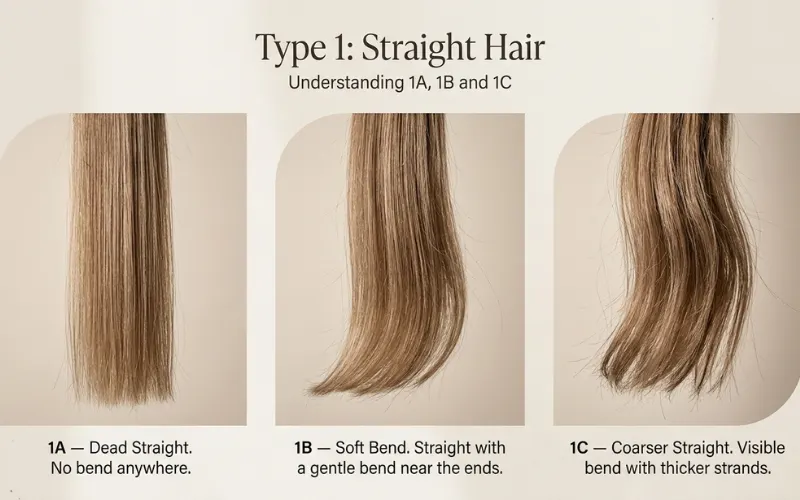
Type 1 hair has no curl pattern along the shaft. It grows from a round follicle, so the strand emerges cylindrical and reflects light evenly along its length.
The issue with type 1 is sebum, not dryness. A straight shaft is an uninterrupted runway from the pilosebaceous unit down, so oil reaches the mid-lengths in a day or two. Condition from the ears down only, and use dry shampoo between washes. Blondes brass faster here, hence purple shampoo. For volume, blunt lines beat any bottle.
Type 2: Wavy Hair (2A, 2B, 2C)
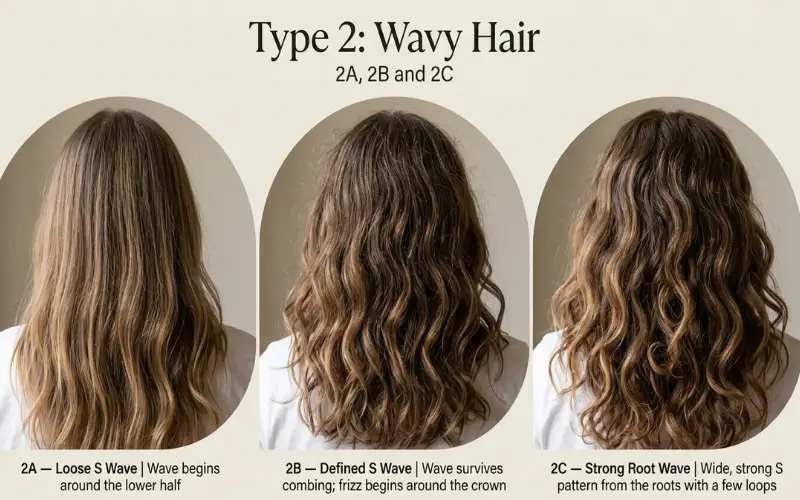
Type 2 hair forms an S-shaped wave along the shaft, sitting between straight and curly. It is the family people mistype most often, usually after years of brushing a 2B into a 1C.
Is My Hair 2A, 2B or 2C?
2A waves comb out flat and stay flat, with the pattern living in the bottom half. 2B waves survive a comb and frizz at the crown first. 2C waves start at the root, run wide and strong, and a few sections close into full loops. If part of your head loops and part waves, you are 2C, not 3A.
Heavy emollients and occlusives flatten waves. Light gel on soaking-wet hair, then no touching until dry: how to get waves to hold.
Type 3: Curly Hair (3A, 3B, 3C)
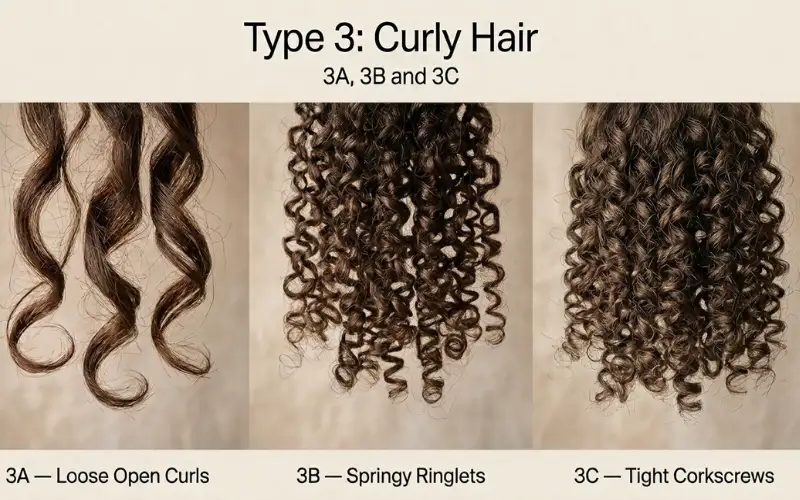
Type 3 hair forms closed loops and spirals. The follicle is curved, so the strand grows with an elliptical rather than round cross-section, and the flatter that ellipse, the tighter the loop.
3A curls are wide and soft, 3B are springy ringlets, 3C is a dense mass of pencil-width corkscrews.
Curls are dry by design, because sebum cannot travel down a spiral. Low-sulphate cleanser, humectant-led leave-in on wet hair, gel over the top, break the cast once dry. At 3C, sectioned application starts mattering.
Type 4: Coily Hair (4A, 4B, 4C)
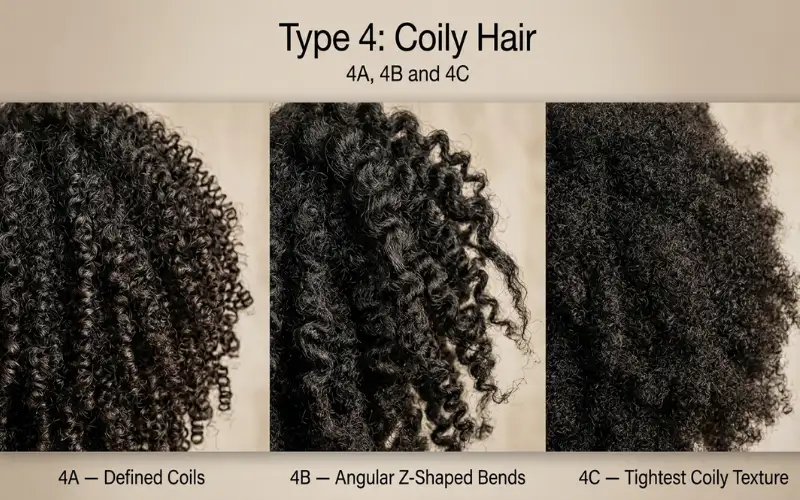
Type 4 hair grows in tight coils and sharp zigzags. It is the most fragile family on the chart, because every bend is a point where the cuticle scales lift, giving a 4C strand hundreds of mechanical stress points a 1A strand does not have.
4A holds a visible S in each coil. 4B folds at angles rather than curling, so it needs banding or twist-outs to read as defined. 4C shows almost no pattern until manipulated.
For types 1 to 3 the goal is definition. For type 4 it is length retention. Deep condition weekly, seal with an occlusive over a water-based leave-in, detangle with conditioner in and fingers first. Loc styles are the low-manipulation route many type 4 clients settle on.
How Much Does 4C Hair Shrink?
4C hair typically shrinks 50 to 75 per cent of its stretched length, so 12 inches can sit at 3 to 6 inches when dry. The 75 per cent figure repeated everywhere is an industry convention, not a measurement. Real shrinkage varies with density, strand diameter and how recently the hair was conditioned.
What is the Difference Between Hair Type and Hair Texture?
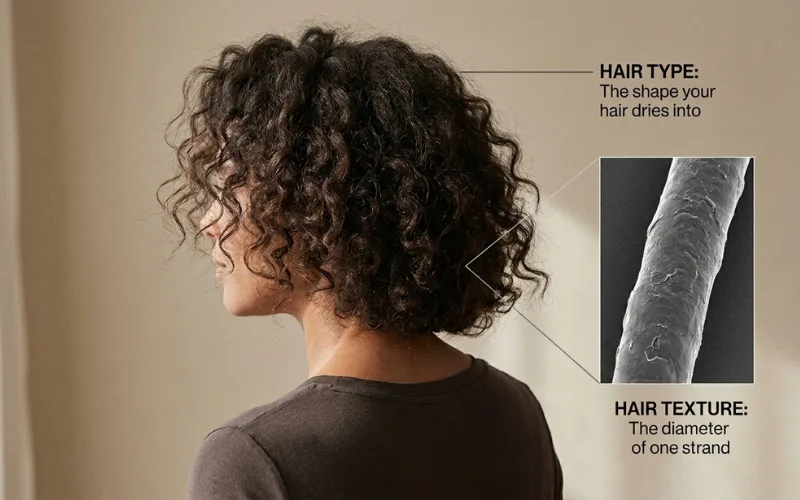
Hair type is the shape your hair dries into. Hair texture is the diameter of a single strand. They are independent: a 4C head is often finer per strand than a 1A head despite looking three times thicker, because the volume comes from coil geometry, not width.
| Measure | What it describes | How to check it |
| Type | The shape your hair dries into | The chart above |
| Texture | The diameter of one strand | Roll one hair between your fingers. Nothing felt, fine. Clearly there, medium. Wiry, coarse. |
| Porosity | How readily the cuticle admits and releases water | Spritz a dry section. Beads and sits, low. Vanishes instantly, high. |
| Density | How many strands you have | Part dry hair. Scalp barely visible, high. Clearly visible, low. |
.Normal terminal scalp hair measures around 82.7 microns across (PubMed), and most adults carry 80,000 to 120,000 terminal hairs, shedding about 100 a day (StatPearls, NIH).
Porosity decides your products. A low-porosity 3B fights buildup; a high-porosity 3B loses water as fast as it absorbs it, a swell-and-contract cycle called hygral fatigue. That is why curls of the same number behave differently. Shampoo formulas by hair type, or if fine texture is the issue rather than pattern, cuts that build weight into fine hair.
Does Hair Type Affect How Fast Hair Grows?
No. Scalp hair grows at roughly 0.35 mm per day, about half an inch a month or six inches a year, and the American Academy of Dermatology puts that rate at half an inch a month regardless of hair type. Between 85 and 90 per cent of follicles sit in the anagen growth phase at any moment (StatPearls, NIH).
Coily hair looks slower because shrinkage hides the gain and tight patterns break at the bends. The rate is identical. What differs is retention.
Hair Types Chart for Men
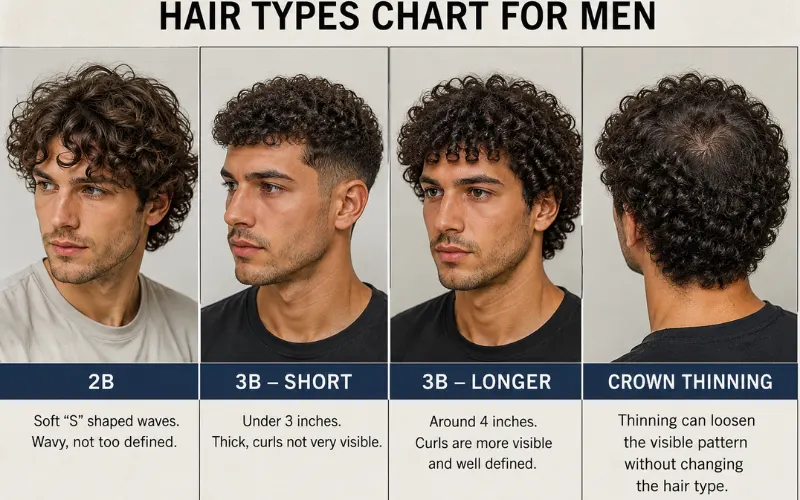
The hair types chart is identical for men and women. There is no separate men’s typing system, because follicle geometry does not vary by sex. A 2B man and a 2B woman have the same curl pattern.
Length is what differs. Under about three inches, pattern barely expresses, so a 3B man with short back and sides reads as “thick and a bit wavy.”
At half an inch of growth a month, that is a two-month wait before a type 3 pattern is readable. Type yourself at your longest, and ask your barber for the pattern rather than the look: “I’m a 3B, leave four inches on top” beats a photo of someone else’s hair. Cuts worth asking for.
One caveat that comes up constantly at the basin: thinning at the crown loosens the pattern there first, so men losing density read it as a type change. It is not. Follicular miniaturisation reduces strand diameter, and finer strands hold less curl. Thinning hair is a separate problem.
Who Created the Hair Types Chart?
The hair types chart is the Andre Walker Hair Typing System, created in the 1990s by Andre Walker, Oprah Winfrey’s stylist from 1985 to 2015 and winner of seven Emmys for his work on her show. He built the numbering to sell his own product line: identify your type, buy the matching bottle (Wikipedia).
Two things are worth knowing before you take your number too seriously.
- 3C and 4C were not in the original chart. Walker launched types 3 and 4 with A and B subtypes only. The natural hair community added 3C and 4C afterwards because the existing categories did not describe real heads (99% Invisible). Four of the twelve subtypes in use today are crowdsourced, not authored.
- It has been criticised for implying a hierarchy. The numbers ascend from straight to coily, so the system reads to many people as a ranking rather than a description. That critique, usually called texturism, was the subject of 99% Invisible and The Stoop episodes in 2018.
The chart describes the shape. It ranks nothing and says nothing about hair health.
What is the Rarest Hair Type?
Type 1A is the rarest hair type. Genuinely pin-straight hair with no bend anywhere is uncommon, and most people who assume they are 1A turn out to be 1B or 1C once it air-dries untouched. Among textured types, 4C gets called rare but is not. It is underrepresented in the chart’s own reference images, which is a documentation problem, not a frequency one.
What is the Prettiest Hair Texture?
There is no prettiest hair texture, and the question comes from the ranking problem built into the chart. Every type looks best hydrated, cut for its pattern and left alone. The textures that photograph most often are the ones with the most marketing behind them, which is a budget, not a verdict.
Can Your Hair Type Change?
No. Curl pattern is set by follicle geometry, which is genetic, so the underlying type is stable for life. Expression changes: hormonal shifts, medication, heat damage to the disulfide bonds in the cortex, and follicular miniaturisation all distort the pattern. If one section no longer curls and the rest does, that section is damaged, not retyped.

BeautyLiesTruth publishes hair and personal color guidance built on primary research. Color claims are tested by draping under controlled daylight, and every figure is traced to a published source rather than to another blog.