

3A hair forms loose spiral curls roughly half an inch to an inch across, about the width of a piece of sidewalk chalk. The curl wraps around itself rather than zigzagging on a flat plane, which is what puts it in type 3 rather than type 2.
It is the first curl pattern on the chart, and most of the difficulty with it comes from that position. 3A sits between hair that behaves like waves and hair that behaves like curls, and routines written for either side tend to miss.
What Is a 3A Hair Type?

3A is the loosest of the three curl patterns. The spiral is well defined, has visible circumference, and starts near the root. Strands run fine to medium, the hair carries natural shine because the cuticle stays relatively smooth on a loose curve, and the crown tends to fall flatter than the lengths.
Diameter is the working definition. A curl you could wrap around a piece of sidewalk chalk is 3A. Anything closer to a marker barrel is 3B.
Am I 2C or 3A?
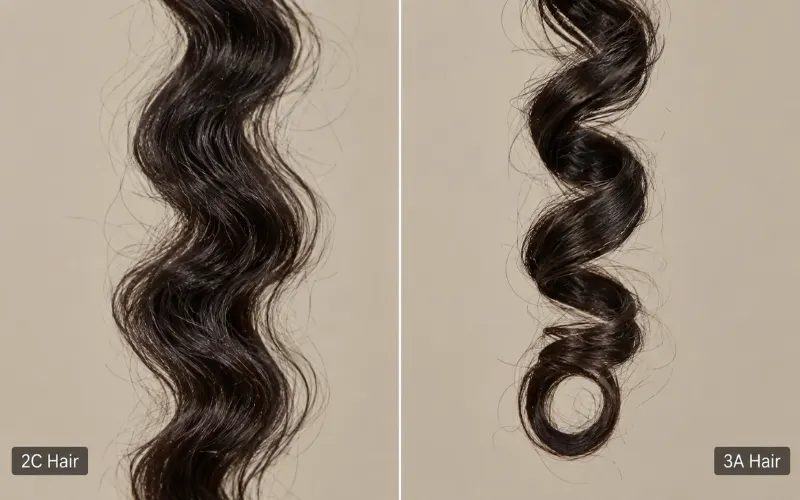
This is the most searched question on the whole type 3 chart, and the answer is dimensional rather than descriptive. A 2C wave bends back and forth along a flat plane, however tight the bends get. A 3A curl turns around an axis and forms a closed loop you can see through.
Shrinkage confirms it. Pull a single strand straight, let go, and see how much shorter it sits. 3A typically loses a fifth of its length or more between wet and dry because a spiral takes up vertical space. 2C hair loses very little.
Product response is the third check. 2C is content with a gel and holds its shape for days. 3A needs cream and gel together, and it falls apart faster without them. The hair type quiz reads pattern alongside width, density and porosity, which matters at this boundary because a fine 3A and a coarse 2C need almost opposite products despite sitting next to each other on the chart.
How Do I Know If I Have 3A, 3B, or 3C Hair?
Curl diameter separates the three, and a household object is the fastest measure.
| Type | Curl diameter | Comparison object | Definition | Shrinkage |
| 3A | Half an inch to an inch | Sidewalk chalk | Loose, springy, falls out easily | About a fifth |
| 3B | A third to half an inch | Marker barrel | Springy ringlets, denser | Around a third |
| 3C | A quarter inch or less | Pencil or straw | Tight corkscrews packed close | Half or more |
Density rises as diameter falls. 3A has visible space between curls; 3C does not. The hair types chart sets all twelve codes against each other.
What Are Common Problems With 3A Hair?
Three, and they share one cause. The curl is loose enough to be pulled out of shape by almost anything.
Definition drops fastest. A 3A spiral has less mechanical interlock than a tighter curl, so it separates under a brush, under humidity, and under its own weight as the hair grows. Second, the ends dry out while the roots stay oily, because scalp oil cannot travel the length of a spiral. Third, product weight collapses the pattern, and 3A tolerates less of it than any other type 3 code.
Why the Crown Falls Flat on 3A Hair
Weight sits on the crown that does not sit anywhere else. Every curl below it hangs from that point, and a loose spiral has little structural resistance, so the top of the head compresses while the lengths keep their shape.
Sleeping flattens it further. The pineapple, which is gathering the hair loosely on top of the head overnight, exists to keep the crown off the pillow, and it works better than any volumising product for this specific problem. Clipping the roots while drying does the same job during the day.
A 3A Routine That Keeps Definition
Wash more often than curly hair guidance usually suggests. Once a week is the standard advice in this space and it is too infrequent for most 3A scalps, since a loose curve lets oil reach the mid-lengths within days. The American Academy of Dermatology ties frequency to how oily the scalp actually gets in its healthy hair guidance, which is the better rule than a fixed weekly schedule.
Detangle only in the shower with conditioner in the hair. Dry brushing separates the spiral into frizz that will not reform until the next wash.
Apply cream and then gel to soaking wet hair, in that order, and scrunch upward. Squeeze water out with a cotton shirt rather than a towel. Dry without touching, diffuse on low, and break the cast once the hair is fully dry.
Products for 3A Hair
Light layers rather than one heavy product. A lightweight leave-in for moisture, a curl cream for clumping, and a gel for hold, each applied thinly, works better on this pattern than a single rich cream applied generously.
Skip shea butter, coconut oil and anything sold as intensely nourishing. Those are formulated for tighter, coarser patterns that can carry the weight. Clarify every three or four weeks, since buildup flattens a loose curl faster than dryness does. The natural shampoo guide covers which cleansers clear residue without stripping.
3A Hair Colour
Curls take colour unevenly by nature. Each bend sits at a different angle to the applicator and the cuticle lifts slightly at every turn, so the outside of a spiral absorbs faster than the inside. Balayage and lived-in techniques suit this pattern for that reason, and a precise all-over block tends to look patchy as the curls move.
Lightening costs definition. Bleach raises the cuticle and roughens the fibre, and on a loose curl that means the spiral loosens further rather than just changing shade. Anyone going blonde should plan for more conditioning and for regular toning, which is what purple shampoo handles.
Haircuts for 3A Hair
Cut dry, curl by curl, if the stylist offers it. Wet cutting hides where each spiral actually sits, and on a loose curl a layer placed half an inch out of position shows up as a gap once the hair springs back.
Long layers give the curls room to form without letting weight drag them straight. Avoid heavy blunt lines at the perimeter, which collect density and widen the shape into a triangle. Face framing works well here because 3A has enough spring to hold a shorter piece without it sticking out.
3A Hair on Men

Barely addressed anywhere, and length is the deciding factor. Below about three inches a spiral cannot complete a full turn, so 3A reads as thick and unruly rather than curly and usually gets cut back before the pattern can show.
Past four inches the curls form on their own. A light cream on damp hair and nothing heavier does the job; wax and pomade pull the spiral straight. Ask a barber for weight removed through the interior rather than a uniform clipper length. Scalp becoming visible at the crown as curls separate is worth reading against the thinning hair guide rather than blamed on the pattern, since a loose curl exposes scalp in a way straight hair does not.
Does 3A Run in Particular Ethnicities?
No. Curl pattern varies widely inside every population group, and searches pairing 3A with a specific ethnicity have the causation backwards. A L’Oreal Recherche team led by Roland de la Mettrie measured hair from 1,442 people across 18 countries for Human Biology in 2007 and built eight categories from curve diameter, curl index and wave count, specifically because the older continental groupings failed to describe how much variation exists inside each one.
The typing system itself is worth understanding here. Andre Walker created it in 1997 for a mass-market book, not as a scientific instrument, and it has drawn consistent criticism for ordering patterns numerically in a way that implies a hierarchy. It is a shorthand for shopping, and it describes a strand rather than a person.
Confirm the diameter first, then buy for weight. On 3A the pattern is loose enough that weight decides almost everything about how the day goes.

BeautyLiesTruth publishes hair and personal color guidance built on primary research. Color claims are tested by draping under controlled daylight, and every figure is traced to a published source rather than to another blog.