

2C hair is the waviest end of type 2. The S starts at the scalp rather than partway down, the strands are wider than 2A hair or 2B hair, and the pattern occasionally tightens into a loose spiral near the ends without ever becoming a proper curl.
It is also the type that sits on a border. Half the people searching for it are trying to work out whether they have crossed into type 3, and the honest answer is that plenty of them have.
What Is 2C Hair?
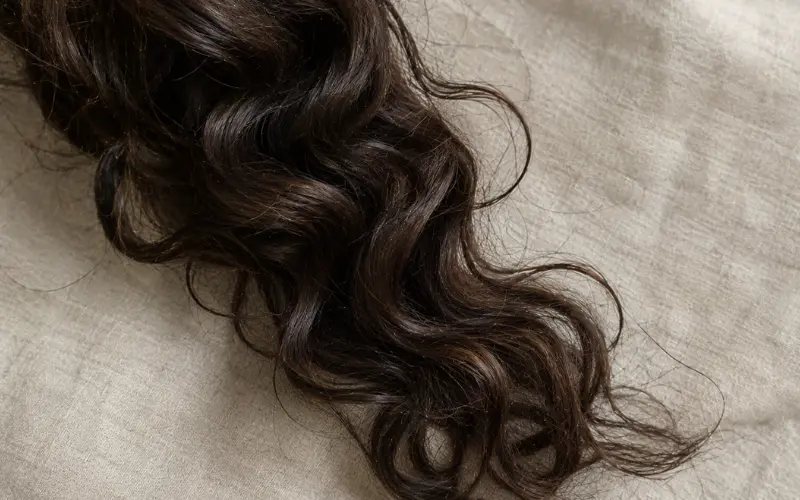
2C is defined by where the wave starts. On 2A and 2B the hair runs straight for the first stretch. On 2C the bend begins at or very near the root, which is why it has visible volume from the scalp outward instead of a flat crown.
The strands are coarser than the rest of the wavy band, the pattern is dense enough to clump on its own, and it holds a shape for days rather than hours. What it does not do is spiral. An S that repeats along a flat plane is a wave, however tight it gets.
Is 2C Curly or Wavy?
Wavy, by definition, and the confusion is understandable. 2C is the last stop before type 3 and it behaves more like curly hair than like the rest of type 2, which is why curly routines mostly work on it while wavy routines often are not enough.
The test is dimensional. A wave lies flat and moves in two directions. A curl wraps around an axis and moves in three. Hold a single strand up to the light and look for whether it corkscrews or zigzags.
How to Tell If Hair Is 2B or 2C
Root behaviour separates them, and product tolerance confirms it.
| Type | Wave starts | Shape | Product tolerance | Frizz |
| 2B | Around the mid-length | Defined S, flat plane | Collapses under curl cream | Through the lengths |
| 2C | At or near the root | Tight S, occasional loose spiral at the ends | Holds against cream and gel | Heavy, needs product to control |
| 3A | At the root | Loose spiral with a visible circumference | Needs cream and gel to define | Constant without product |
Hair that stays flat for the first few inches is 2B hair, not 2C. The hair type quiz reads pattern alongside width, density and porosity, which matters here because 2C strands vary more in width than any other part of the wavy band.
How Do I Tell If My Hair Is 2C or 3A?
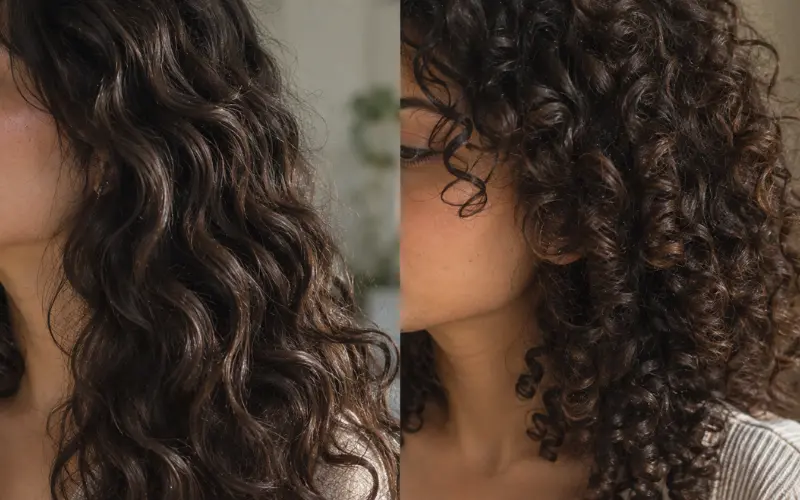
Trace one strand from root to end and count what it does. A 2C strand bends back and forth on a flat plane, even when the bends are tight. A 3A strand turns around itself, and you can see a loop with a diameter roughly the width of a piece of sidewalk chalk.
The shrinkage test backs it up. 3A hair dries noticeably shorter than it hangs when wet, often by a fifth or more, because a spiral takes up vertical space. 2C shrinks a little and 2B barely at all. Anyone whose hair loses several inches between the shower and the mirror has crossed into type 3.
The hair types chart covers where the boundary sits against the rest of the scale.
Is 2C a Rare Hair Type?
No dataset ranks the twelve codes by prevalence, so the honest answer is that nobody knows. The claim circulates anyway.
The measured work on hair shape uses a different system entirely. A L’Oreal Recherche team led by Roland de la Mettrie assessed hair from 1,442 people across 18 countries for Human Biology in 2007 and produced eight categories from curve diameter, curl index and wave count. Nothing in it counts 2C, because the Walker codes were not part of the study.
There is a specific reason to distrust prevalence claims about this type in particular. It sits on the boundary with type 3, and people move across that line depending on the season, their haircut length and how much product they used, so self-reported numbers would wobble even if someone collected them.
Why 2C Frizzes More Than the Rest of Type 2
Scalp oil has further to travel and a harder route. On straighter types it slides down an uninterrupted shaft and reaches the ends within a day or two. On 2C every bend interrupts the journey, so the ends stay dry while the roots still get oily, and dry ends in humid air is the entire frizz mechanism.
Width compounds it. Wider strands present more surface for the cuticle to lift, and a tight wave has more surface per inch of length than a loose one. Frizz control on this type is moisture work at the ends rather than smoothing at the surface, which is why anti-frizz serums applied to the outside disappoint so consistently.
A 2C Routine That Holds
Wash less than you would for 2A or 2B. Twice a week suits most people with this type, and the American Academy of Dermatology ties frequency to how oily the scalp actually gets rather than to a fixed schedule in its healthy hair guidance.
Detangle only in the shower with conditioner in. Dry brushing 2C separates every clump and turns a defined pattern into a halo that cannot be recovered until the next wash.
Apply product to soaking wet hair. Scrunch upward, squeeze the water out with a cotton shirt rather than a towel, then dry without touching. Diffuse on low or air dry, and break the gel cast only once the hair is completely dry.
Products for 2C Hair
This is the type in the wavy band that can carry weight. A curl cream works here where it would flatten 2B, and a weekly mask earns its place because the ends genuinely are not receiving scalp oil.
Gel over mousse for hold. Mousse is sized for looser waves and gives out by mid-afternoon on a pattern this dense. Skip coconut oil and shea butter, which sit on the surface of coarse wavy hair without absorbing, and clarify every three or four weeks so buildup does not flatten the root lift that defines this type. The natural shampoo guide covers which cleansers clear residue without stripping.
Can You Straighten 2C Hair?
Yes, and the temperature setting matters more than most guides admit. Flat irons commonly run above 200 degrees Celsius, and research using infrared spectroscopy and calorimetry has shown that heat at those levels converts hair’s alpha-helix keratin into beta-sheet structures, reduces the fibre’s ability to hold water, and measurably increases breakage when the hair is then combed. Separate thermal analysis puts the denaturation point of hair keratin at around 237 degrees, which means a tool set to its maximum is operating close to the point where the protein structure gives way rather than comfortably below it.
The practical version is to work below 180, use a heat protectant, and accept fewer passes with a lower setting over one hot pass. Coarse wavy hair holds a straightened shape reasonably well, but repeated high-heat straightening is the most common reason a 2C pattern stops recovering, and the change is not reversible. Texture also shifts on its own with age and hormones, which the guidance on supporting skin and hair as they age covers.
Haircuts and Short Styles for 2C Hair
Layers are not optional on this type. Without them the density collects at the perimeter and the shape widens into a triangle, which is the single most common complaint about 2C haircuts.
Short works if it is cut with the pattern rather than against it. A curly cut done dry, section by section, lets the stylist see where each wave actually falls, and a shag or a curly bob sits well at chin length. Blunt lines fight this hair. For anyone adding extensions, match the wave pattern rather than the length first, since 2C texture next to straight wefts reads as obviously artificial in a way that a length mismatch does not.
2C Hair on Men
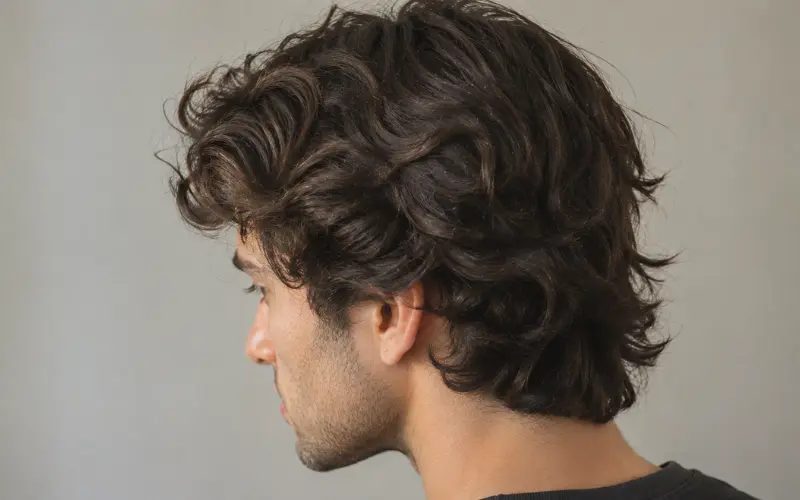
Rarely covered, and the length threshold is lower than for the looser wavy types because the pattern starts at the root. Even a two inch crop shows movement, which is why 2C on men often gets misread as unmanageable rather than wavy.
Ask for weight removed through the top rather than a uniform clipper length, since bulk is what makes this texture stand out rather than fall. A light cream or gel on damp hair defines it; wax flattens it. Scalp visible through the top as the waves separate is worth reading against the thinning hair guide rather than blamed on texture.
Confirm where the wave starts, then buy for weight. On 2C the pattern can carry more than the rest of type 2, and underdressing it is the more common mistake.

BeautyLiesTruth publishes hair and personal color guidance built on primary research. Color claims are tested by draping under controlled daylight, and every figure is traced to a published source rather than to another blog.