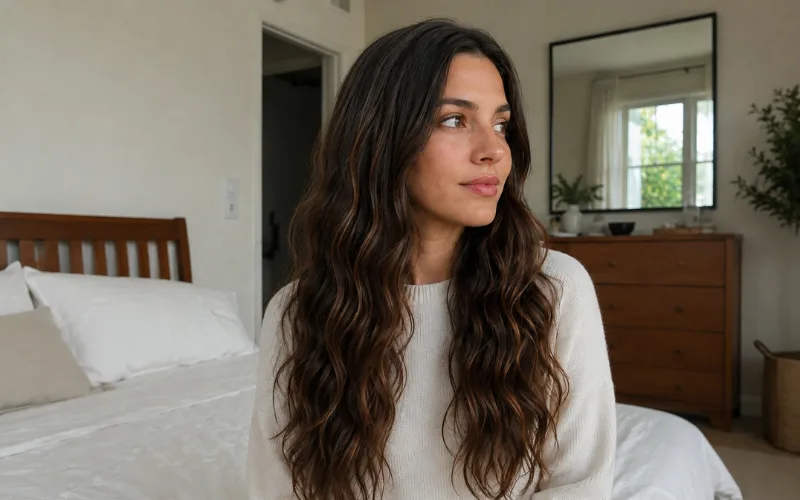
2B hair forms a defined S wave that starts around the mid-length and repeats down to the ends. The roots stay comparatively flat, the strands sit at medium width, and the pattern is consistent enough to be recognisable without product.
It is the middle of the wavy band, which is the reason most of the confusion around it exists. Everything about identifying 2B comes down to where the wave starts and how tight it gets.
What Does 2B Hair Mean?
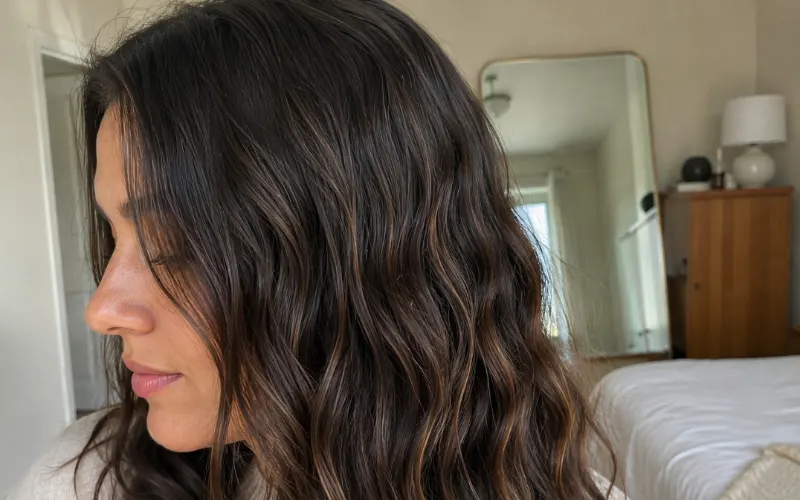
2B is the middle of the three wavy types. The strand runs straight from the scalp through the first few inches, then opens into an S that repeats with reasonable regularity down the length.
Three markers separate it from its neighbours. The wave starts lower than 2C but higher than 2A. It holds a shape for most of a day rather than dropping by lunchtime. And it frizzes through the lengths rather than only at the crown.
How Do I Know If My Hair Is 2A or 2B?
Where the wave begins settles it. Wash, apply nothing, air dry without touching, then find the highest point on a strand where a bend appears.
| Type | Wave starts | Shape | Frizz | Holds a style |
| 2A | Below the ears, often lower | Shallow, open S | Halo at the crown only | Drops within hours |
| 2B | Around the mid-length | Defined S, repeats evenly | Through the lengths | Most of a day |
| 2C | At or near the root | Tight S turning toward a curl | Heavy, needs product | Holds well, can look undone |
Hair that reads as almost straight until the last few inches belongs on the 2A hair page instead. The hair type quiz works through pattern, width, density and porosity together, which matters here because two people can both land on 2B and need opposite products.
2B or 2C?
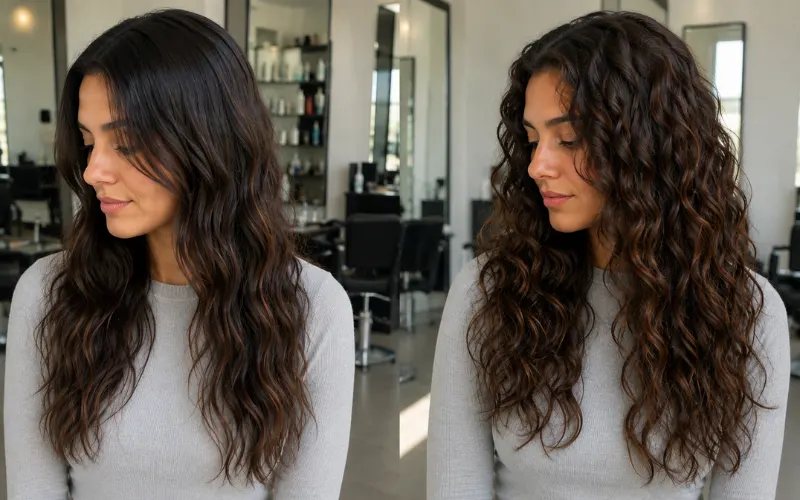
Root behaviour is the test. 2C waves begin at the scalp and the hair has visible volume from the root outward. 2B stays flat for the first stretch and only builds body lower down.
Weight is the tiebreaker. 2C strands are wider and the pattern holds against a heavier product; 2B collapses under the same amount. Anyone whose waves survive a curl cream is probably 2C, and anyone whose waves vanish under it is 2B. The hair types chart covers where both sit against the rest of the scale.
Is 2B Hair Wavy or Curly?
Wavy. 2B sits entirely inside type 2, and the S repeats along a flat plane rather than spiralling around an axis.
The distinction is not academic. A curl wraps in three dimensions and holds product inside the spiral. A wave lies flat and has nothing to hold it, which is why type 3 products drag 2B hair straight and why the curly girl method needs adapting rather than copying.
Why Is 2B Hair So Hard to Maintain?
Because the pattern is not consistent along a single strand. Research on hair curvature using electron microscopy found that curliness is best described by the frequency and amplitude of rotations in the fibre’s cross-section, with the cortex itself elliptical and asymmetric, and structural keratin building up unevenly on the concave side of each bend.
In practice that means one section of a 2B head clumps into a clean S while the section beside it frizzes, and both are behaving normally. Most routines are built as though the whole head has one pattern. It does not, which is why the underside behaves and the crown does not.
The second reason is the flat root. Scalp oil reaches the mid-lengths quickly on hair that starts straight, so 2B gets greasy at the top while the ends stay dry, and treating either problem alone makes the other worse.
A 2B Hair Routine That Holds the Pattern
Wash two to three times a week for most people. The American Academy of Dermatology ties frequency to how oily the scalp actually gets rather than to a set schedule in its healthy hair guidance, which is a better rule than any number.
Detangle only in the shower with conditioner in the hair. Combing 2B dry breaks the clumps apart and turns a defined S into frizz that cannot be recovered until the next wash.
Apply styling product to soaking wet hair, not damp. Water is what lets sections clump together, and product applied to towel-dried hair coats individual strands instead of grouping them. Scrunch upward, dry without touching, and break the cast once the hair is fully dry.
Diffuse on low or air dry. Root lift comes from diffusing upside down, not from volumising spray, which flattens the wave it was meant to lift.
What Products Work on 2B Hair
Light hold, low weight. A mousse or a light gel does the work here; curl creams sized for type 3 hair are the single most common mistake on this type, and the answer to which curl cream is usually none of them.
A lightweight leave-in on the mid-lengths and ends, a clarifying wash every three or four weeks to clear the buildup that flattens waves over time, and nothing heavy near the roots. Skip butters and dense oils entirely. The natural shampoo guide covers which cleansers clear buildup without stripping, which matters more on wavy hair than dryness does.
2B Haircuts and Styles
Long layers, and ask for them cut on dry hair if the stylist will do it. Wet cutting hides where the wave actually falls, and a layer placed in the wrong spot on wavy hair shows up as a shelf once it dries.
Length below the collarbone gives the S room to repeat. Above the chin, 2B tends to expand outward into a triangle, which is why a blunt bob rarely works on this type without internal weight removed. Curtain bangs suit it; blunt fringes fight it.
2B Hair on Men

Barely covered anywhere, and the length threshold is the whole story. Under about three inches the S cannot complete a repeat, so 2B reads as messy rather than wavy and usually gets cut off before it can show.
Past four inches the pattern appears on its own. A light mousse or sea salt spray on damp hair brings definition, and clay works where wax does not. Scalp showing at the crown as waves separate is worth reading against the thinning hair guide rather than blamed on the texture, since a separating wave exposes scalp in a way straight hair does not.
2B Hair Colour
Wavy hair takes colour unevenly along the length, because the bends sit at different angles to the applicator and the raised cuticle at each curve absorbs faster than the straight sections between them. Balayage and lived-in colour suit this hair type for that reason, and precise all-over blocks of colour tend to look patchy as the waves move.
Lightened wavy hair also loses definition, since bleaching raises the cuticle further and roughens the fibre. Anyone going blonde should expect to spend more on conditioning to keep the pattern, and toning becomes routine rather than occasional, which is what purple shampoo handles.
Is 2B a Particular Ethnicity’s Hair Type?
No, and searches pairing 2B with a specific ethnicity get the causation backwards. Wave pattern varies widely inside every population group, which is the finding the largest study on the subject was built to demonstrate. A L’Oreal Recherche team led by Roland de la Mettrie measured hair from 1,442 people across 18 countries for Human Biology in 2007 and produced eight categories from curve diameter, curl index and wave count precisely because the older continental groupings failed to describe the variation inside each one.
2B appears across every population. What differs between individuals is fibre width and density, and those are separate measurements from the wave itself.
Confirm where the wave starts, then buy for weight rather than for pattern. Weight is what decides whether the S survives to the evening.

BeautyLiesTruth publishes hair and personal color guidance built on primary research. Color claims are tested by draping under controlled daylight, and every figure is traced to a published source rather than to another blog.