

2A hair is the loosest wave on the typing chart. It sits flat at the roots, opens into a shallow S from the mid-lengths down, and elongates back toward straight as the day goes on.
It is a wave pattern, not straight hair that happens to bend. That distinction decides which shelf of the shop belongs to you, and most people with 2A hair spend years on the wrong one.
What Is a 2A Hair Type?
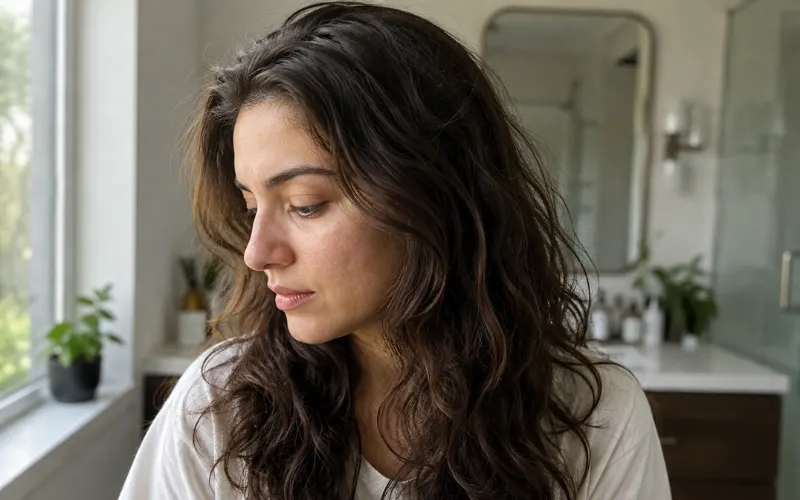
2A is type 2 hair at its loosest. The strand runs straight from the scalp for several inches, then opens into a soft S that repeats down the length. Strands tend toward fine or medium, the roots lie flat, and the pattern is visible on dry hair without any product in it.
The repeat is the defining trait. One bend near the ends is straight hair with body. Two or more bends in sequence is a wave.
2A Is a Wave, Not Straight Hair With Bends
Worth stating plainly, because most guides hedge on it. 2A belongs to the wavy category and responds to wavy technique.
Product category is why it matters. Volumising sprays built for fine straight hair treat the wave as a flaw to smooth out. Curl creams sized for type 3 flatten it under their own weight. 2A needs the middle ground, and reaching into either neighbouring category is the most common reason a routine fails on this hair type.
1C or 2A?
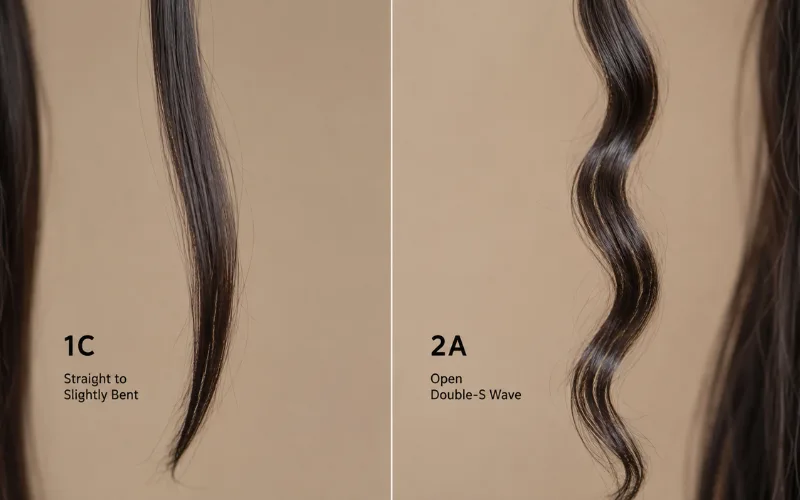
In a photograph these look identical. The separation is whether the bend repeats.
A 2A wave forms an open S and then forms another below it. A 1C hair bend happens once or twice and stops. Test on dry, product-free hair on a still day, since humidity pushes 1C into looking wavier than it is and a blow-dry pulls 2A into looking straighter.
Strand width runs as a tiebreaker in the other direction. 1C strands are wide enough to feel when rolled between finger and thumb, and 2A strands usually are not. When the two tests disagree, the repeat test wins. The number in the code records pattern; the letter records width. The hair type quiz reads both separately for that reason.
How Do I Tell If My Hair Is 2A or 2B?
| Type | Where the wave starts | Shape | Frizz | Holds a style |
| 2A | Mid-length or lower | Shallow, open S | Halo frizz at the crown | Drops within hours |
| 2B | Closer to the roots | Defined S, tighter | Frizz through the lengths | Holds most of a day |
| 2C | At the root | S tightening toward a loose curl | Heavy, needs product | Holds well |
If waves are visible before the ears, that is 2B territory. The hair types chart covers all twelve codes.
The Wave Is Set at the Follicle, Not in the Shaft
Hair shape is decided below the skin. A L’Oreal Recherche team led by Sophie Thibaut dissected and cultured scalp follicles for the British Journal of Dermatology in 2005 and found that follicles growing curved hair were themselves curved, bent at the bulb into roughly the shape of a golf club, with an asymmetric proliferating layer. Straight-hair follicles were straight. The curvature held even when follicles were grown in culture, away from any scalp, product or weather.
That has a practical consequence the wavy hair community mostly skips over. Pattern cannot be trained. What a good routine changes is definition, clumping and how long the shape survives, which is worth doing and is not the same as making the hair curlier. Anyone promising to move you from 2A to 2B with a technique is selling something.
Why 2A Waves Drop by the Afternoon
Gravity beats a shallow S. The bend in 2A hair is wide and open, so there is little mechanical interlock holding it, and the weight of the length below slowly pulls it out. Longer hair drops faster than shorter hair for the same reason.
Product weight finishes it. Anything heavy applied to fine strands with an open wave will straighten the pattern within an hour of drying, which is why so many people conclude their waves have disappeared when what actually happened is they were flattened.
Does 2A Hair Get Frizzy?
Yes, and in a specific place. 2A frizz shows up as a halo at the crown and along the part rather than through the lengths, because that is where the shortest and newest strands sit and where the pattern is weakest.
Humidity lifts the cuticle and the fibre swells. On tighter patterns the frizz merges into the curl and hides. On an open wave there is nothing for it to blend into, so it reads as flyaway rather than texture.
A 2A Routine That Holds
Wash more often than curly hair guidance suggests. Sources in this space disagree, some recommending daily and others twice a week, and the resolution is that 2A has a smooth enough shaft for scalp oil to travel down quickly, so most people land at two to four times a week. The American Academy of Dermatology ties frequency to how oily the scalp actually gets in its healthy hair guidance, which is the better rule than any fixed number.
Apply styling product to soaking wet hair, not damp. This is the opposite of the advice for straight types, and it is because clumping needs water to form. Scrunch upward, let it dry without touching, then break the cast once fully dry by scrunching gently.
Air dry or diffuse on low. A concentrated nozzle blows the clumps apart and turns definition into frizz.
What Products Do I Use for 2A Hair?
Think in weight classes rather than brands. A lightweight cleanser, a rinse-out conditioner used from the ears down, a mousse or light gel for hold, and a clarifying wash every few weeks to clear the buildup that flattens waves over time.
Skip butters, heavy leave-in creams and most oils. They are formulated to fill a tight pattern and 2A has no pattern deep enough to hold them. The natural shampoo guide covers which cleansers clean thoroughly without stripping, which matters here because buildup does more damage to wave definition than dryness does.
2A Hair on Men

Almost no guide covers this, and wavy hair on men has a length threshold. Under about three inches an open S cannot complete a repeat, so 2A reads as an unruly cowlick rather than a wave and gets cut off before it can show.
Grow the top past four inches and the pattern appears on its own. Sea salt spray or a light mousse on damp hair brings definition; wax and pomade kill it. Anyone finding the crown looks thinner as the hair gets longer should read that against the thinning hair guide, since a loose wave separates and shows scalp in a way straight hair does not.
Haircuts for 2A Hair
Long layers, cut dry where possible. Weight is the enemy of an open wave, so removing it from the interior lets the pattern lift instead of hanging.
Blunt one-length cuts fight this hair type. So does heavy face framing, which drags the front sections straight. A collarbone or longer length with soft internal layering gives the wave enough room to form a repeat without enough length to be pulled flat by its own weight.
What a Realistic Before and After Looks Like
Search results for 2A transformations set expectations badly. What genuinely changes with a better routine is clumping, definition and how long the shape lasts through a day.
What does not change is the pattern, for the reason the follicle research above lays out. Texture can shift over years with hormones and age, which the guidance on supporting skin and hair as they age covers, but not through a styling technique. Judge a new routine on definition at hour six, not on whether the waves got tighter.
BeautyLiesTruth publishes hair and personal color guidance built on primary research. Color claims are tested by draping under controlled daylight, and every figure is traced to a published source rather than to another blog.