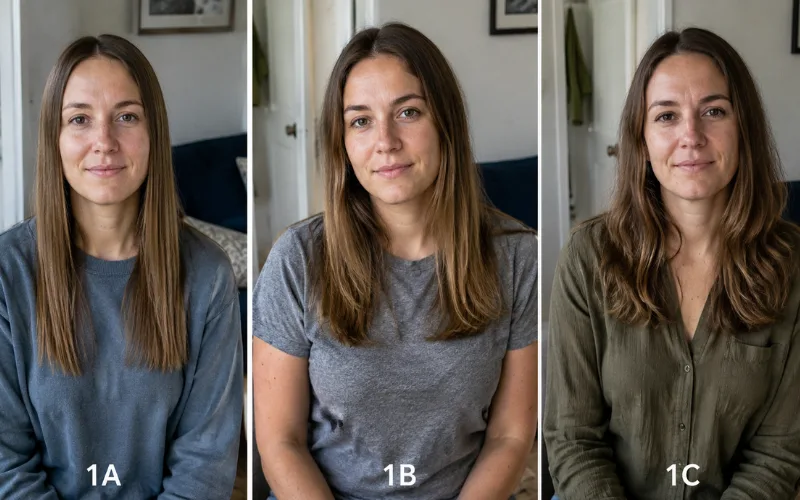
1B hair is straight hair with body. It falls without a defined wave, the ends bend under slightly, and it holds a curl for most of a day. That last part is the one behaviour that separates it from 1A, which drops a set within about two hours.
Two different things get labelled 1B, and the search results mix them together. One is a curl pattern on the hair typing chart. The other is a colour code stamped on packs of braiding hair. Both are covered here, because knowing which one you are looking at saves an expensive mistake at the beauty supply counter.
What Does 1B Hair Mean?
1B means straight hair of medium strand width with a soft bend toward the ends. It sits between pin-flat 1A and coarser 1C on the 1A to 4C scale. The reliable marker is curl retention rather than appearance, since 1A and 1B look almost identical in a photograph.
The letter records curl pattern and nothing else. Strand width, density and porosity are separate measurements, and those are the ones that decide which products work on your hair. The hair type quiz reads all four rather than the pattern alone.
Is My Hair 1A, 1B, or 1C?
Wash it, put nothing in it, and let it air dry untouched. Then set a small section with a hot tool and look at it six hours later. What survives tells you more than what the hair looks like on day one.
| Type | Air dried, no product | Set holds for | Humidity behaviour |
| 1A | Flat root to tip, no bend anywhere | Under two hours | Stays smooth |
| 1B | Straight with a soft bend at the ends | Most of a day | Mostly holds |
| 1C | Straight at the root, visible kick lower down | A full day or more | Frizzes and swells |
Judge it dry. Wet hair hangs straighter than it really is, which is why so many 1B results get self-reported as 1A hair. If your result sits further along the scale, the full hair types chart covers all twelve codes.
How Rare Is 1B Hair?
1B usually gets described as the most common straight type. No published count supports that, and the sentence has simply been copied between sites for years. One of the pages currently ranking states that most straight-haired women fall into 1B without citing anything at all.
The measured research does not use the Walker codes. A L’Oreal Recherche team led by Roland de la Mettrie measured hair from 1,442 people across 18 countries for Human Biology in 2007 and produced eight categories, built from curve diameter, curl index and wave count. Straight hair was widespread in that sample. Nothing in it ranks 1A against 1B, because those labels were not part of the study.
A later micro-CT review found that two of the eight-category system’s curl variables varied noticeably between the people doing the scoring. If trained assessors disagree, a bathroom-mirror estimate is not a statistic.
Do Most Asians Have 1A or 1B Hair?
Hair shape does not sort by ethnicity, and demonstrating that was the explicit purpose of the de la Mettrie work. What does vary is fibre width. Hair across East Asian populations tends to run wider than average, and most consumer charts quietly treat fine as 1A and medium as 1B.
So wide, dead-straight hair usually lands at 1B or 1C on those charts even when the pattern shows no bend at all. The chart is measuring two separate things and reporting only one of them, which is where most of the confusion on this question comes from.
Why 1B Hair Goes Flat at the Crown
Sides and back hold their shape. The crown gives up first. Hair grows out of a whorl there, so the strands point in several directions at once and lose the mutual support that keeps hair standing everywhere else.
Weight finishes the job. Medium strands take more product than fine ones before collapsing, but not much more, and a rich conditioner applied near the roots will flatten the crown by mid-afternoon. Oil compounds it, since sebum travels down a straight shaft with nothing to slow it.
Worth separating from thinning. StatPearls puts normal shedding at around 100 hairs a day, with 85 to 90 percent of follicles in the growth phase at any time. A crown that looks sparse in overhead light on flat hair is usually a lighting and lift problem rather than a hair loss one.
1B Hair Texture and Products
Medium width is the working assumption, so 1B tolerates slightly more than 1A without tipping over. Mousse on damp hair, a texturising spray for grip, and a light conditioner kept from the ears down.
Skip butters, thick creams and anything sold on the promise of deep nourishment. Those are formulated for hair that needs slip through a curl pattern, and 1B has no pattern to fill. The natural shampoo guide flags which formulas stay light enough for straight hair with body.
Wash on how oily the scalp actually gets rather than on a fixed schedule, which is how the American Academy of Dermatology frames its healthy hair guidance too. For most people with this type that lands at every second or third day.
1B vs 1C Hair
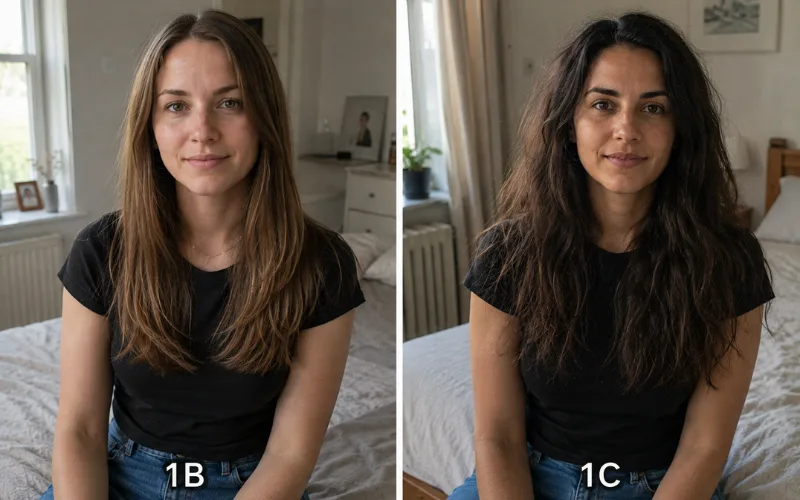
1C keeps the straight root but develops a visible kick from mid-length down, and the strands are wider and stiffer. It frizzes in humidity where 1B mostly holds. Anyone whose hair swells on a damp day and needs a smoothing product to look finished is closer to 1C than 1B.
1B Hair on Men
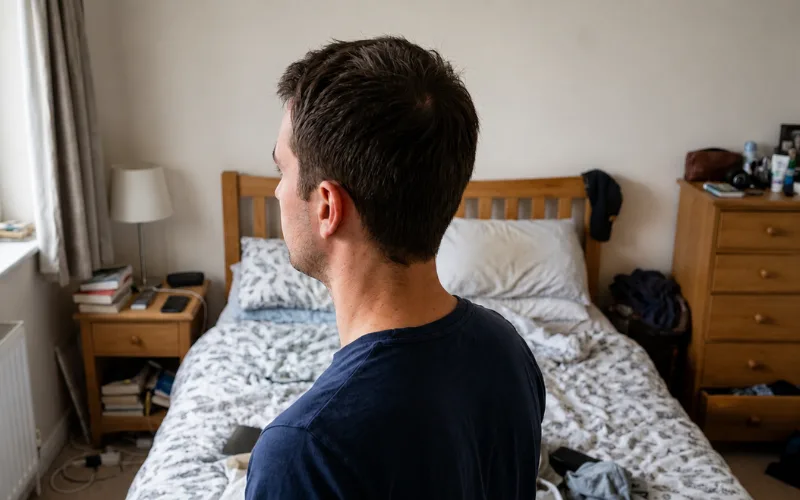
Cropped hair hides curl pattern. Under roughly two inches a bend cannot complete itself, so 1B reads as flat 1A on a short back and sides. Judge from the crown or the back where the hair sits longest, or grow it out for six weeks first.
Type 1B hair on male heads runs into the same weight ceiling. Clay and paste hold without greasing; wax and pomade sit heavy and pull the crown down within hours. Anyone watching scalp appear through the top will get more from the thinning hair guide than from any typing chart, since flat straight hair and early recession look similar in a mirror and are not the same thing.
1B Hair Colour Is Not 1B Hair Type
Different system, same label. In extensions, wigs and braiding hair, 1B is a colour code meaning off-black. It sits between #1, a dyed jet black, and #2, the darkest natural brown. The B marks it as the shade that reads as unprocessed rather than dyed.
That scale runs from 1 at the dark end up to 613 at platinum, and it appears on Kanekalon colour charts across brands including Xpression, Outre and Sensationnel. It has no connection to curl pattern whatsoever. Someone with 3C hair can wear 1B braiding hair, and frequently does.
Cool skin undertones tend to carry 1B and #2 better than warmer shades like 27 or 30, which is a question of depth and undertone rather than hair type. The skin tone chart walks through how to read yours.
What 1B Means on a Pack of Braiding Hair
1B is the default black on most braiding hair, which is why searches for 1B hair for braiding return product listings rather than hair typing guides. Packs sold for girls and shorter styles carry the same code.
A T in front of the code means the colour is ombré rather than solid. T1B/27 runs off-black roots into strawberry blonde ends, T1B/30 into light auburn. Buy the plain 1B if you want the braids to read as natural hair.
The Best Haircuts for 1B Hair
Layers work here, and this is the real split from 1A. Fine pin-straight hair loses what little weight it has when layered, but 1B carries enough body for long layers to create movement rather than thinness.
A long bob cut just past the jaw is the reliable choice, since the blunt line at the ends holds weight while the length keeps the shape from going helmet-like. A deep side part buys visible lift at the crown for free. Blunt fringes suit this type better than wispy ones, which need a wave the hair does not have.
BeautyLiesTruth publishes hair and personal color guidance built on primary research. Color claims are tested by draping under controlled daylight, and every figure is traced to a published source rather than to another blog.