

3B hair forms springy ringlets roughly the circumference of a permanent marker, tighter than a 3A spiral and looser than a 3C corkscrew. The curls start at or near the root, pack closely enough to read as a full head of volume, and hold their shape without much persuasion.
The pattern is easy to recognise once the diameter test is applied. Most of the confusion around 3B comes from questions that have nothing to do with the curl itself, and those get answered further down.
What Is 3B Hair?
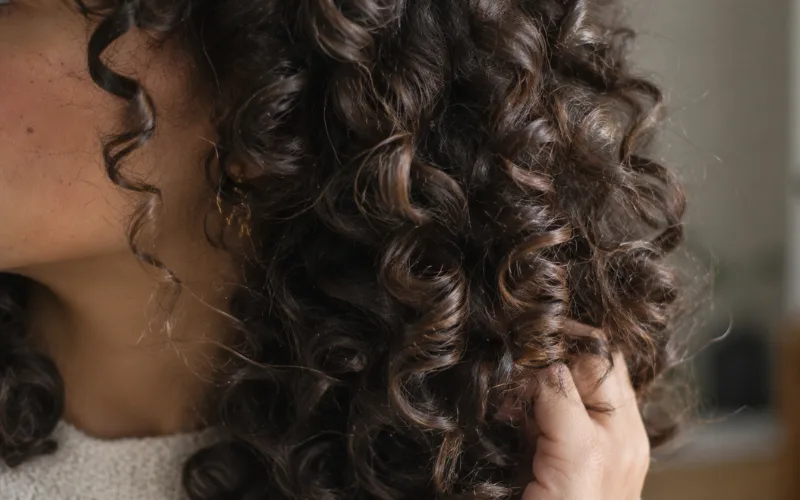
3B is the middle of the three curl patterns. The ringlets have a clear circumference, spring back when pulled and released, and cluster densely enough that individual curls are hard to separate without disrupting them.
Density is the practical marker. 3A leaves visible gaps between curls, and 3B does not. Where 3A hangs, 3B stands out from the head, which is why volume is rarely the complaint on this type and frizz almost always is.
Is My Hair 3A, 3B, or 3C?
Measure a single dry curl against a household object. That is faster and more reliable than comparing photographs, because lighting and length change how a pattern reads on screen.
| Type | Curl diameter | Comparison object | Density | Shrinkage |
| 3A | Half an inch to an inch | Sidewalk chalk | Gaps between curls | About a fifth |
| 3B | A third to half an inch | Marker barrel | Packed, no visible gaps | Around a third |
| 3C | A quarter inch or less | Pencil or straw | Very dense, corkscrews touch | Half or more |
Curls loose enough to hang rather than stand belong on the 3A hair page. The hair type quiz reads pattern alongside width, density and porosity, which matters on this type because two people can both measure 3B and need different products entirely depending on strand width.
3B or 3C?
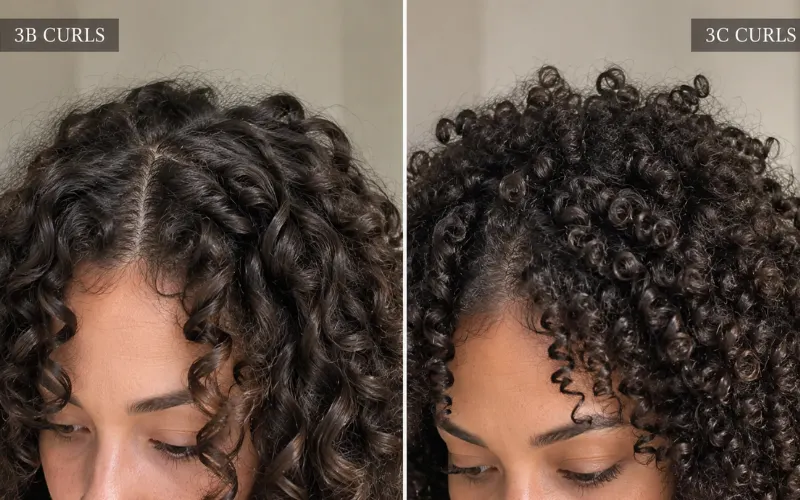
Spacing settles it when diameter is ambiguous. 3B ringlets have definition you can see from a few feet away, with each curl distinguishable in the mass. 3C corkscrews sit so densely that the eye reads texture rather than individual curls.
Shrinkage is the second check. 3B loses roughly a third of its length drying; 3C commonly loses half. Anyone whose hair reaches the shoulder wet and the jaw dry is closer to 3C. The hair types chart sets all twelve codes against each other.
Is Type 3B Hair Rare, and What Is the Rarest Curly Type?
No published dataset ranks the twelve codes by prevalence, so any claim about which curl type is rarest is guesswork repeated until it sounds like a fact.
The measured research does not use the Walker codes at all. A L’Oreal Recherche team led by Roland de la Mettrie assessed hair from 1,442 people across 18 countries for Human Biology in 2007 and produced eight categories built from curve diameter, curl index and wave count. Curly hair was well represented across that sample. Nothing in it counts 3B, because 3B was not one of the categories.
There is a structural reason rarity questions cannot be answered here. Self-typing is unreliable at every boundary, and curl patterns shift with humidity, length, damage and product. A prevalence figure would need a fixed measurement standard applied to a representative population, and no such exercise has been published for this system.
Is 3B Hair African American?
No single hair type belongs to any ethnicity. Curl patterns across the type 3 range occur in people of African descent and also across Mediterranean, Middle Eastern, South Asian, Latin American, mixed-heritage and European populations, and the variation inside any one group is wider than the average difference between groups.
That was the point of the de la Mettrie work cited above. It set out to classify hair by measurable geometry precisely because the older African, Asian and European groupings failed to describe the range that exists within each one.
The typing system itself has a history worth knowing. Andre Walker created it in 1997 for a mass-market book rather than as a scientific instrument, and it has drawn steady criticism for numbering patterns in a sequence that reads as a ranking. It is shopping shorthand describing a strand, not a statement about a person.
Why 3B Hair Dries Out
Scalp oil cannot travel a spiral. On straight hair sebum reaches the ends within a day or two; on a 3B ringlet it rarely gets past the mid-lengths, so the ends are effectively unmoisturised no matter how oily the roots feel.
The bends compound it. Each turn in a curl is a point where the cuticle sits slightly raised, so moisture escapes faster and the fibre takes on humidity faster in the other direction. Dryness and frizz on this hair type are the same problem viewed from two sides, which is why anti-frizz products that coat the surface without adding moisture disappoint so consistently.
A 3B Routine That Holds
Cleanse once or twice a week for most people. The American Academy of Dermatology ties frequency to how oily the scalp actually gets in its healthy hair guidance, which beats a fixed schedule, and dense curls conceal oil at the root longer than looser patterns do.
Detangle in the shower with conditioner in and fingers or a wide tooth comb. Dry detangling on 3B destroys clump formation and the pattern does not recover until the next wash.
Layer cream then gel onto soaking wet hair, section by section rather than all over, and scrunch upward. Squeeze water out with a cotton shirt, dry without touching, diffuse on low, and break the cast only when the hair is completely dry. A weekly deep conditioning mask does more for this type than any leave-in.
Products for 3B Hair
Moisture first, hold second. A conditioner with real slip, a cream for clumping, and a gel for cast, applied in that order and each one thinly rather than one product generously.
3B carries more weight than 3A and less than 3C. Heavy butters flatten the ringlets at the crown while leaving the ends dry, which is the worst of both. Clarify every three or four weeks to clear buildup, and use a satin pillowcase, which costs less than most products and preserves more definition than any of them. The natural shampoo guide covers which cleansers clear residue without stripping.
3B Hair Growth
Curly hair grows at the same rate as everyone else’s. Scalp hair advances at roughly 0.35 millimetres a day, about half an inch a month and six inches a year, and curl pattern has no effect on that number.
What changes is how much of it shows. A 3B curl loses around a third of its length to shrinkage, so six inches of growth reads as four. Breakage does the rest. Every bend in a curl is a mechanical weak point, and dry ends snapping at those points can remove length as fast as the root produces it, which is why length plateaus on this type without ever indicating slow growth. Retention rather than growth is the thing to work on.
3B Hair Colour
Curls take colour unevenly by design. The outside of each spiral faces the applicator and absorbs first, the inside absorbs last, so precise all-over blocks of colour look patchy once the hair moves. Balayage and lived-in techniques suit the pattern better.
Lightening costs definition. Bleach raises the cuticle and roughens the fibre, and on a dense curl that means more frizz and a looser spiral rather than simply a lighter shade. Anyone going lighter should plan for deep conditioning as routine maintenance and for regular toning, which is what purple shampoo handles.
3B Hair on Men

Length is the deciding variable and it is shorter than for the wavy types, because a 3B ringlet completes a turn within an inch or two. Even a modest crop shows the pattern, which is why 3B on men more often gets cut for volume control than for length.
Ask for weight removed through the interior rather than a uniform clipper guard, since bulk is what makes this texture widen rather than fall. A light cream on damp hair defines it and wax destroys it. Scalp becoming visible at the crown as curls separate is worth reading against the thinning hair guide rather than blamed on the curl pattern.
Measure the diameter first, then buy for weight and porosity. Those two decide how the day goes far more than the code does.

BeautyLiesTruth publishes hair and personal color guidance built on primary research. Color claims are tested by draping under controlled daylight, and every figure is traced to a published source rather than to another blog.