
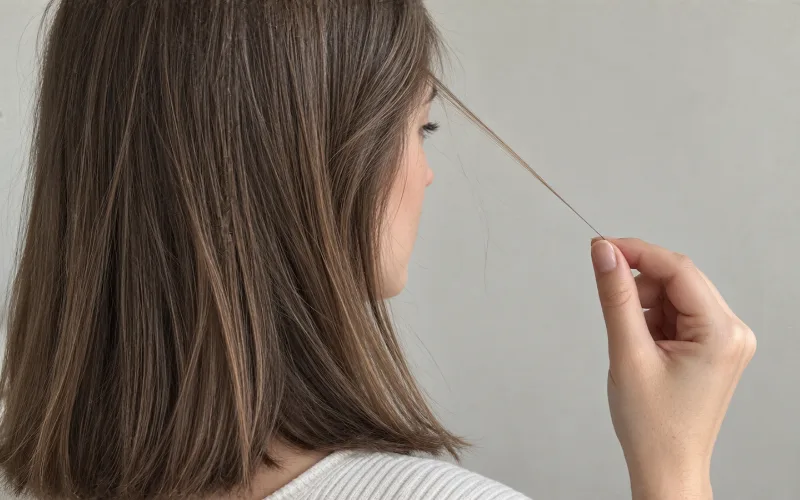
Fine hair describes the width of a single strand, not how much hair grows on your head. A fine strand is narrow, light and flexible, which is why it goes flat quickly, shows scalp oil sooner, and loses a set long before a thicker strand would.
Someone with fine hair can have a great deal of it. Someone with coarse hair can have very little. The two measurements are independent, and confusing them is the reason so much fine hair advice misses.
Is There a Measurement for Fine Hair?
Not an agreed one, which is worth knowing before trusting any chart that presents fine, medium and coarse as though they were measured categories. Different sources put the fine cut-off anywhere from below 50 to below 60 micrometres, and none of them cite a standard.
One threshold does have a clinical definition, and it describes something else. In trichoscopy, a terminal hair is one measuring at least 40 micrometres across and a vellus hair is under that. That line separates proper scalp hair from the short, soft hair found on the body, and it is used to assess hair loss rather than texture.
So fine, medium and coarse are salon shorthand. Useful shorthand, as long as nobody treats it as a measurement.
How Do I Know If My Hair Is Fine?
Three checks, done on clean, dry hair with no product in it.
Roll a single strand between finger and thumb. If you can barely feel it, that is fine. If it feels distinctly present or wiry, it is coarse. Somewhere in between is medium, and most people are.
Compare one strand against a sewing thread held beside it. A strand noticeably narrower than the thread is fine; one about the same width or thicker is medium to coarse.
Then check the ponytail, which measures something different. Gather all your hair and measure the circumference of the base. Under two inches suggests low density, two to four inches medium, and above four inches high. A fine-strand ponytail can still be thick, and a coarse-strand ponytail can be slim.
Fine, Medium or Coarse
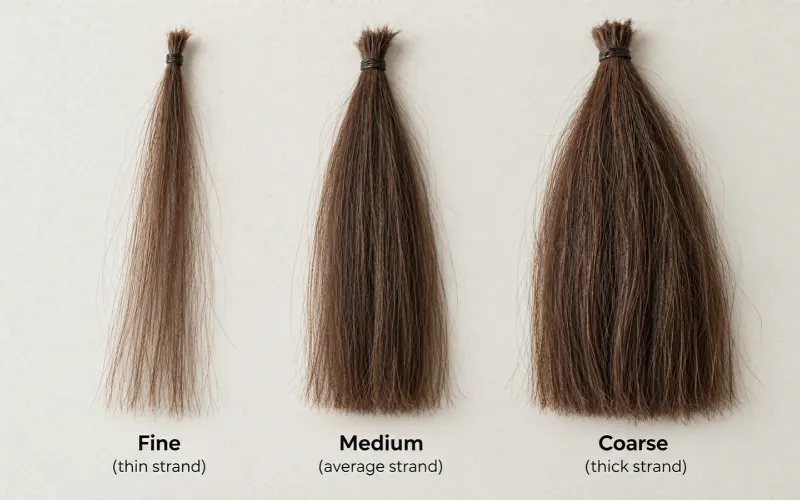
The three sit on one scale and describe how much a strand can carry before it gives up. Fine hair collapses under weight that medium hair tolerates and coarse hair barely notices.
That is the practical use of the scale. A leave-in cream sized for coarse hair will flatten fine hair of the same curl pattern by lunchtime, and a volumising spray built for fine hair does nothing on coarse strands. Weight tolerance follows width, not curl.
Fine Hair vs Thin Hair
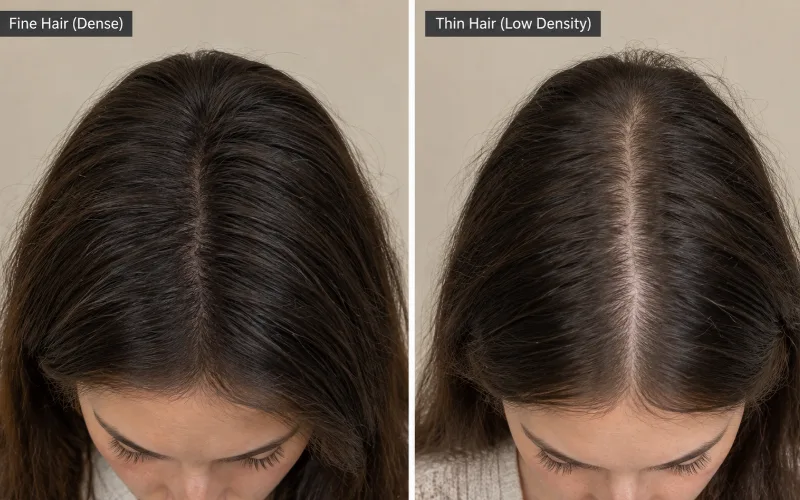
Two different measurements, constantly used as synonyms.
| What it measures | How to check | Can it change? | |
| Fine | Width of one strand | Roll a strand between finger and thumb | Slowly, with age and hormones |
| Thin | How many strands grow per square centimetre | Ponytail circumference, or how much scalp shows at the part | Yes, and a change is worth investigating |
A healthy adult scalp carries roughly 80,000 to 120,000 terminal hairs, and where someone sits in that range is density rather than texture. Fine and dense together is common, and it reads as a full head of hair that will not hold a style.
Can Hair Be Fine and Thick at the Same Time?
Yes, and the combination confuses more people than any other. Fine describes each strand; thick usually describes the whole head. A dense head of narrow strands looks and feels substantial in a ponytail while behaving like fine hair the moment product touches it.
The practical consequence is that these heads get sold the wrong products twice over. Volumising ranges assume low density and do nothing for someone who already has plenty of hair. Rich, nourishing ranges assume coarse strands and flatten narrow ones within an hour. What fine and dense hair actually needs is lightweight formulas in generous quantities, since there is a lot of hair to cover and very little weight tolerance per strand.
Thin or Thinning? The Distinction That Actually Matters
Most guides stop at fine versus thin. The more useful split is between hair that has always been low density and hair that is becoming lower, because only one of those is a medical question.
Low density on its own is a normal variation. Loss of density over time is not, and the trichoscopic marker for it is variation in strand width across the scalp, since hair shaft diameter variability is the most sensitive trichoscopic feature of androgenetic alopecia. Miniaturising follicles produce progressively narrower hairs, so a scalp with a mix of wide and narrow strands looks different from one that is uniformly fine.
Androgenetic alopecia affects approximately 50 percent of men by age 50 and 80 percent by age 70 and is common in women too. If a part is widening, if shedding has increased, or if strand width has visibly changed within a few years, that is a question for a dermatologist or trichologist rather than a shampoo.
Can Fine Hair Hold a Curl?
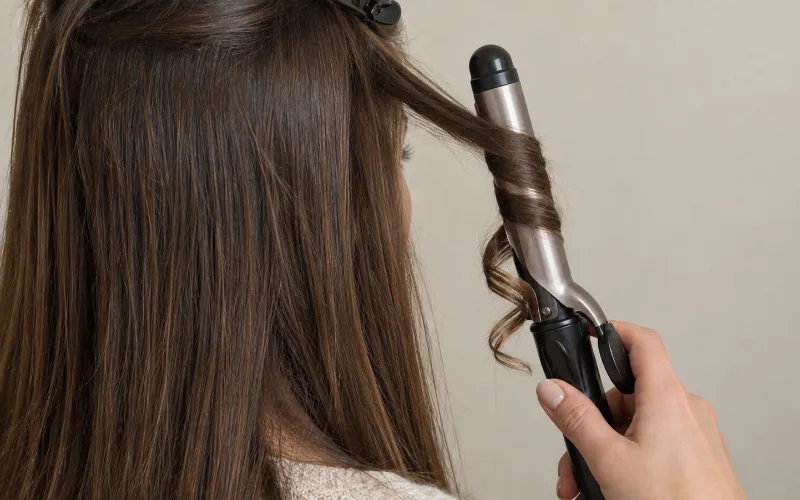
Yes, and only briefly without help. A fine strand takes a set easily, because heat reaches through a narrow fibre quickly, and it drops the set just as easily, because there is less mass holding the new shape.
Three things extend it. Work in smaller sections than you think you need, let each curl cool completely before it is touched, and use a mousse or texturising spray for grip rather than a cream for hold. Hairspray applied before the curl is brushed out lasts longer than hairspray applied after.
What Are the Downsides of Fine Hair?
Volume is the obvious one. Fine strands compress under their own weight and under product, so the crown flattens first. Oil is the second, since sebum travels a narrow shaft quickly and roots look greasy within a day. The third is fragility, because a narrower fibre carries less load before it breaks, which makes heat and chemical processing more costly than they are on coarse hair.
There are genuine advantages, which most guides skip. Fine hair takes colour faster and with less processing time, it dries in a fraction of the time coarse hair needs, it rarely frizzes, and it carries shine better because a smoother, flatter surface reflects more light.
What Is Fine Hair Called?
In salons it is called fine, or occasionally baby fine for the narrowest strands. In clinical settings the measurement is hair shaft diameter.
Vellus hair is a different thing and gets confused with it. Vellus hairs are the very short, soft, barely pigmented hairs found across the body and along the hairline, and they sit below the terminal threshold described earlier. Fine scalp hair is still terminal hair, just at the narrow end.
How to Care for Fine Hair
Wash on how oily the scalp gets rather than on a schedule, which is how the American Academy of Dermatology frames frequency in its healthy hair guidance. For most fine hair that lands between daily and every second day.
Keep conditioner from the ears down. Anything applied near the roots shows up as flatness within hours. Choose lightweight formulas and clarify every few weeks, since buildup costs fine hair more volume than dryness does, and the natural shampoo guide covers which cleansers stay light enough.
Volume comes from mousse worked into damp hair before drying, not from product added afterwards. Heat protection matters more here than on thicker hair, and blunt cuts read as denser than layered ones. Strand width also declines gradually with age and hormonal change, which the guidance on supporting skin and hair as they age covers.
Fine Hair on Men
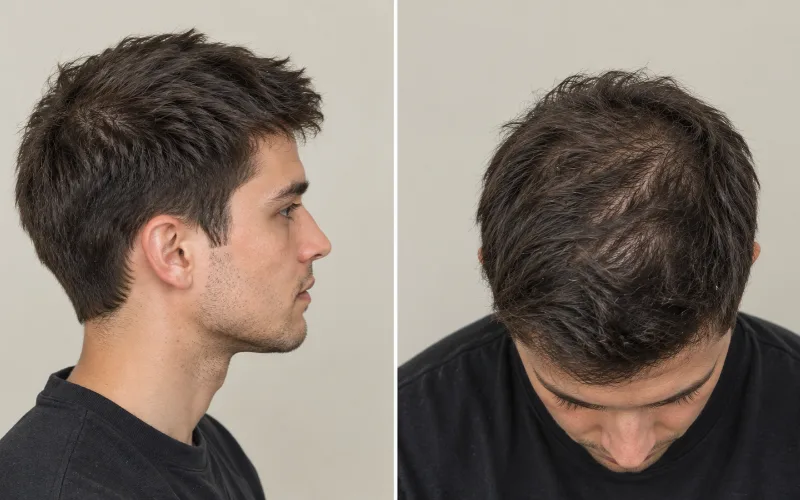
The same definition applies, with one complication. Fine strands and early hair loss look identical in a mirror, since both show scalp through the top and both lie flat.
The difference is whether anything has changed. Hair that has always been fine is texture. Hair that used to hold a style and no longer does, or a part that has widened, is worth reading against the thinning hair guide. On styling, clay and paste hold fine hair where wax and pomade drag it flat, and the hair types for men guide covers pattern alongside width.
Fine Hair in Women
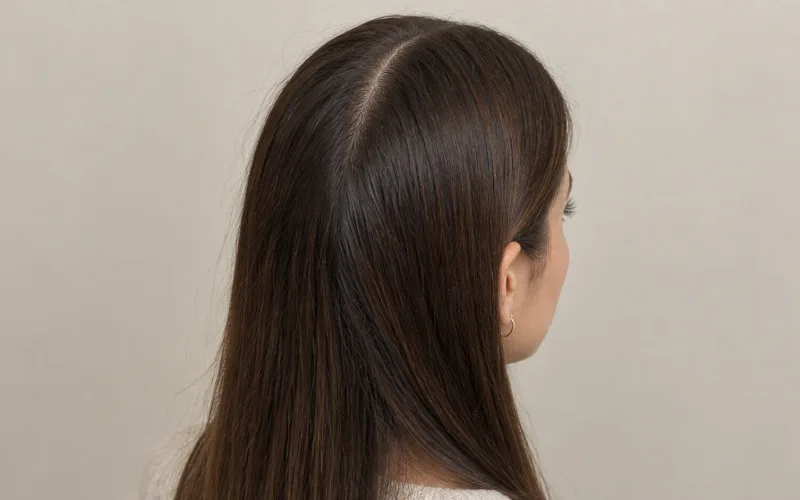
The definition is identical, and so is the confusion with loss. Female pattern hair loss presents differently from the male version: the frontal hairline usually stays intact while the part widens and density drops across the top of the scalp, which reads as hair becoming finer rather than receding.
Hormonal change is the common trigger for a genuine shift in strand width, around pregnancy, postpartum and menopause in particular. Hair that has always been fine needs styling adjustments. Hair that has become finer within a couple of years needs a clinician first and a styling routine second.
Where Fine Hair Sits on the Hair Type Chart
It does not, properly, and that is the chart’s main blind spot. The 1A to 4C system records curl pattern, so fine hair appears at every code on it.
The exception is confusing rather than helpful. Inside the straight family the letter is commonly used for strand width instead of pattern, which is why 1A hair gets described as fine by default. Everywhere else on the chart, width is a separate measurement that has to be read on its own. The hair types guide covers the full system, the hair types chart sets all twelve side by side, and the hair type quiz reads width, density and porosity alongside the pattern, which is the combination that decides what actually works.

BeautyLiesTruth publishes hair and personal color guidance built on primary research. Color claims are tested by draping under controlled daylight, and every figure is traced to a published source rather than to another blog.