Beauty previews are good at direction and poor at exact color. A hair color app shows whether a shade family suits your face, not how your hair will lift. A selfie color analysis shifts with light and camera angle. Makeup try-ons drift with screen settings. An AI Botox preview shows the kind of softening, not the dose. Daylight, no filters and a white reference make all of them more honest.
Knowing before you commit is the whole appeal. A color analysis quiz tells you which palette to shop, a hair color app shows a shade before the dye goes on, and a growing number of clinics show you your own face with softer lines before a single injection. Every one of those previews is a photo, processed by a phone and viewed on a screen, and both steps change color. Here is what each kind gets right, where it misleads, and how to get a truer read.
Why Every Preview Bends Color
Phone cameras guess. Automatic white balance and exposure decide how warm and how bright a scene should look, and skin is where they slip most. An imaging-lab evaluation of phone and web cameras found that color shifts, exposure errors and lower image fidelity were common in scenes with darker skin tones.
The angle you hold the phone at matters too. In a smartphone color study archived in PubMed Central, changing the camera angle altered both the lightness and the hue recorded for skin-tone color standards, changing the distance altered lightness, and switching on the flash did not fix either.
Then there is the screen you judge it on. On iPhones, True Tone is on by default and adjusts display color to the light in the room, while Night Shift pushes the display toward warmer tones. A copper preview checked in bed at night looks warmer than it really is. Beauty filters and auto-enhance add their own smoothing and tint on top.
Hair Color Try-on Apps
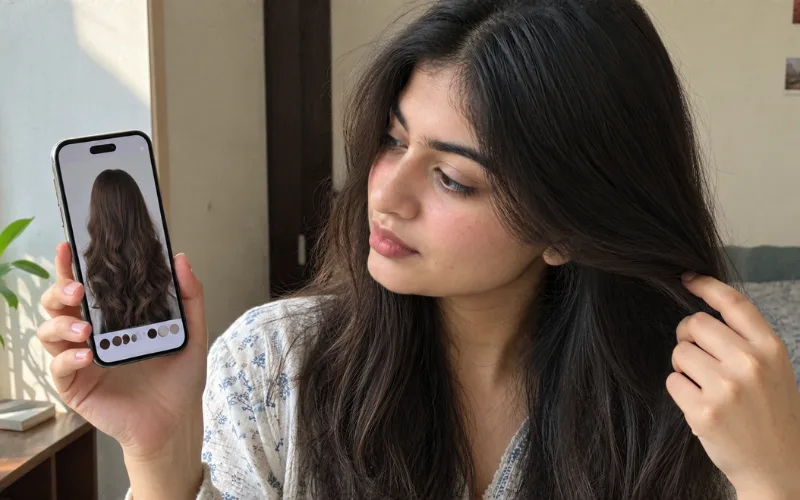
These apps find your hair in the frame and recolor those pixels. They are genuinely useful for one question: does this shade family suit your face? Seeing copper against your skin and eyes, then ash brown in the same photo, settles a lot before anyone mixes color, and the best free hair color apps make that comparison quick.
What they cannot show is chemistry. Lightening dark hair exposes warm underlying pigment that a preview simply paints over, and porosity, old box dye and earlier bleaching all change how a new shade takes. In colorist practice, previews are weakest on very dark bases and on tight curl patterns such as 4C, where light scatters off the strand differently, so knowing your hair type helps set expectations. A preview also cannot tell you whether you will react to the dye, which is why the FDA advises a patch test before every color service.
Selfie Color Analysis
Seasonal color analysis weighs undertone, depth and the contrast between skin, hair and eyes, and every one of those reads is sensitive to light. A selfie under a warm ceiling bulb can nudge a cool summer toward autumn. The color analysis quiz works best with the photo conditions listed below, and a skin tone chart helps you sanity-check depth and undertone against what the camera shows.
Side-by-side comparisons beat any single reading. Holding gold and silver near your face in the same daylight removes most of the camera’s guesswork, because both options share whatever error the light introduces.
Makeup Shade Try-ons
Virtual foundation matching and lipstick try-ons rely on the same camera read of your undertone, so they inherit its errors. Treat a foundation match as a shortlist and confirm it with a stripe along the jaw in daylight. Lipstick try-ons are good at color family and poor at finish: a sheer gloss and a matte in the same shade read very differently in person. The logic of which colors look good on you holds up better than any single on-screen swatch.
AI Botox and Injectable Previews
These tools map the landmarks of your face and simulate what relaxing the muscles behind forehead lines, frown lines or crow’s feet might look like. Their real value is sorting what an injectable can change from what it cannot. If the preview softens your forehead but the texture or dark spots that bother you are still there, Botox answers only part of the question.
What a preview cannot know is your muscle strength, how much product you need, or how each side of your face moves. Real results appear within three to seven days and last about three to four months, according to the American Academy of Dermatology, which is also the window in which a preview can be checked against reality. Demand explains why previews exist at all: neuromodulators made up roughly half of all minimally invasive cosmetic procedures in 2025, according to the American Society of Plastic Surgeons.
Some med spas now build a preview into the consultation so you can see your botox results before you buy, which also gives you a concrete image to discuss with the injector. Whatever the preview shows, confirm the injector is licensed and the product is FDA-approved. In 2024 the CDC investigated reports from 22 people in 11 states who were harmed by counterfeit or mishandled injections given by unlicensed or untrained people or in non-healthcare settings.
How to Get a Truer Preview
Face a window in daylight and switch off warm overhead bulbs.
- Turn off beauty filters and auto-enhance.
- Hold the phone at eye level, at arm’s length and at the same angle every time.
- Put a plain white sheet of paper in the frame as a color reference.
- Switch off True Tone and Night Shift, or your phone’s equivalents, while you judge color.
- Run the same look through two or three apps. If they agree, the direction is probably right.
- Take screenshots to your colorist, makeup artist or injector, and use them to start the conversation rather than settle it.
Questions People Ask
Are Hair Color Apps Accurate?
For direction, yes: they show whether a shade family suits your face. For the final result, no, because they cannot see how your hair lifts, its porosity or the old color underneath.
Can an App Tell My Color Season?
It can suggest one, but the answer depends heavily on light and camera. Confirm it by comparing colors side by side near your face in daylight.
Are AI Botox Simulators Accurate?
They are approximations. They show the kind of softening to expect, but the dose and the final result depend on your muscles and the injector.
Why Does My Hair Color Look Different in Photos?
The camera’s automatic white balance, the room’s light and your screen’s color settings all shift color. Daylight and a white reference in the frame get you closest to what people see in person.
A good preview is a first step. It shows a direction, and the final call still happens in daylight, in person, with a professional who can see what the camera cannot.
I spent the last 7+ years helping people discover what truly works for them in fashion and beauty. After styling clients in boutique fashion houses and testing countless skincare products myself, I learned one simple truth: the best style is the one that makes you feel confident every single day. On my blog, I share the same honest tips I give my friends: simple, practical, and a little inspiring.