

Men’s hair runs across twelve types, from pin-straight 1A to tightly coiled 4C. The number gives the family, straight, wavy, curly or coily, and the letter narrows it within that family.
The chart below puts each type next to its common name and the cuts that tend to suit it. Reading the chart is quick. Reading your own hair accurately takes one extra step, covered underneath.
The Men’s Hair Type Chart
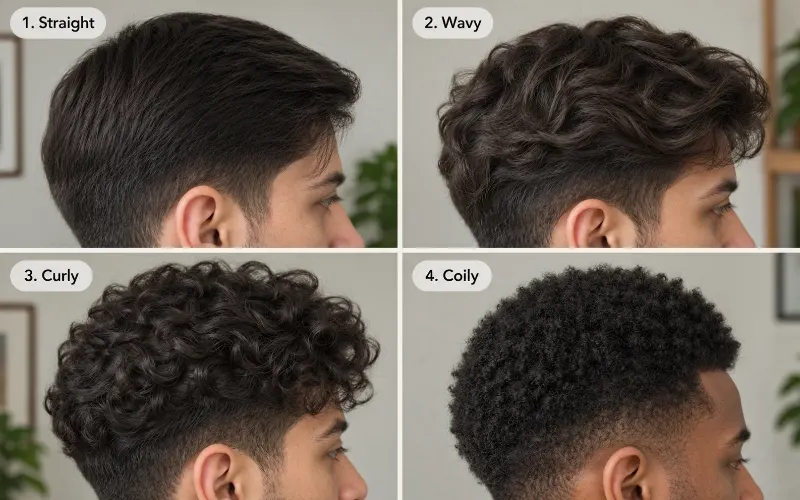
| Type | Common name | What it looks like | Cuts that suit it |
| 1A | Pin straight | Fine, flat to the scalp, no bend anywhere | Crew cut, side part, blunt crop |
| 1B | Straight with body | Soft bend at the ends | Textured crop, side part, short quiff |
| 1C | Coarse straight | Thick strands with one or two bends | Textured crop, layered side part |
| 2A | Loose waves | Open S from the mid-lengths down | Longer top with short sides, flow cut |
| 2B | Defined waves | S starting around the mid-length | Quiff, textured top, medium flow |
| 2C | Deep waves | Tight S starting at the root | Curly-top taper, medium length |
| 3A | Loose curls | Spiral about the width of sidewalk chalk | Curly fringe, longer curly top |
| 3B | Springy curls | Ringlet about the width of a marker | Curly top with faded sides |
| 3C | Tight curls | Corkscrew about the width of a pencil | Taper, curly top with short sides |
| 4A | Soft coils | Defined S coil, crochet-needle width | Shaped afro, twists, taper |
| 4B | Z-pattern coils | Sharp angled bends, cottony feel | High-top, twists, shaped afro |
| 4C | Tight coils | Densest zigzag, little visible coil | Taper, twists, shaped afro |
How to Read the Chart
Pick the family first, from what a single dry strand does. No bend at all is type 1. A bend that repeats along a flat plane is type 2. A strand that wraps into a loop is type 3. A strand that folds at sharp angles is type 4.
The letter comes second. In the curly and coily families it tracks how tight the pattern gets, which is why a household object is the quickest measure. In the straight family it mostly tracks strand width, since there is no pattern to tighten.
One caution matters more on men than anyone else. Short hair hides pattern, because a wave needs length to complete a bend, so a 2B head cut to an inch can read as 1A. The hair types for men guide covers how to read hair that is cut short and how much length each type needs.
Is My Hair 2A, 2B or 2C?
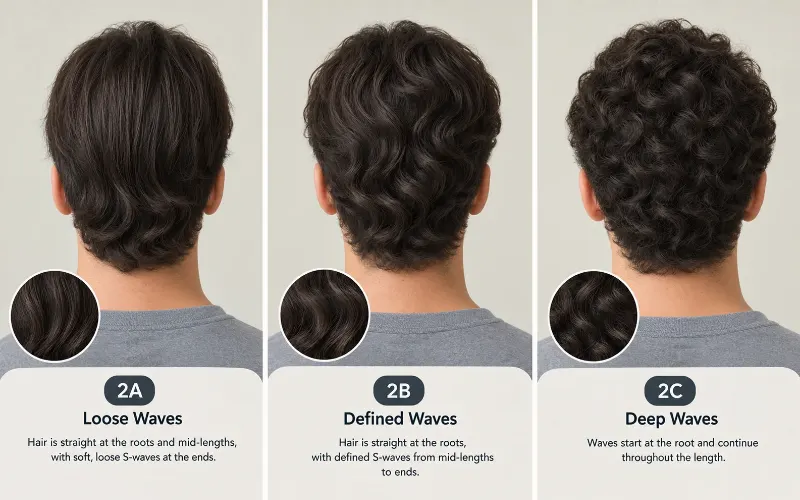
Find the highest point on a dry strand where the first bend appears. A wave starting at the root is 2C, one starting around the mid-length is 2B, and one that only appears in the last few inches is 2A. On men this is the most misread group on the whole chart, since 2A and 2B need the most length before they show.
1A Hair on Men

1A is fine, pin-straight hair with no bend anywhere along the strand. It shows its pattern at any length, which makes it the one type a short cut cannot disguise.
It also gets confused with thinning. Fine straight hair lies flat and lets scalp show in overhead light, and early thinning does the same, so a man who reads as 1A in his thirties after reading as 1B or 1C in his twenties is worth a closer look at his crown and temples.
Black Men’s Hair Types
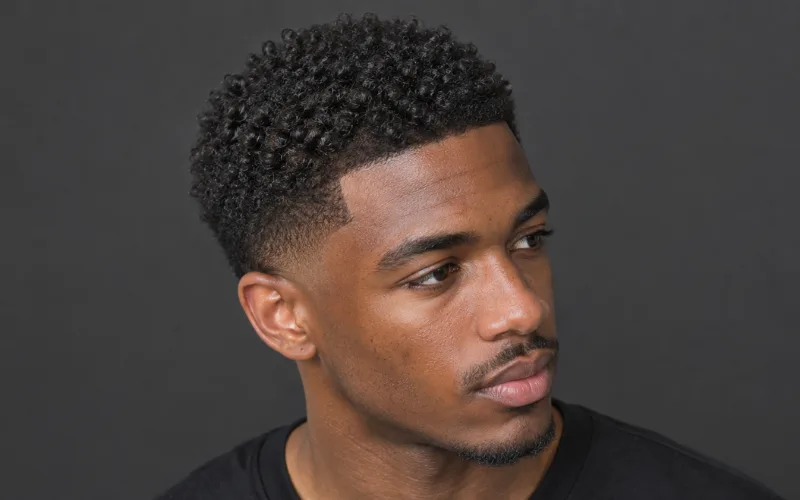
The same chart applies. Black men’s hair most often falls in the 3C to 4C range, though type 2 and type 3 patterns occur too, and coily hair occurs across many populations. A L’Oreal Recherche team led by Roland de la Mettrie measured hair from 1,442 people across 18 countries and found the variation inside every group wider than the difference between groups.
One point of confusion is worth clearing up. Waves, including 360 waves, are a style rather than a hair type. They are created by brushing and compressing short, usually coily hair until it lies in a repeating ripple, and the same head of hair can wear waves, a taper, twists or a high-top.
What Is the Rarest Hair Type for Males?
No study has counted the twelve types in men or anyone else, so every answer is repetition rather than evidence. 1A is the usual claim. The rarest hair type page covers where the claim came from and what the measured research actually counted.
What Do Clipper Numbers 1, 2, 3, 4 and 5 Mean?
These numbers have nothing to do with hair type. They are clipper guard sizes, and the higher the number, the longer the hair left behind. Wahl lists its #8 guard at one inch, and the standard numbered set works in eighths of an inch below that.
| Guard | Hair left | Typical use |
| #1 | 1/8 inch, about 3 mm | Short buzz cut |
| #2 | 1/4 inch, about 6 mm | Buzz cut, faded sides |
| #3 | 3/8 inch, about 10 mm | Longer buzz cut |
| #4 | 1/2 inch, about 13 mm | Short all-over cut |
| #5 | 5/8 inch, about 16 mm | Longer sides, blended top |
Oster clippers are the common exception, since their numbers refer to the blade rather than a guard and run on a different scale. Growth puts the numbers in perspective too. Scalp hair grows at roughly 0.35 millimetres a day, so a #1 grows out to #2 length in about nine days.
Guards also explain why curly and coily hair often looks wrong after a clipper cut. A single guard leaves the same length everywhere, but hair that shrinks by half or more between wet and dry sits unevenly once it springs back, which is why those types are better shaped with scissors.
Hair Type Chart for Women
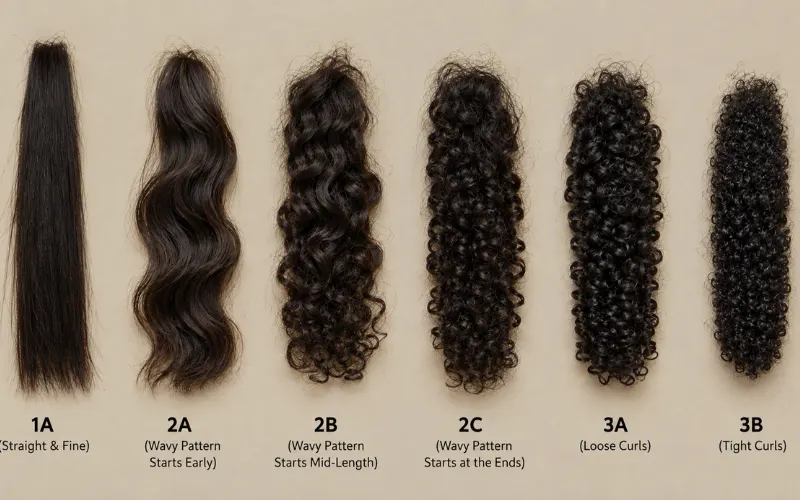
The codes are identical, since hair type describes a strand rather than a person. The general hair types chart covers all twelve with longer-hair examples, where patterns are easier to see.
Find your family on the chart, confirm it on the longest hair you have, and the hair type quiz will cross-check the result against strand width, density and porosity, the three things the chart cannot show.

BeautyLiesTruth publishes hair and personal color guidance built on primary research. Color claims are tested by draping under controlled daylight, and every figure is traced to a published source rather than to another blog.