

Type 3 is curly hair. The strand wraps around an axis into a visible spiral, which is the single trait separating it from wavy hair that bends along a flat plane and from coily hair that folds at sharp angles.
The three subtypes are sizes of the same spiral. 3A is a loose loop, 3C is a tight corkscrew, and the most reliable way to tell them apart is a household object held against a single dry curl.
What Is Type 3 Hair?
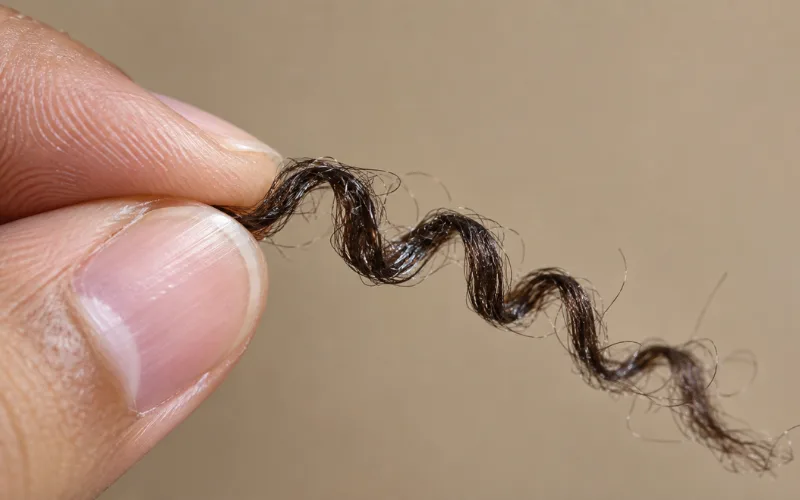
Type 3 hair forms closed loops you can see through. The spiral starts at or near the root, has a measurable circumference, and springs back when a curl is pulled straight and released.
It shrinks noticeably between wet and dry, since a spiral takes up vertical space that a wave does not. It also dries out faster than straighter hair, because scalp oil cannot travel the length of a spiral and the ends receive very little of it.
What Are Hair Types 1, 2, 3 and 4?
Four families, each describing curl pattern and nothing else. Type 1 has no bend. Type 2 waves along a flat plane. Type 3 spirals around an axis. Type 4 bends at sharp angles into tight coils.
Each family divides into A, B and C. Andre Walker built the system in 1997 for a mass-market book as a shopping shortcut rather than as a scientific instrument, and the hair types guide covers all twelve codes.
The Three Type 3 Subtypes
| Curl diameter | Comparison object | Density | Shrinkage | |
| 3A | Half an inch to an inch | Sidewalk chalk | Visible gaps between curls | About a fifth |
| 3B | A third to half an inch | Marker barrel | Packed, no visible gaps | Around a third |
| 3C | A quarter inch or less | Pencil or a drinking straw | Corkscrews touch, reads as texture | About half |
3A hair hangs rather than stands, with shine and a crown that flattens. 3B hair stands out from the head in springy ringlets and frizzes before it flattens. 3C hair packs so densely that the eye reads texture rather than individual curls.
How Can I Tell If My Hair Is 3B or 3C?
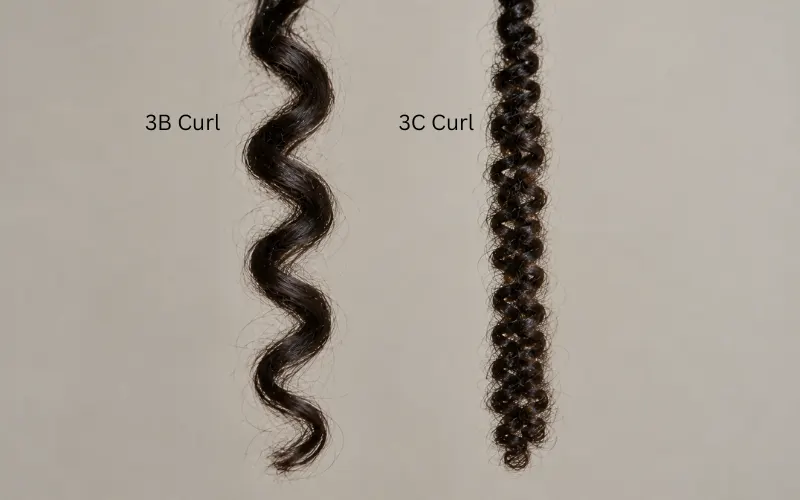
Measure one dry curl. A curl that fits around a marker barrel is 3B; one that fits around a pencil is 3C.
Spacing confirms it when the diameter is borderline. 3B ringlets remain individually visible from a few feet away, while 3C corkscrews merge into one mass at that distance. Shrinkage is the third check, with 3B losing around a third of its length drying and 3C about half.
Type 2 or Type 3?
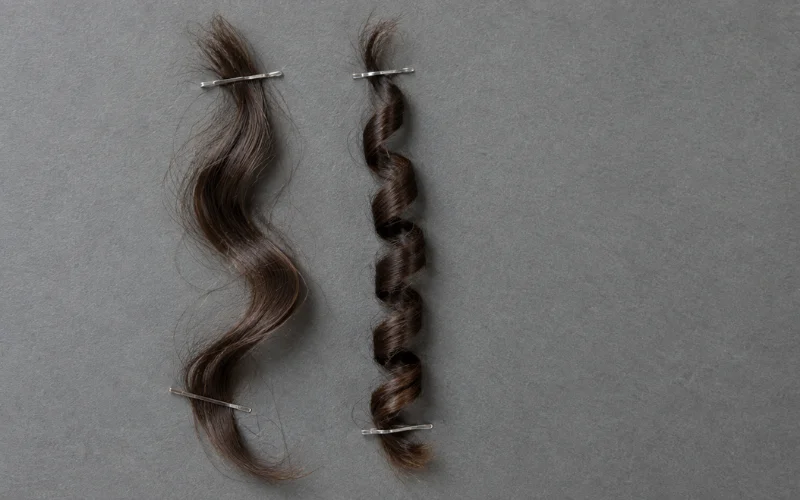
Ask whether the strand lies flat or wraps. A wave zigzags back and forth on one plane, however tight the bends get. A curl turns around itself and forms a loop with a visible circumference.
2C hair is where the two families meet, and it is often mistaken for 3A. The shrinkage test resolves most of those cases: 3A loses a fifth or more of its length between wet and dry, while 2C loses very little. The type 2 hair guide covers the wavy family from the other side of that line.
Type 3 or Type 4?
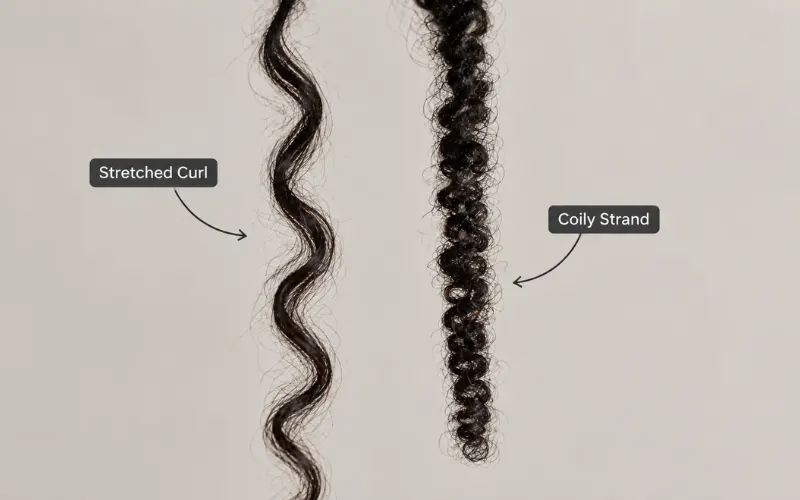
Rounded or angular. A 3C spiral keeps a smooth curved path through each turn. A 4A hair coil has corners, so stretching a single dry strand reveals an S with angles rather than a continuous loop.
Feel settles what the eye cannot. 4A compresses between the fingers and rebounds with a spongy resistance, while 3C simply springs back. Shrinkage is the test to distrust here, since 3C commonly loses about half its length and 4A between fifty and sixty percent, so the ranges overlap. The hair types chart sets all twelve codes against each other, and the hair type quiz reads pattern alongside width, density and porosity.
What Is the Rarest Curl Type?
Nobody knows. No published dataset ranks the twelve codes by prevalence, and claims naming any curl type as the rarest are repetition rather than evidence.
The measured work on hair shape uses a different system. A L’Oreal Recherche team led by Roland de la Mettrie assessed hair from 1,442 people across 18 countries for Human Biology in 2007 and produced eight categories from curve diameter, curl index and wave count, none of them Walker codes. Curly hair was well represented across that sample. The rarest hair type page traces where these claims came from and what the research actually counted.
Can White People Have Type 3 Hair?
Yes, and commonly. Type 3 curls occur across European, Mediterranean, Middle Eastern, North African, Latin American, South Asian, mixed-heritage and African-descended populations, and the variation inside any one group is wider than the average difference between groups.
The question tends to come from an assumption that curl pattern tracks ethnicity, which is precisely what the de la Mettrie research was built to test. It replaced the older African, Asian and European groupings with measured geometry because those categories failed to describe the range inside each one. Type 3 describes a strand, not a background.
Can You Get Type 3 Hair?
Not permanently, and not with a routine. Curl pattern is set below the skin. A L’Oreal team led by Sophie Thibaut cultured dissected scalp follicles for the British Journal of Dermatology in 2005 and found that follicles growing curved hair were themselves curved at the bulb, and kept that curvature even when grown away from the scalp. Straight-hair follicles were straight.
What a routine can do is reveal a pattern that was already there. Plenty of people with wavy or loosely curly hair have never seen it properly, because brushing, heavy conditioner and blow drying flatten it. A perm changes the fibre chemically and grows out. Heat tools change it for a day.
How to Care for Type 3 Hair
Cleanse once or twice a week, adjusting for how oily the scalp actually gets, which is how the American Academy of Dermatology frames frequency in its healthy hair guidance. Dense curls hide oil at the root longer than looser patterns do.
Detangle only in the shower with conditioner in the hair, using fingers or a wide tooth comb. Dry detangling separates clumps into frizz that will not reform until the next wash.
Layer products thinly on soaking wet hair: a leave-in for moisture, a cream for clumping, a gel for hold. Weight tolerance rises across the family, so 3A needs the lightest versions and 3C can carry rich creams. Dry without touching, diffuse on low, break the cast once completely dry, and sleep on satin.
Type 3 Hair Growth
Curl pattern has no effect on growth rate. Scalp hair advances at about 0.35 millimetres a day, roughly half an inch a month and six inches a year, the same on type 3 as on straight hair.
What changes is how much shows. Shrinkage hides between a fifth and a half of every inch depending on the subtype, and breakage at the bends removes length from dry ends. Length retention rather than growth is the thing to work on.
Type 3 Hair on Men
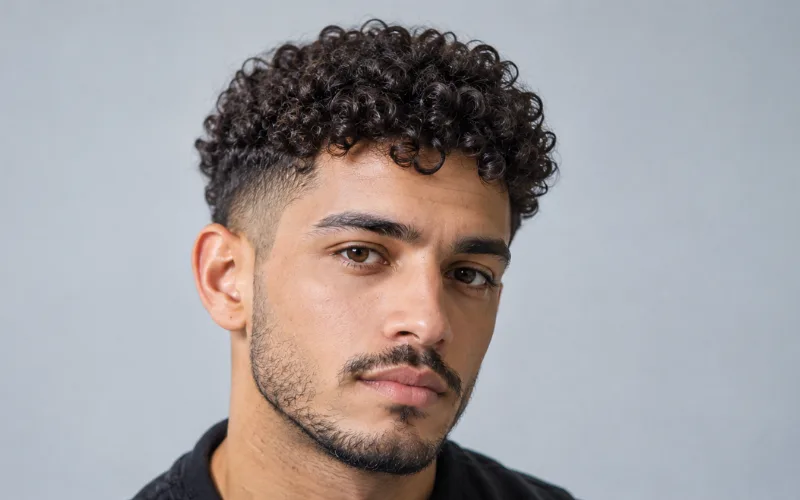
The pattern shows earlier than on wavy hair, because a spiral completes a turn within an inch or two. Even a modest crop reveals the curl, which is why type 3 on men more often gets cut for width control than for length.
Ask for weight removed through the interior rather than a uniform clipper guard, and for a dry cut if the barber offers one, since hair that shrinks by up to half produces a result nobody predicted when cut wet. A light cream on damp hair defines it and wax destroys it. Scalp becoming visible as curls separate is worth reading against the thinning hair guide rather than blamed on the pattern.
Measure the curl, then buy for weight and porosity. Those two decide more about how type 3 hair behaves than the letter does.

BeautyLiesTruth publishes hair and personal color guidance built on primary research. Color claims are tested by draping under controlled daylight, and every figure is traced to a published source rather than to another blog.