

Type 1 is straight hair. No spiral, no repeating S, no pattern of any kind from root to tip, which is what separates it from every other family on the chart.
It splits into three subtypes, and the split is not about how straight the hair is. All three are straight. What changes across 1A, 1B and 1C is the width of the strand and how much body comes with it.
What Is Type 1, 2, 3 and 4 Hair?
The four families describe curl pattern and nothing else. Type 1 has no bend. Type 2 waves along a flat plane in a repeating S. Type 3 spirals around an axis into visible loops. Type 4 bends at sharp angles into tight coils.
Each family then divides into A, B and C. Andre Walker built the system in 1997 for a mass-market book as a shopping shortcut rather than as a scientific instrument, and the hair types guide covers all twelve codes and how to identify yours.
The Three Type 1 Subtypes
| Strand width | Behaviour when air dried | Holds a set for | Main complaint |
| Fine | Flat root to tip, no bend anywhere | Under two hours | Greasy roots, no volume |
| Medium | Straight with a soft bend at the ends | Most of a day | Flat crown |
| Coarse | Straight with one or two bends lower down | A full day or longer | Frizz in humidity |
1A hair is the fine, pin-flat end of the family. 1B hair carries medium strands with enough body to hold a curl. 1C hair is the coarse end, thick enough to feel between finger and thumb and the only one of the three that frizzes.
Why the Letters Mean Width Here
This is where most type 1 confusion starts, and almost no guide says it out loud. In curly hair contexts the A, B and C letters describe how tight the pattern gets within a family, so 3A is a loose ringlet and 3C a corkscrew.
Inside type 1 that reading cannot work, because there is no pattern to tighten. So the industry uses the letter for strand width and density instead, running low at A through high at C. When one chart calls 1C the waviest straight type and another calls it the thickest, both are describing the same hair with different rulers.
How Do I Tell If My Hair Is 1B or 1C?
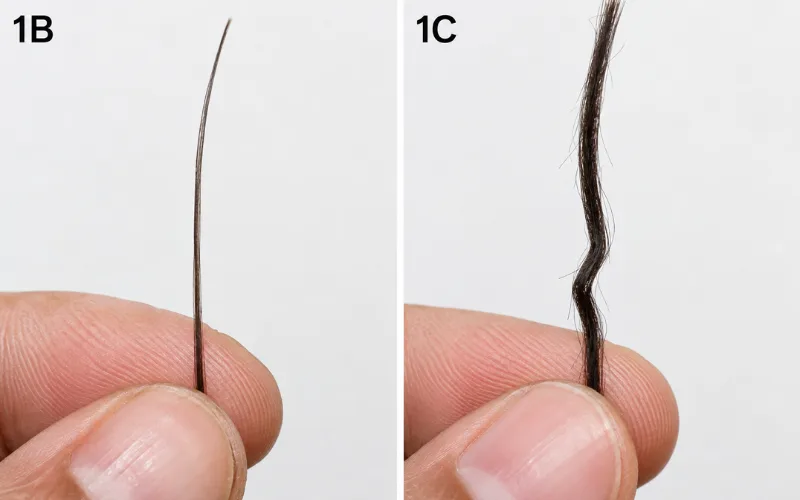
Roll a single strand between finger and thumb. If it is too fine to feel, the hair is 1A or 1B. If it feels wiry and distinctly present, it is 1C.
Humidity is the confirming test. 1C swells and frizzes on a damp day while 1B mostly holds its shape, because a wider strand presents more surface for the cuticle to lift. Judge the hair dry, clean and product-free, since wet hair hangs straighter than it really is and pulls a 1B result down toward 1A.
Is My Hair Type 1C or 2A?
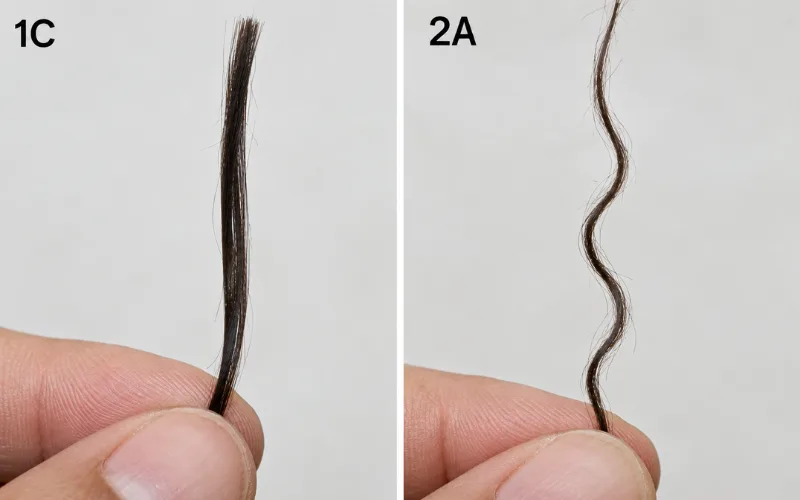
The question is whether the bend repeats. A 1C strand bends once or twice and then stops. A 2A hair strand forms an open S and then forms another one below it.
Strand width runs the other way as a tiebreaker. 1C strands are wide enough to feel; 2A strands usually are not. When the two tests disagree, the repeat test wins, because the number in the code records pattern and the letter records width. The hair type quiz reads both separately for that reason, and the hair types chart sets all twelve codes side by side.
Is 1A the Rarest Hair Type?
It is the answer repeated everywhere and no study has ever measured it. No published dataset ranks the twelve codes by prevalence, and the claim circulates because beauty sites have copied it from each other for years.
The measured research uses a different system. A L’Oreal Recherche team led by Roland de la Mettrie assessed hair from 1,442 people across 18 countries for Human Biology in 2007 and produced eight categories from curve diameter, curl index and wave count. Straight hair was common in that sample. The rarest hair type page traces where the claim came from and what the research actually counted.
Why Type 1 Goes Flat and Greasy
Sebum travels a hair shaft by contact. On a straight fibre nothing interrupts the journey, so scalp oil reaches the mid-lengths within a day or two, where a tightly curved strand keeps its ends dry for a week. That is the mechanism behind greasy roots across the whole family, and it is the one thing all three subtypes share.
Volume is a separate problem caused by weight. Fine and medium strands carry very little product before the roots collapse, which is why a leave-in cream sized for wavy hair flattens a type 1 head by lunchtime.
How to Care for Type 1 Hair
Wash on how oily the scalp actually gets rather than on a schedule. The American Academy of Dermatology ties frequency to scalp condition in its healthy hair guidance, and for this family that usually lands between daily and every third day.
Keep conditioner on the mid-lengths and ends. Anything applied within an inch of the roots shows up as flatness by afternoon. Volume comes from mousse worked into damp hair before drying rather than from product added afterwards, and heat protection matters more than it looks like it should, since thin strands reach damage temperature faster than thick ones.
The one exception is 1C, which needs moisture at the ends that the other two do not, because its bends interrupt the oil’s path down the strand.
Type 1 Hair on Men
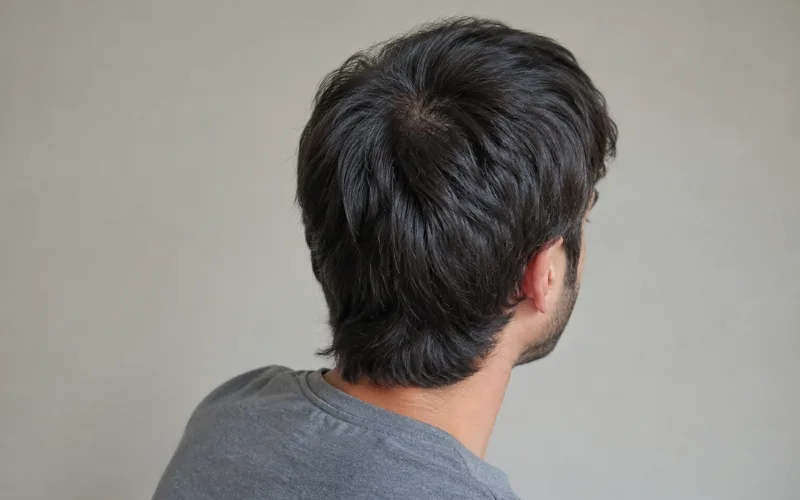
Short hair hides curl pattern, which is why so many men type themselves wrong. Under about two inches a wave cannot complete a full bend, so a 1B or even a 2A head reads as flat 1A on a crop.
Judge from the crown or the back where the hair sits longest, or wait six weeks. Hair advances at roughly 0.35 millimetres a day, about half an inch a month, which is enough length to see the truth. On short styles the product weight matters more than the code: clay and paste hold, wax and pomade drag the crown down. Anyone noticing scalp through the top should read that against the thinning hair guide, since fine straight hair and early recession look similar in a mirror and need opposite responses.
Haircuts for Type 1 Hair
Weight is the deciding factor and it runs opposite across the family. Blunt cuts suit 1A, because a clean weighty line at the ends creates an impression of density that layering removes. Heavy internal layering is the standard mistake on fine hair.
1B takes long layers without thinning out, and a lob just past the jaw is the reliable choice. 1C needs layers, since without them the bulk collects at the perimeter and the shape widens. A deep side part buys visible lift at the crown on all three.
Confirm the width before the code. On type 1 the letter is doing more work than the number, and width is what decides which products survive the afternoon.

BeautyLiesTruth publishes hair and personal color guidance built on primary research. Color claims are tested by draping under controlled daylight, and every figure is traced to a published source rather than to another blog.