

Type 2 is wavy hair. The strand travels in an S that repeats along a flat plane, which puts it between straight hair that never bends and curly hair that wraps around an axis.
The three subtypes are not degrees of waviness so much as answers to one question: how far down the strand does the wave start? That single measurement separates 2A from 2B from 2C more reliably than anything else.
What Is Type 2 Hair?
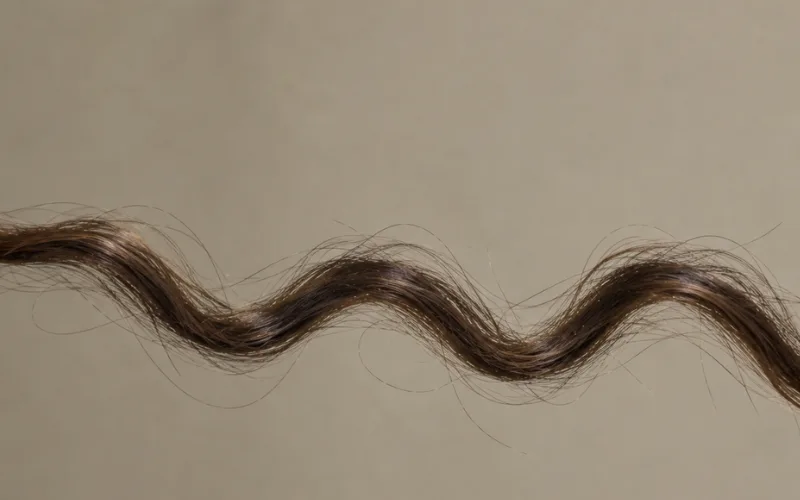
Type 2 hair forms a visible S without forming a spiral. Hold a strand up and the bends travel back and forth on one plane rather than turning around themselves, and that flatness is the whole definition of the family.
It is a curl pattern, not straight hair with bends in it, and treating it as the latter is the most common reason type 2 routines fail. Volumising sprays built for fine straight hair treat the wave as a flaw to smooth, while curl creams sized for type 3 flatten it under their own weight.
What Are Hair Types 1, 2, 3 and 4?
Four families, each describing curl pattern and nothing else. Type 1 has no bend from root to tip. Type 2 waves along a flat plane. Type 3 spirals around an axis into visible loops. Type 4 bends at sharp angles into tight coils.
Each family divides into A, B and C. Andre Walker built the system in 1997 for a mass-market book as a shopping shortcut rather than a scientific instrument, and the hair types guide covers all twelve codes and how to identify yours.
The Three Type 2 Subtypes
| Wave starts | Shape | Holds a style | Main complaint | |
| 2A | Below the ears, often lower | Shallow, open S | Drops within hours | Waves fall out by afternoon |
| 2B | Around the mid-length | Defined S, repeats evenly | Most of a day | Frizz through the lengths |
| 2C | At or near the root | Tight S, occasional loose spiral | Holds well | Volume and frizz to control |
2A hair is the loose end of the family, nearly straight until the last few inches. 2B hair is the middle, with a wave you can see from a few feet away. 2C hair is the coarse end, waving from the scalp with enough density to carry a curl cream.
How Do I Know If My Hair Is 2A or 2B?
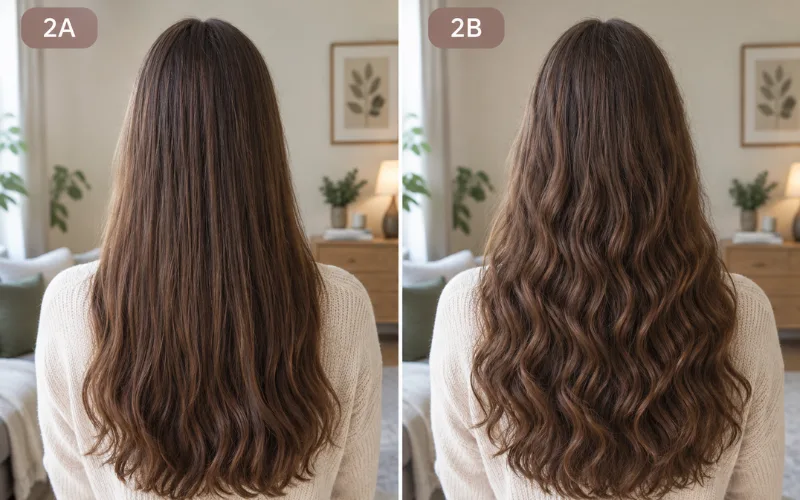
Wash, apply nothing, air dry untouched, then find the highest point on a strand where a bend appears. Waves visible before the ears put the hair at 2B. Waves that only show in the last few inches put it at 2A.
Product tolerance confirms it. 2B collapses under a curl cream where 2C holds against one, and 2A collapses under almost anything heavier than a mousse. Judge dry, since wet hair hangs straighter than it really is and pushes every result one step toward straight.
Where Type 1 Ends and Type 2 Begins
The test is whether the bend repeats. A 1C hair strand bends once or twice and then stops. A 2A strand forms an open S and then forms another one below it.
Strand width runs the other way as a tiebreaker. 1C strands are wide enough to feel when rolled between finger and thumb and 2A strands usually are not. When the two tests disagree, the repeat test wins, because the number records pattern and the letter records width. The hair type quiz reads both separately for that reason.
Type 2 or Type 3?
Dimensional, again. A wave moves in two directions on a flat plane, however tight its bends get. A curl wraps around an axis and forms a closed loop you can see through.
Shrinkage settles the borderline cases. 3A hair typically dries a fifth shorter than it hangs wet because a spiral takes up vertical space, while 2C loses very little. Anyone whose hair loses several inches between the shower and the mirror has crossed into type 3. The hair types chart sets all twelve codes against each other.
What Ethnicity Has Type 2 Hair?
No hair type belongs to an ethnicity, and type 2 is the clearest illustration of why the question does not work. Wavy hair appears across European, Middle Eastern, South Asian, Latin American, East Asian, mixed-heritage and African-descended populations, and the variation inside any one group is wider than the average difference between groups.
Demonstrating that was the purpose of the largest measured study on hair shape. A L’Oreal Recherche team led by Roland de la Mettrie assessed hair from 1,442 people across 18 countries for Human Biology in 2007, replacing the older African, Asian and European groupings with eight categories built from curve diameter, curl index and wave count, because the continental categories failed to describe the range inside each one.
Is Type 2 Hair Rare?
No dataset ranks the twelve codes by prevalence, so claims about any type being rare or common are repetition rather than evidence. Wavy hair is certainly not rare by any reasonable reading of the research, since the measured work finds broad categories well populated across every region studied.
Type 2 does carry one quirk worth knowing. It is the family people most often misidentify themselves out of, because a brush, a blow dry or a heavy conditioner flattens the pattern, and plenty of people who believe they have straight hair have never seen their own waves. The rarest hair type page traces where these claims came from and what the research actually counted.
Why Type 2 Waves Fall Flat
Gravity beats an open S. The bend is wide enough that there is little mechanical interlock holding it, so the weight of the length below slowly pulls it out, and longer hair drops faster than shorter hair for the same reason.
Product weight finishes the job. Anything heavy applied to a shallow wave straightens the pattern within an hour of drying, which is why so many people conclude their waves have vanished when they were flattened.
Pattern itself cannot be trained. A L’Oreal team led by Sophie Thibaut cultured dissected scalp follicles for the British Journal of Dermatology in 2005 and found curved follicles produce curved hair and keep that curvature even grown away from the scalp. A good routine changes definition, clumping and how long the shape lasts. It does not move anyone from 2A to 2B.
How to Care for Type 2 Hair
Wash more often than curly hair guidance suggests. A type 2 shaft is smooth enough for scalp oil to travel down quickly, so most people land at two to four times a week, and the American Academy of Dermatology ties frequency to how oily the scalp actually gets in its healthy hair guidance.
Apply styling product to soaking wet hair rather than damp, since water is what lets sections clump. Scrunch upward, dry without touching, break the cast once fully dry, and diffuse on low or air dry. Detangle only in the shower with conditioner in.
Clarify every three or four weeks. On this family buildup does more damage to wave definition than dryness does.
Type 2 Hair on Men

Length is the deciding factor and almost nobody covers it. Under about three inches an open S cannot complete a repeat, so type 2 reads as an unruly cowlick and gets cut off before the pattern can show.
Past four inches the waves appear on their own. Hair advances at roughly 0.35 millimetres a day, about half an inch a month, so six weeks of growth is enough to see what is really there. Sea salt spray or a light mousse on damp hair brings definition; wax and pomade kill it. Anyone finding the crown looks thinner as waves separate should read that against the thinning hair guide, since a separating wave exposes scalp in a way straight hair does not.
Find where the wave starts, then buy for weight. On type 2 the weight of the product decides whether the pattern survives to the evening.

BeautyLiesTruth publishes hair and personal color guidance built on primary research. Color claims are tested by draping under controlled daylight, and every figure is traced to a published source rather than to another blog.