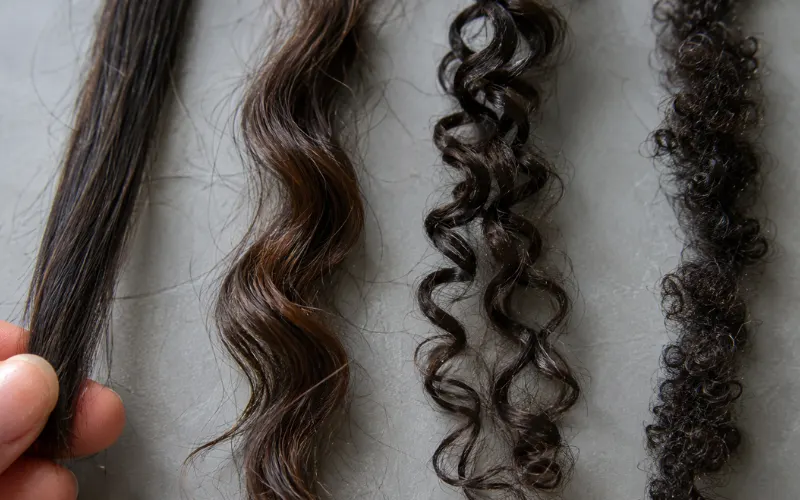
Hair type describes the shape a strand grows in. Four numbered families cover the range, from straight through wavy and curly to coily, and each one splits into three lettered subtypes, giving twelve codes from 1A to 4C.
Knowing the code is useful and it is also the smallest part of the picture. Three other measurements decide which products actually work, and none of them appear on the chart.
What Is a Hair Type?
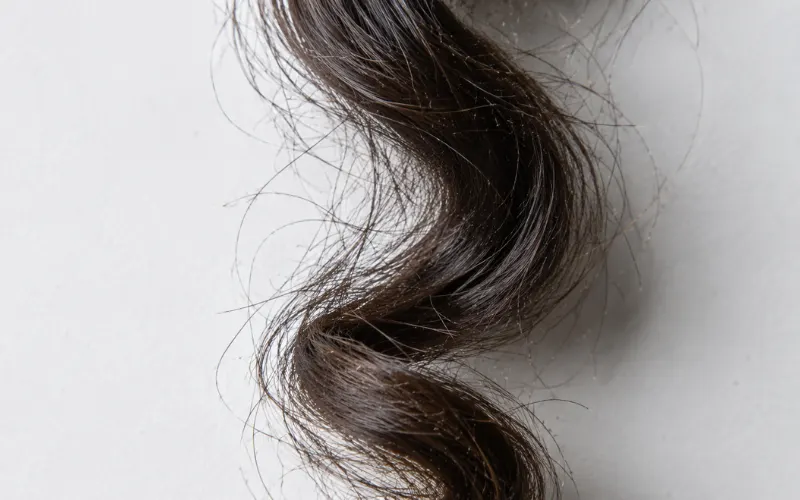
A hair type is a description of curl pattern and nothing else. Type 1 has no bend, type 2 waves along a flat plane, type 3 spirals around an axis, and type 4 bends at sharp angles into coils.
Andre Walker built the system in 1997 for a mass-market book, as a shortcut for choosing products rather than as a scientific instrument. That origin explains both its usefulness and its limits. It is shopping shorthand, and it was never designed to carry the weight now placed on it.
Hair Type Is Not Hair Texture
These two get used interchangeably and they measure different things. Type is the shape of the curl. Texture is the width of a single strand, described as fine, medium or coarse.
The two are independent. Coarse hair grows perfectly straight in plenty of people, and fine hair grows in tight coils in plenty of others. Most product disappointments trace back to this confusion, because weight tolerance follows texture rather than type, and a cream sized for coarse hair will flatten fine hair of the same curl pattern.
The Four Hair Types
- Type 1, straight: No bend from root to tip. 1A hair is pin-flat and drops a curl within two hours, 1B hair has a soft bend at the ends and holds a set most of the day, and 1C hair is coarse enough to frizz in humidity.
- Type 2, wavy: An S that repeats along a flat plane. 2A hair waves from the mid-lengths and elongates by afternoon, 2B hair waves from around the mid-length and holds, and 2C hair waves from the root with visible volume.
- Type 3, curly: A spiral that wraps around an axis. 3A hair curls at about the width of sidewalk chalk, 3B hair at a marker barrel, and 3C hair at a pencil.
- Type 4, coily: Tight coils and zigzags. 4A hair forms a defined S coil, 4B hair bends at sharp Z angles, and 4C hair is the tightest pattern with no visible curl in its natural state.
The hair types chart sets all twelve side by side.
What the A, B and C Letters Mean
Two conventions are in circulation at once, which is the source of most confusion on this topic and something almost no guide mentions.
In curly hair contexts the letter describes how tight the pattern gets within its family, so 3A is a loose ringlet and 3C a corkscrew. In type 1 and type 2 contexts the letter is commonly used for strand width and density instead, running low at A through high at C, so 1A means fine and 1C means coarse.
Both readings appear in the same search results. When one chart calls 1C the waviest straight type and another calls it the thickest, they are describing the same hair with different rulers. The number is the reliable part of the code. The letter is not.
How Do I Identify My Hair Type?
Wash, apply nothing, and let the hair air dry untouched. No towel scrunching, no brushing while damp, no diffuser. Product residue and mechanical handling both distort the pattern, and wet hair hangs straighter than it really is, which is the single most common cause of a wrong result.
Then read one strand from mid-length to end. A strand with no bend anywhere is type 1. A bend that repeats along a flat plane is type 2. A strand that turns around itself into a visible loop is type 3. A strand that changes direction at sharp angles is type 4.
Diameter sets the letter within types 3 and 4. Compare a single curl against a household object: sidewalk chalk, a marker, a pencil, a crochet needle. The hair type quiz runs the same checks alongside the three measurements below.
The Three Things the Chart Does Not Measure
- Strand width: Roll a single hair between finger and thumb. If you cannot feel it, it is fine; if it feels wiry, it is coarse. This decides how much product weight the hair can carry before it collapses.
- Density: How many strands grow per square centimetre, which is a separate question from how thick each one is. Part the hair and look at how much scalp shows. Thin coverage and coarse strands frequently occur together.
- Porosity: How readily the cuticle admits and holds moisture. Low-porosity hair resists absorption and product sits on the surface; high-porosity hair absorbs fast and loses it just as fast. This governs the order products go on in, and on type 3 and type 4 hair it matters more than the code does.
Am I Type 3 or 4? Do I Have 2C or 3C?
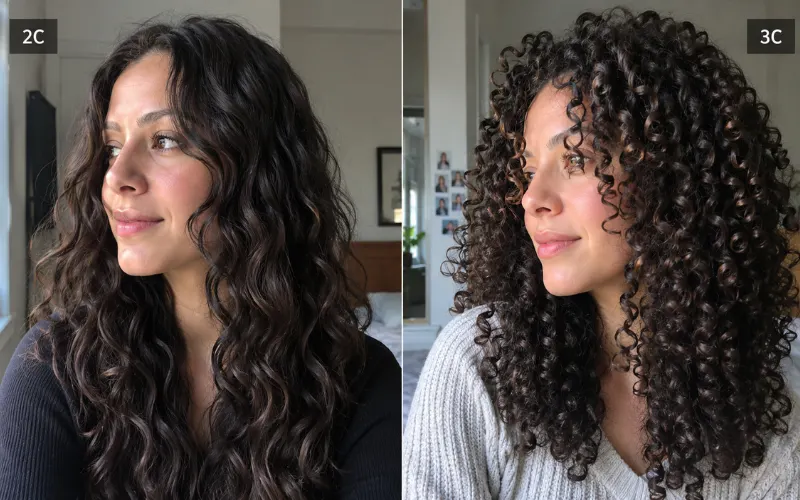
Almost every identification question is a boundary question, and the boundaries are where the system is weakest.
Between type 2 and type 3, ask whether the strand lies flat or wraps. A wave zigzags on a plane even when the bends are tight; a curl forms a closed loop with a visible circumference. Between type 3 and type 4, ask whether the turn is rounded or angular. A 3C spiral holds a curved path; a 4A coil has corners.
Shrinkage is the test to distrust. The published ranges overlap between adjacent codes, and density, porosity, product weight, drying method and humidity all shift a reading. Use shrinkage to set expectations about length, not to pick a code.
Is 4C the Rarest Hair Type?
Nobody knows, and no published dataset ranks the twelve codes by prevalence. Every confident claim about the rarest or most common type is repetition rather than evidence.
The measured research uses a different system entirely. A L’Oreal Recherche team led by Roland de la Mettrie assessed hair from 1,442 people across 18 countries for Human Biology in 2007 and produced eight categories built from curve diameter, curl index and wave count. None of them are Walker codes, so nothing in that work counts 1A against 4C.
Hair Types for Men
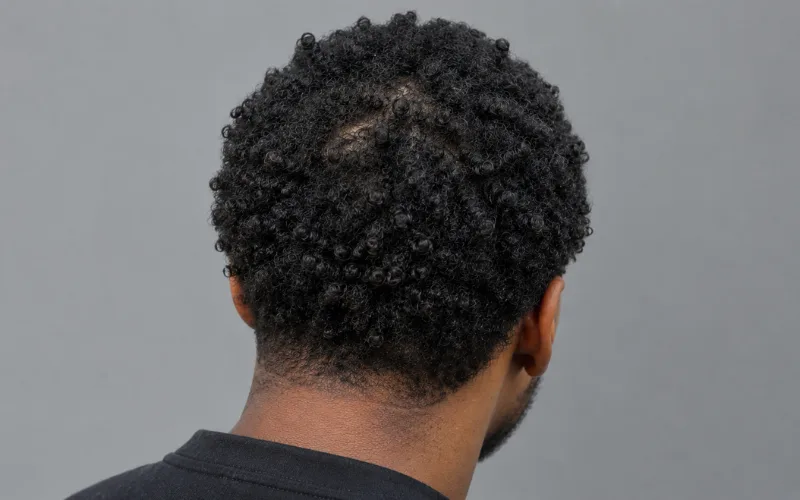
The same twelve codes apply, with one complication. Short hair hides curl pattern, because a wave or curl needs enough length to complete a full bend. Under about two inches, a 2A or even a 2B head reads as straight.
Judge from the crown or the back where the hair sits longest, or grow it out for six weeks first. Hair advances at roughly 0.35 millimetres a day, about half an inch a month, so six weeks is enough to see the truth. Anyone noticing scalp through the top should read that against the thinning hair guide rather than the typing chart, since texture and early loss look similar in a mirror.
Why Your Hair Type Can Change
Pattern is set below the skin. A L’Oreal team led by Sophie Thibaut cultured dissected scalp follicles for the British Journal of Dermatology in 2005 and found that follicles growing curved hair were themselves curved, bent at the bulb, and kept that curvature even when grown away from the scalp. Straight-hair follicles were straight.
So pattern cannot be trained by a routine. It does shift over years, since hormones, pregnancy, medication and age all change what the follicle produces, and chemical processing changes the fibre permanently. A result from five years ago may no longer describe what is growing now.
What to Do Once You Know
Buy for weight and porosity rather than for the code. Wash frequency follows how oily the scalp actually gets rather than a fixed schedule, which is how the American Academy of Dermatology frames it in its healthy hair guidance too.
The code narrows the shelf. The three measurements pick the bottle.
BeautyLiesTruth publishes hair and personal color guidance built on primary research. Color claims are tested by draping under controlled daylight, and every figure is traced to a published source rather than to another blog.