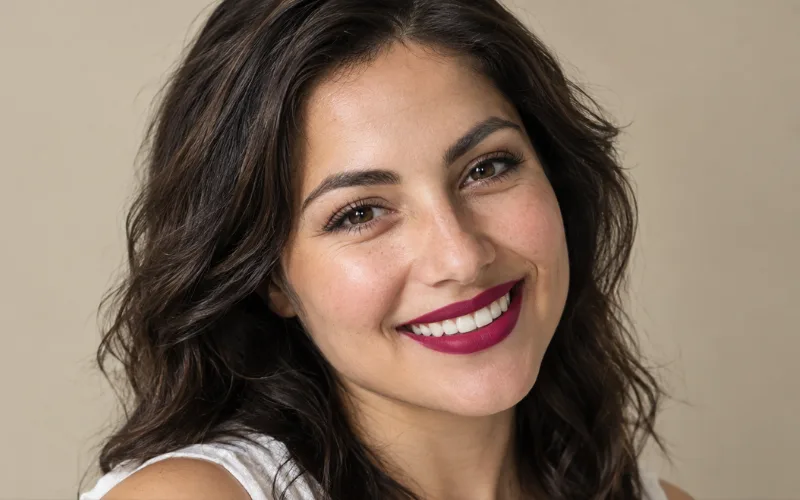
Teeth look whiter beside colors that push against yellow: blue-based reds, berry and plum lips, and deeper, cooler hair around the face. Nude, beige, caramel and orange-based shades do the opposite. When 100 observers scored the same smiles with and without five lipstick shades, nude scored darkest and red and violet scored whitest.
Most people try to fix a dull smile with whitening strips. Colorists look at the frame first, because nobody ever sees a tooth on its own. It sits between two lips, inside a face, under a head of hair, and the eye judges its color against all three. Change that frame and the same enamel reads brighter or yellower.
Why the frame changes the color of your teeth
Tooth color is judged in context. Researchers in Cluj-Napoca, Romania photographed four women smiling in beige, violet, dark red, bright red and brown lipstick, plus bare lips, then asked 100 people to score tooth whiteness from 1 to 6, according to the study archived in PubMed Central. The teeth never changed. The scores did.
Yellow is the problem, and blue-violet sits directly opposite it on the color wheel. That is why purple shampoo cancels brass in blonde hair, and toothpaste makers use the identical trick. Blue covarine, a pigment the FDA and EU allow in toothpaste, leaves a faint blue-violet film on enamel that counteracts yellow and makes teeth read whiter straight after brushing, per a systematic review and meta-analysis. Like a toning shampoo, it works on the surface rather than changing the color underneath.
Lip colors that make teeth look whiter
Blue-based reds, berry, plum, fuchsia and cool pinks all push against yellow. When 212 raters in Thailand scored smiles wearing red, pink and orange lipstick, the red with blue-purple undertones was rated most attractive, and the authors of the International Journal of Dentistry study credited that undertone with offsetting yellow in both skin and teeth.
Nude, beige, caramel, coral and orange-reds sit on the yellow side of the wheel and drag the teeth with them. An earlier study by Reno and colleagues found magenta lifted perceived whiteness while yellow tones did not, so undertone matters more than depth.
Spring and autumn are the warm color seasons; summer and winter are the cool ones, and some widely shared lipstick guides swap them. As practitioner judgement rather than a tested finding: summers and winters can wear blue-reds freely, while springs and autumns look best in the deepest, reddest shade inside their warm palette. The color season quiz gives a starting direction.
Hair colors that make teeth look whiter
Hair is the largest color field around the face, so it behaves like an oversized lipstick. Colgate’s makeup guidance notes that teeth look whiter set against darker hair, and that a single flat, pale color all over tends to draw the eye to off-white teeth, where highlights that add dimension help.
No study has tested hair color and tooth shade directly, so the points below apply the lip findings through standard color theory:
- Brassy or golden tones near the face add yellow to the frame. On blonde hair, keeping the tone neutral or cool matters more than which blonde you pick.
- Espresso, ash brown, blue-black and cool burgundy give the most contrast. Honey, gold and copper warm everything, so if you love them, keep the face-framing pieces a shade deeper.
- Silver and gray hair is bright and cool, which can make off-white teeth look yellower by comparison. A deeper cool lip rebuilds the contrast. There is more on supporting skin and hair as they age.
- Before committing to a new shade, preview it on a selfie with a free hair color app and check the smile in the same photo.
Skin tone decides how white is too white
Deeper skin already gives teeth contrast, so the whitest shade on a dental chart does not suit everyone. In a King Saud University study of 336 people shown the same smiles digitally set against four skin tones, 49.1% chose the brightest bleach shade for the fair female face. On the deepest tone tested, the top pick was B1, a natural shade, at 26.5%, and the authors concluded that the brightest bleach shades can look unnatural on darker skin. It covers one population in one country, so treat it as a direction rather than a rule.
In practice, find your depth on the skin tone chart before setting a whitening goal. By the same color logic, silver cools the frame around a smile and yellow gold warms it, as the guide to jewelry metals for your undertone explains, while a stark optic-white collar can make off-white teeth look yellower by comparison. It is one more reason to know what colors look good on you.
When color tricks are not enough
Makeup and hair change how teeth read. They do not change the enamel. Peroxide whitening lightens natural enamel, while chips, small gaps and a single darker tooth are usually handled with cosmetic bonding.
Bonding usually takes one visit. The dentist matches tooth-colored composite resin to a shade guide, prepares the surface with a one-step dental bonding adhesive, a single self-etching coat that lets the resin grip the enamel, then sculpts the composite and cures it under a blue light. Cleveland Clinic puts the lifespan of bonding at three to 10 years.
If you want both treatments, the order matters more than anything else. Composite resin does not respond to peroxide, so whiten first and bond second. Bond first and the repaired tooth stays at your old shade while the rest of the smile lightens around it. After that, the teeth protection tips guide helps keep both stain-free.
Questions people ask about this
What hair color makes your teeth look whiter?
Deeper, cooler shades such as espresso, ash brown, blue-black and cool burgundy give the most contrast. Blonde does not make teeth look yellow by itself, but brassy blonde can, so on blonde hair a neutral or cool tone matters more than the base shade.
What lipstick color makes teeth look yellow?
Nude, beige, caramel, coral and orange-based reds. In a 100-observer study, nude lipstick scored lowest for tooth whiteness while red and violet scored highest.
Should you whiten before or after dental bonding?
Before. Composite resin does not whiten, so bonding placed first stays at your old shade while the teeth around it lighten.
What tooth shade looks most natural?
It depends on skin depth. In a 336-person study, the brightest bleach shades were preferred on fair skin and natural shades such as B1 and A1 on deeper skin.
BeautyLiesTruth publishes hair and personal color guidance built on primary research. Color claims are tested by draping under controlled daylight, and every figure is traced to a published source rather than to another blog.