
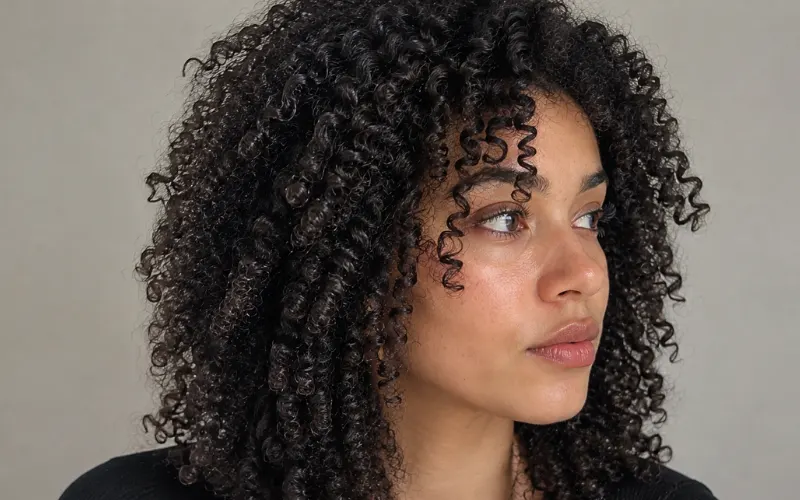
Type 4 is coily hair. Instead of waving on a flat plane or spiralling into loops, the strand folds at sharp angles into tight coils and zigzags, and it does so from the scalp outward.
The three subtypes differ in how visible that pattern is. 4A shows defined coils on its own, 4B shows a sharp Z when a strand is stretched, and 4C often shows no repeating shape at all until product or stretching brings it out.
What Is Type 4 Hair?
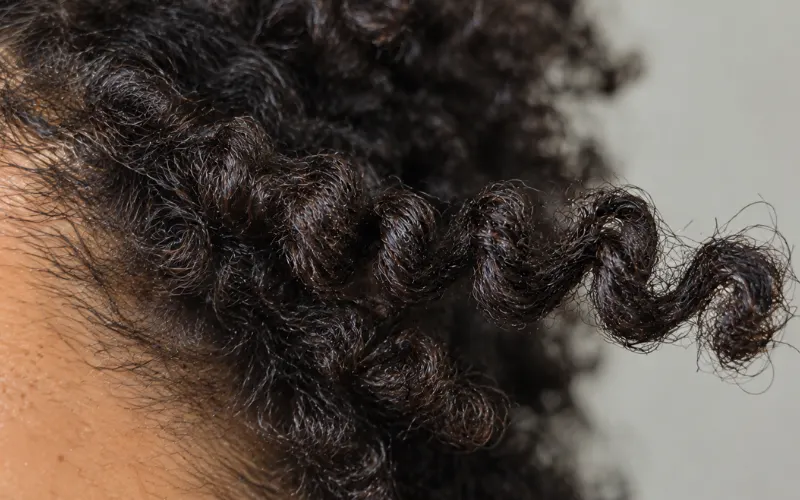
Type 4 hair forms tight coils or zigzags that begin at the root and pack densely together. It grows outward from the head before it grows down, carries more volume than any other family, and shrinks more than any other family between wet and dry.
The fold is the defining trait. Where a curl turns around a smooth path, a type 4 strand changes direction at angles, which is why it scatters light rather than reflecting it and why matte hair on this type is structural rather than a sign of poor condition.
What Are Type 1, 2, 3 and 4 Hair?
Four families, each describing curl pattern and nothing else. Type 1 has no bend. Type 2 waves along a flat plane. Type 3 spirals around an axis. Type 4 folds at sharp angles into coils.
Andre Walker built the system in 1997 for a mass-market book, as a shopping shortcut rather than a scientific instrument. The hair types guide covers all twelve codes and how to identify yours.
The Three Type 4 Subtypes
| Pattern | Visible without product | Comparison | Typical shrinkage | |
| 4A | Rounded S coil, springy | Yes, coils show clearly | Crochet needle | 50 to 60 percent |
| 4B | Sharp Z, bends at angles | Partly, clumps in sections | Pen tip | 50 to 75 percent |
| 4C | Very tight zigzag, no consistent coil | Rarely | No clear equivalent | Up to 75 percent |
4A hair is the most defined of the three, with coils you can trace with a finger. 4B hair bends rather than curves, reading as cottony and full. 4C hair is the tightest pattern on the whole chart and the one most often mistaken for having no pattern at all.
How to Tell If You Have 4A, 4B or 4C Hair
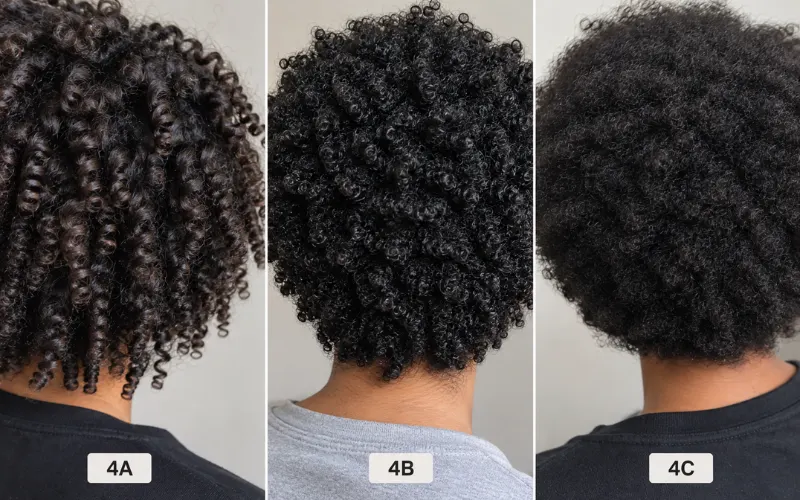
Stretch a single clean, dry strand and look at the shape it holds before springing back. A rounded S means 4A. A Z with fairly regular angles means 4B. A fine zigzag with little consistency between bends means 4C.
Visibility without product is the fastest check. 4A shows its coils on wash day with nothing in it. 4B shows texture and volume but no clear repeating coil until stretched. 4C rarely shows definition at all in its natural state.
The 4B and 4C boundary is soft, and plenty of heads carry both. The routine that suits one generally suits the other, so landing between them is not a problem to solve. The hair type quiz reads pattern alongside width, density and porosity, and on this family porosity decides product choice far more than the letter does.
Am I Type 3 or 4?
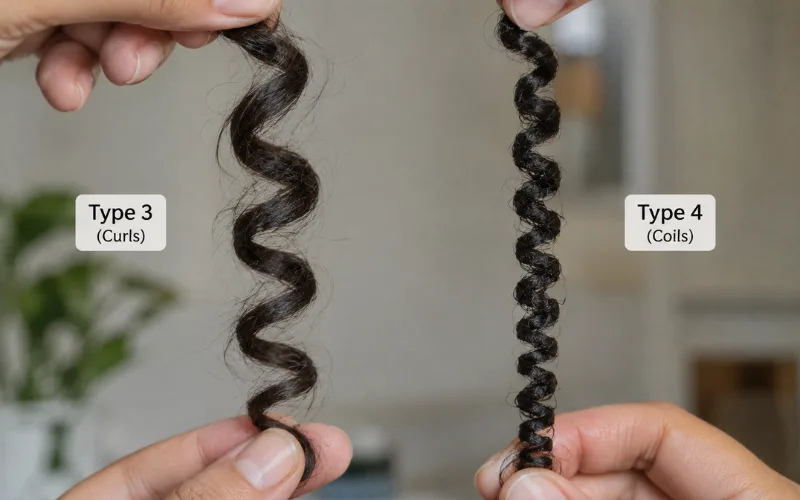
Rounded or angular. A 3C hair spiral keeps a smooth curved path through each turn. A 4A coil has corners, so stretching a strand reveals an S with angles rather than a continuous loop.
Feel settles what the eye cannot. Type 4 compresses between the fingers and rebounds with a spongy resistance, while type 3 simply springs back. Avoid using shrinkage here, since 3C commonly loses about half its length and 4A between fifty and sixty percent, so the ranges overlap. The type 3 hair guide covers the curly family from the other side, and the hair types chart sets all twelve codes side by side.
Is There a 4D, 4Z or 5C?
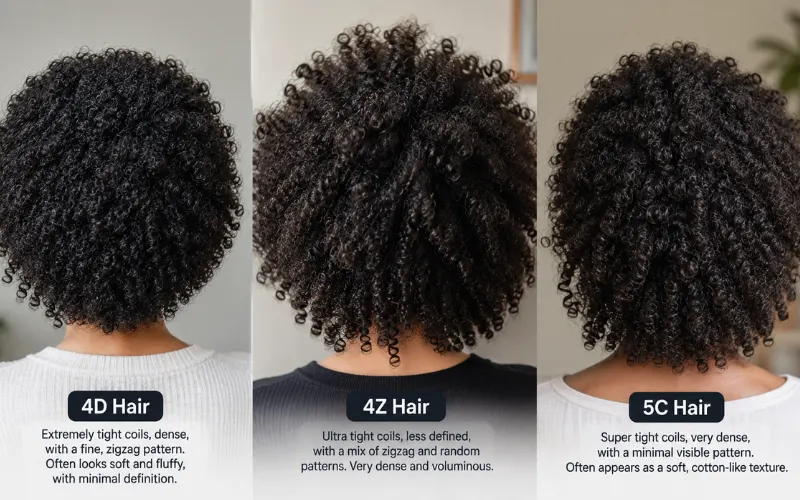
No. The chart ends at 4C, and none of those codes exist in any version of the system, despite steady search volume for all three.
They circulate because 4C is the last label available for a very wide range of real textures, so people reach past the end of the scale to describe what they actually have. That is a genuine limitation of the system rather than a gap in anyone’s knowledge. Worth knowing too that 4C itself was not in Walker’s original scale, which stopped at 4B. It was added later by the Black natural hair community, which found the existing codes inadequate for describing their own hair.
What Ethnicity Has Type 4 Hair?
No hair type belongs to an ethnicity. Type 4 patterns are most commonly discussed in the context of Black hair, and the typing system reached wide use through that community, but coily hair also occurs across Melanesian, Papuan, Caribbean, Latin American and mixed-heritage populations, with more variation inside any one group than between groups on average.
That was the finding the largest measured study on hair shape was built to establish. A L’Oreal Recherche team led by Roland de la Mettrie assessed hair from 1,442 people across 18 countries for Human Biology in 2007 and replaced the older continental groupings with eight categories built from curve diameter, curl index and wave count, because those groupings failed to describe the range inside each one.
Why Type 4 Is Dry and Fragile
Each fold in the strand is a stress point. When hair is pulled, force concentrates at those corners instead of distributing along a curve, and cracks start there. A L’Oreal study of breakage recorded that 96 percent of African-American respondents in its survey experienced breakage, and reported that the chemical composition of that hair is not significantly different from other groups. The difference comes from fibre geometry and grooming stress. The hair is not weaker material.
Dryness compounds it. Scalp oil travels a hair shaft by contact, and a strand that changes direction every millimetre offers no continuous path, so the ends receive almost nothing. Dry fibre cracks at lower loads than conditioned fibre, which makes dryness and breakage the same problem.
How to Care for Type 4 Hair
Work in sections, soaking wet, with conditioner heavy enough that fingers pass through without catching, and detangle from the ends upward. Never detangle dry. This single habit retains more length on type 4 than any product.
Cleanse roughly weekly, co-washing in between if the hair feels stripped. The American Academy of Dermatology ties frequency to how oily the scalp actually gets in its healthy hair guidance, and dense coils hide scalp oil for a long time, so judge by the scalp rather than the hair.
Weight is an asset on this family. Rich creams, butters and thick conditioners work here where they would flatten anything in types 1 to 3. Layer liquid, oil and cream in the order porosity dictates, deep condition weekly, and clarify every three or four weeks, since layered products build up quickly. The natural shampoo guide covers which cleansers clear residue without stripping.
Protective styles help, and scalp tension is the variable to watch. Tensile testing found that at low and moderate twist levels hair recovers its mechanical properties, so braids and twists are not damaging in themselves. Pulling them tight at the hairline is.
Type 4 Hair Growth
Coil pattern has no effect on growth rate. Scalp hair advances at about 0.35 millimetres a day, roughly half an inch a month and six inches a year, the same on type 4 as on straight hair.
Length appears to stall because of arithmetic and breakage. At up to seventy-five percent shrinkage, a year of growth can show as an inch and a half, and breakage at the folds removes length from the ends at a similar rate to what the root adds. Retention is the entire problem, and it responds to moisture, sectioned handling, stretched and protective styles, and trimming damaged ends.
Type 4 Hair Colour
Colour on type 4 carries a cost the looser families do not pay. Lightening raises the cuticle on hair already dry by structure and already concentrating stress at every fold, so bleached type 4 breaks more readily than virgin hair under the same handling.
Depositing colour without lift is the lower-risk route. If lightening is the goal, spacing sessions further apart and treating deep conditioning as routine does more than any repair claim, and toning becomes part of the schedule, which is what purple shampoo handles.
Type 4 Hair on Men
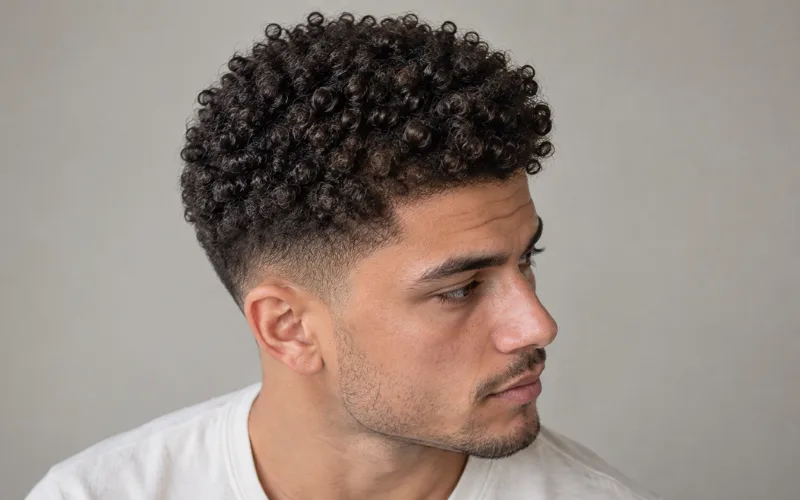
Length is never the constraint, since the pattern shows at any length. Width, shape and moisture are the questions.
Ask a barber to shape rather than clipper to a uniform guard, and to cut dry, because hair that shrinks by up to three quarters produces a result nobody predicted when cut wet. A leave-in and a cream on damp hair softens and defines it; a brush turns the pattern into frizz and takes ends with it. Moisturise at night rather than in the morning, keep a durag or bonnet in the routine, and keep braids loose at the hairline. Anyone seeing thinning at the temples or crown will get more from the thinning hair guide than from any typing chart, since traction loss and pattern loss look alike and need opposite responses.
Identify by what a stretched strand does, then build the routine around porosity and handling. On type 4, how the hair is touched decides more than what goes on it.

BeautyLiesTruth publishes hair and personal color guidance built on primary research. Color claims are tested by draping under controlled daylight, and every figure is traced to a published source rather than to another blog.