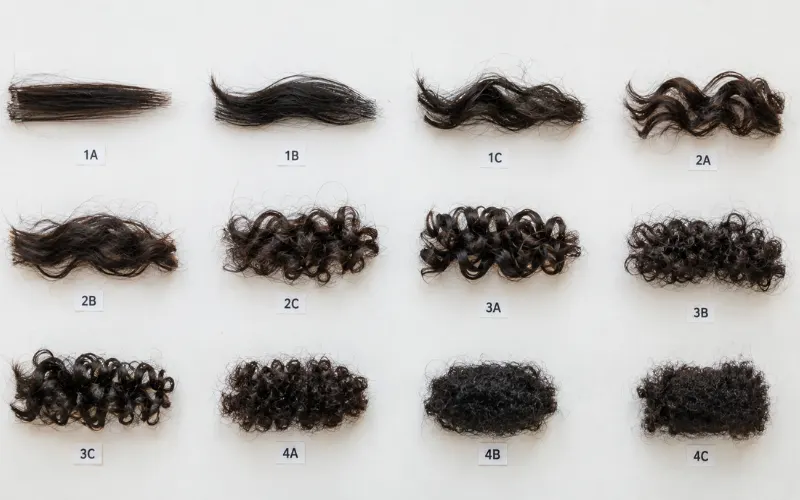
Men’s hair falls into the same twelve types as anyone else’s, from pin-straight 1A to tightly coiled 4C. What differs is how hard it is to read them, because most men wear their hair shorter than the length a pattern needs to show itself.
That single fact explains most of the confusion around men’s hair types. A wave needs room to complete a bend, and a crop that stops at an inch often never gives it any.
What Hair Type Means for Men
Hair type describes the shape a strand grows in and nothing else. Type 1 has no bend, type 2 waves along a flat plane, type 3 spirals into loops, and type 4 folds at sharp angles into coils. Each splits into A, B and C, giving twelve codes.
Andre Walker built the system in 1997 for a mass-market book as a shopping shortcut rather than a scientific instrument, and it was never adjusted for short hair. The hair types guide covers the full system.
Why Short Hair Hides Your Hair Type
A wave or curl needs a minimum length to complete one full bend. Below that length the pattern cannot form, so the hair reads straighter than it really is. A 2A or 2B head cut to an inch looks like 1A. A 3A head cut close reads as thick and unruly rather than curly.
The threshold depends on how tight the pattern is. Loose waves need several inches; tight coils show at almost any length. That is why so many men with wavy hair believe they have straight hair, and why a new haircut sometimes seems to change the texture overnight.
How Do I Identify My Hair Type as a Man?
Judge the longest hair on your head, not the sides. The crown and the back usually carry the most length and give the truest reading.
Wash, apply nothing, and let the hair air dry untouched, with no towel rubbing and no brushing. Wet hair hangs straighter than it really is and product flattens pattern, so both push a result toward straight. Then read one strand from mid-length to end.
If everything is cut too short to tell, grow it out for six weeks. Scalp hair grows at roughly 0.35 millimetres a day, about half an inch a month, which is enough to reveal most patterns. The hair type quiz asks about how your hair behaves rather than how it looks in a photo, which is also why typing from a selfie, by AI or otherwise, is unreliable: lighting, product and length all distort what a camera sees.
Men’s Hair Types Chart: 1A to 4C
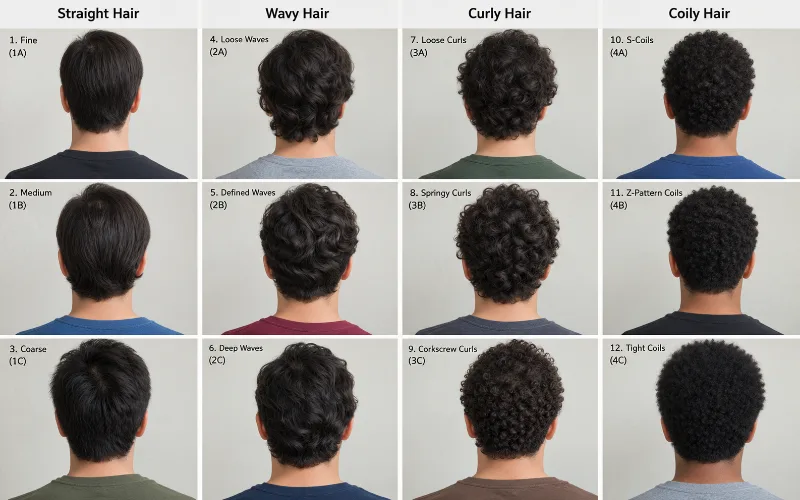
The length column is approximate, drawn from how long each pattern typically needs to complete a bend. Treat it as a guide to when a reading becomes trustworthy rather than a measurement.
| Type | What it looks like | Length before the pattern reads reliably |
| 1A | Pin-straight, fine, flat to the scalp | Any length |
| 1B | Straight with a soft bend at the ends | About two inches |
| 1C | Straight and coarse, one or two bends | About two inches |
| 2A | Loose, open S from the mid-lengths | Four inches or more |
| 2B | Defined S from around the mid-length | Four inches or more |
| 2C | Tight S starting at the root | About two inches |
| 3A | Loose spiral, sidewalk-chalk width | Four inches or more |
| 3B | Springy ringlet, marker width | One to two inches |
| 3C | Tight corkscrew, pencil width | About an inch |
| 4A | Defined S coil, crochet-needle width | Any length |
| 4B | Sharp Z bends, cottony | Any length |
| 4C | Tightest zigzag, no consistent coil | Any length |
Do I Have 1A, 1B or 1C Hair?
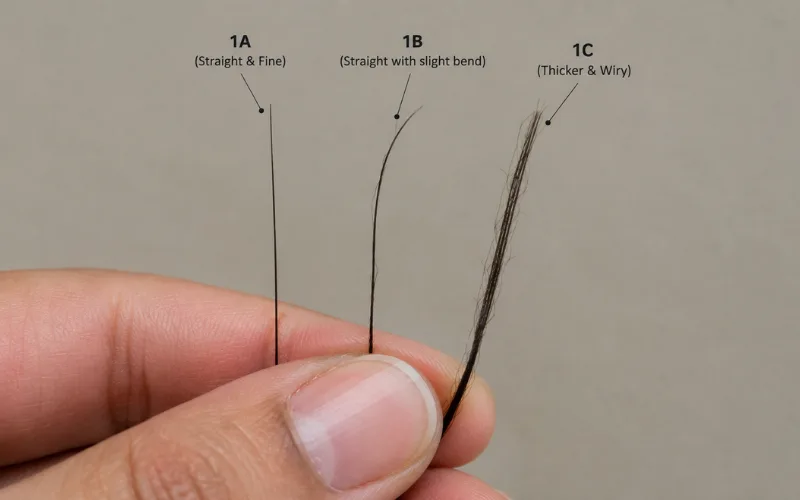
Roll a single hair between finger and thumb. Too fine to feel means 1A or 1B; distinctly wiry means 1C. Then check the ends: a soft bend separates 1B from pin-flat 1A.
On straight hair the letter mostly tracks strand width rather than pattern, since there is no pattern to tighten. The type 1 hair guide compares the three side by side.
Is My Hair 2A, 2B or 2C?
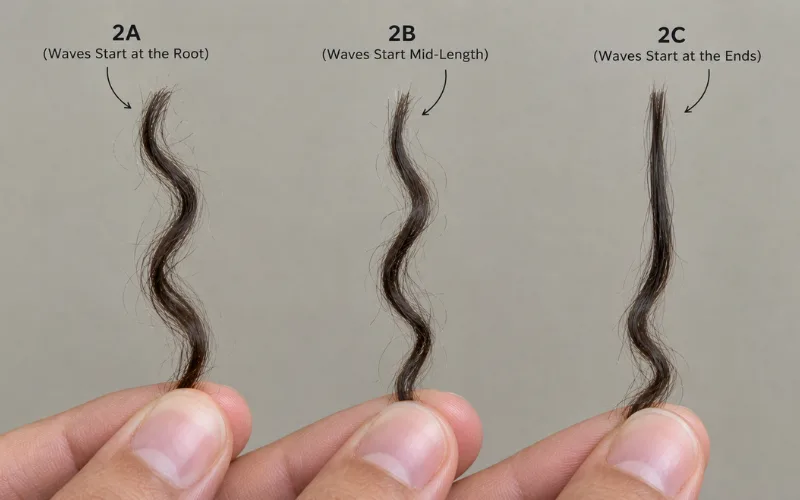
Find the highest point on a dry strand where a bend appears. A wave that starts at the root is 2C. One that starts around the mid-length is 2B. One that only appears in the last few inches is 2A.
This is the group most often misread on men, because 2A and 2B need the most length to show. The type 2 hair guide covers where each one starts and how to tell them apart.
Wavy or Curly? The Line Most Men Misread
A wave moves back and forth on a flat plane, however tight its bends get. A curl wraps around itself and forms a loop you can see through. That is the whole distinction, and it has nothing to do with how much volume the hair has.
Men misread it in both directions. Short wavy hair can look curly because a crop leaves only the tightest bend at the ends, and short curly hair can look wavy because a spiral cut before it completes a turn reads as a kink. The honest test uses the longest section of hair, dry and product free, and looks for a closed loop rather than a bend.
Curly and Coily Hair on Men
Types 3 and 4 show their pattern at shorter lengths, so identification is easier and the practical questions shift to width, shaping and moisture. Measure one curl against a household object: sidewalk chalk for 3A, a marker for 3B, a pencil for 3C. The type 3 hair guide covers the curly family.
Type 4 patterns are most commonly discussed in the context of Black men’s hair, though coily hair occurs across many populations. A L’Oreal Recherche team led by Roland de la Mettrie measured hair from 1,442 people across 18 countries and found variation inside every group wider than the differences between them. One finding is worth stating plainly: a L’Oreal breakage study reported that the chemical composition of this hair is not significantly different from other hair. Its fragility comes from the shape concentrating stress at each fold, not from weaker material. The type 4 hair guide covers care.
Texture, Thickness and Density
The chart measures shape. Three other measurements decide which products actually work, and none of them appear on it.
Texture, often called thickness, is the width of a single strand. Roll one hair between finger and thumb: too fine to feel means fine, distinctly wiry means coarse. Density is how many strands grow per square centimetre, which is a separate question entirely, so coarse strands and low density often occur together and read as thick hair up close and thin hair from above. Porosity is how readily the strand absorbs and holds moisture, and it matters most on curly and coily hair.
Density is the one to watch on men, because it is the measurement that changes first when thinning begins.
What Determines Your Hair Type
The follicle, not the strand. Several men’s grooming guides state that curl comes from the cross-sectional shape of the hair shaft, oval for curly and round for straight. That is a persistent misconception.
A L’Oreal team led by Sophie Thibaut dissected and cultured scalp follicles for the British Journal of Dermatology in 2005 and found that follicles producing curly hair were themselves curved, bent at the bulb, and kept that curvature even when grown away from the scalp. Straight-hair follicles were straight. So pattern is set below the skin, and no product or routine changes it.
How Thinning Changes Your Hair Type Reading
This is the part almost no guide covers, and it affects most men eventually. Androgenetic alopecia affects approximately 50 percent of men by age 50 and 80 percent by age 70, and sons of fathers who went bald carry five to six times the relative risk.
The condition shortens the growth phase and miniaturises follicles, which produces progressively finer, shorter hairs.
Finer strands read as a lower letter, so a man who was once 1C can start reading as 1B or 1A as thinning progresses, and shorter growth cycles make it harder for any pattern to reach the length it needs. A changing hair type in your thirties is sometimes the first visible sign of thinning rather than a change in texture. The thinning hair guide covers what to do about it.
Hair Types for Boys
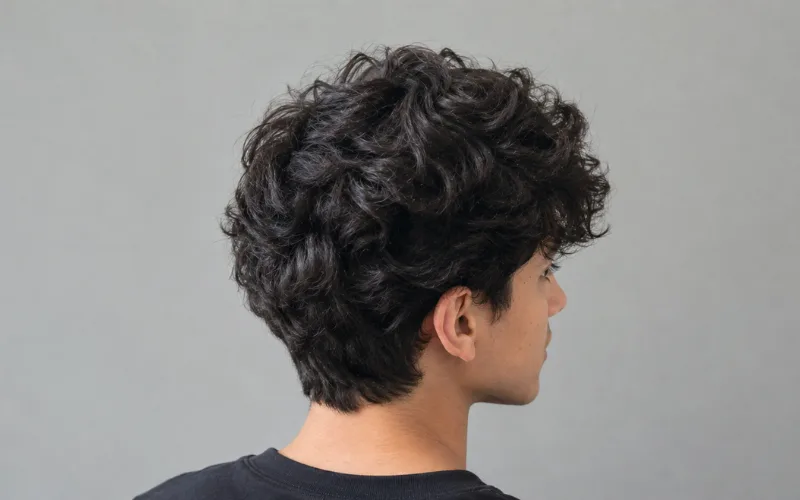
The same chart applies, with one caveat. Hair texture commonly shifts through puberty as hormone levels change, so a boy’s hair type is not necessarily the one he keeps. Straight hair that turns wavy in the early teens, or loose curls that tighten, are both ordinary.
Type a boy’s hair the same way as anyone else’s, from the longest section, dry and product free, and expect to check again after puberty.
What Is the Most Attractive Hair Type for Guys?
No study ranks curl types by attractiveness, and preferences vary too much between people for one to exist. What does hold up consistently is that hair cut and styled for its actual type reads better than hair forced against it.
Straight hair cut to hold a sharp line, waves given the length to form, curls cut dry so they fall evenly, and coils shaped rather than clippered to a uniform guard all look deliberate. Most unflattering men’s hair is a mismatch between cut and pattern rather than a problem with the pattern itself.
What Is the Rarest Men’s Hair Type?
No study has counted the twelve types in men or anyone else, so every answer to this question is repetition rather than evidence. 1A is the usual claim, and it traces back to beauty sites copying one another rather than to any dataset. The rarest hair type page covers where the claim came from and what the measured research actually counted.
Haircuts and Styling by Hair Type
Weight is the variable that changes across the chart. Straight hair collapses under heavy product, so clay and paste over wax and pomade. Wavy hair needs a light mousse or sea salt spray on damp hair to bring the pattern forward. Curly hair takes a cream for definition, applied wet and left untouched to dry. Coily hair carries rich creams and needs moisture before bed rather than in the morning.
Cuts follow the same logic. Straight hair holds sharp lines, which suits crew cuts, side parts and textured crops, and fine straight hair looks denser cut blunt than layered. Wavy hair needs length on top to show, so a longer top with shorter sides, a quiff or a flow cut works where a short crop erases the wave. Curly hair suits a curly fringe, a taper, or a curly top with faded sides. Coily hair suits a shaped afro, a high-top, twists or a taper. Curly and coily hair are both better cut dry and shaped with scissors than taken down with one clipper guard, since hair that shrinks by half or more between wet and dry produces a result nobody predicted when it is cut wet.
Read the longest hair you have, allow it enough length, and buy for weight. On men’s hair the length you wear it at decides how much of your type you ever get to see.
BeautyLiesTruth publishes hair and personal color guidance built on primary research. Color claims are tested by draping under controlled daylight, and every figure is traced to a published source rather than to another blog.