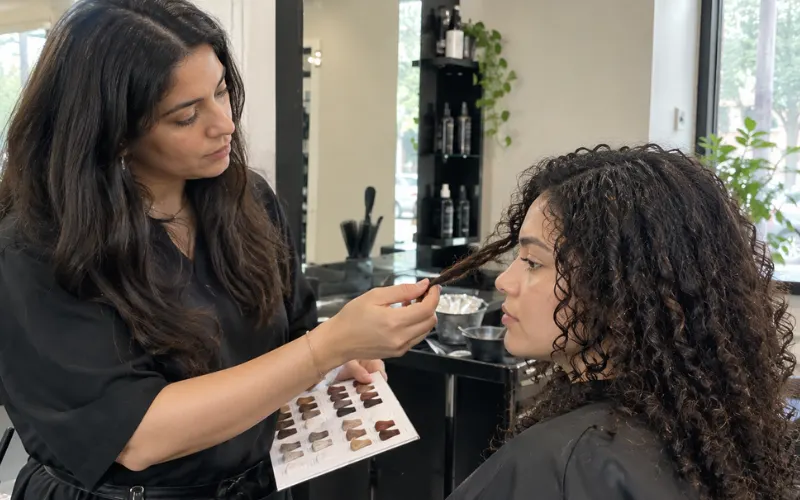
A colorist worth booking for a trend asks about your hair history, patch tests the dye, strand tests anything risky and tells you honestly how many sessions the look will take. Check the license with your state board too. In Georgia, most renewals require continuing education in health and safety.
A shade can go from one video to a hundred salon requests in a week. The screenshot shows the finished color. It does not show the patch test, the three lightening sessions or the breakage risk behind it, and the gap between a colorist who keeps up and one who simply says yes usually shows in the first ten minutes of the consultation.
What a good colorist asks first
Before mixing anything, a careful colorist builds a picture of what is already on your hair and your scalp. Expect questions like these:
- What has been on your hair in the last two years? Box dye, henna, relaxers, keratin smoothing and old bleach all change how new color lifts and holds. The FDA also advises waiting at least 14 days after bleaching, relaxing or perming before dyeing.
- Have you ever reacted to hair dye, or had a black henna tattoo? The FDA notes that temporary tattoos sold as black henna contain PPD, the dye ingredient most often behind hair color allergies, and can raise the risk of reacting to hair dye later.
- How is your scalp today? The FDA advises against dyeing hair on an irritated, sunburned or damaged scalp, and against scratching or brushing it for three days beforehand.
- What is your hair type? Texture and porosity change how fast color takes and how much lightening a strand can stand. The hair type quiz is a useful starting point, and tightly coiled hair such as 4C usually needs a gentler lightening plan because it breaks more easily.
- How much upkeep do you want? Platinum and vivid shades can mean a toner or gloss every few weeks.
The history, texture and upkeep questions reflect standard colorist practice rather than a published rule; the scalp and timing advice is the FDA’s.
The two tests that separate careful from careless
The patch test comes first. The FDA’s consumer guidance is to rub a little of the dye inside the elbow or behind the ear, leave it for two days and repeat it every time, and it adds that salons should do the same.
It matters because PPD is in most permanent hair color. A review in PubMed Central puts PPD allergy at 0.3% to 1.5% of the general population and 6.2% of North American patients patch tested for dermatitis. The FDA also warns that sensitivity can build with repeated use, so years of dyeing without trouble is no guarantee.
The strand test is the colorist’s own check. A small section from underneath is processed first to see how old color or henna lifts before the whole head is committed. A salon that skips both for a first-time client’s permanent color is cutting a corner that matters.
Which trends need a plan, not a promise
- In colorist practice, platinum or icy blonde from dark or box-dyed hair usually takes more than one appointment. One-sitting promises tend to be paid for in breakage.
- Brow and lash tints are their own category. The FDA reports that permanent brow and lash dyes have caused serious eye injuries, including blindness, and provides only for silver nitrate products, sold for professional use, to color them. Hair dye should never go near the eyes.
- A shade can be on trend and still wrong for your coloring. Checking your color season, or which colors look good on you, before the appointment, and previewing the shade on a selfie with a free hair color app, costs far less than a correction.
Good colorists rarely refuse a trend outright. They suggest a softer version, a staged plan, or a gloss to test the direction first.
What a license tells you, with Georgia as the example
Cosmetology is a licensed profession, and most state boards let anyone check a license online. In Georgia, the Secretary of State’s licensee search shows whether a Master Cosmetologist, Hair Designer or other license is active.
Georgia licenses renew every two years, and after the first renewal each one requires 5 hours of continuing education: 3 in a board-approved health and safety course and 2 from topics that include industry trends and the licensee’s area of practice. Since January 1, 2026, licensees must log those hours in CE Broker, and the board audits them, according to the Georgia State Board of Cosmetology and Barbers. Many stylists complete the hours through online Georgia cosmetology license renewal courses approved by the board, covering topics such as sanitation and sterilization.
Read that requirement for what it is. Five hours every two years, mostly on health and safety, keeps sanitation knowledge current. It does not teach balayage or a platinum lift. Skill with a specific trend comes from advanced training the colorist chooses and a lot of practice, so ask where they learned the technique and ask to see that exact service on hair like yours.
Questions people ask
How do I check if my hairstylist is licensed?
Search your state board’s online lookup by the stylist’s name. In Georgia, the Secretary of State’s licensee search shows the license type and whether it is active.
Should a salon do a patch test before coloring my hair?
Yes. The FDA says salons should patch test before dyeing, leaving the dye on the skin for two days, and that the test should be repeated every time.
How many continuing education hours do Georgia cosmetologists need?
Five hours every two years, starting with the second renewal: three in health and safety and two in an approved elective. Licensees who have held a license for 25 years or longer can apply for a waiver.
Can you go from black to platinum in one appointment?
Rarely without serious damage. In colorist practice it is spread over several sessions, depending on hair history and texture.
Trends will keep changing. What makes one safe to wear stays the same: a colorist who asks, tests and plans, and a license you can check before you sit down.
How this was checked: patch test, scalp, timing and brow and lash guidance comes from the FDA; allergy figures come from a peer-reviewed review archived in PubMed Central; Georgia’s licensing and continuing education rules come from the Georgia Secretary of State. Consultation and multi-session advice reflects colorist practice and is labeled as such in the text.
BeautyLiesTruth publishes hair and personal color guidance built on primary research. Color claims are tested by draping under controlled daylight, and every figure is traced to a published source rather than to another blog.