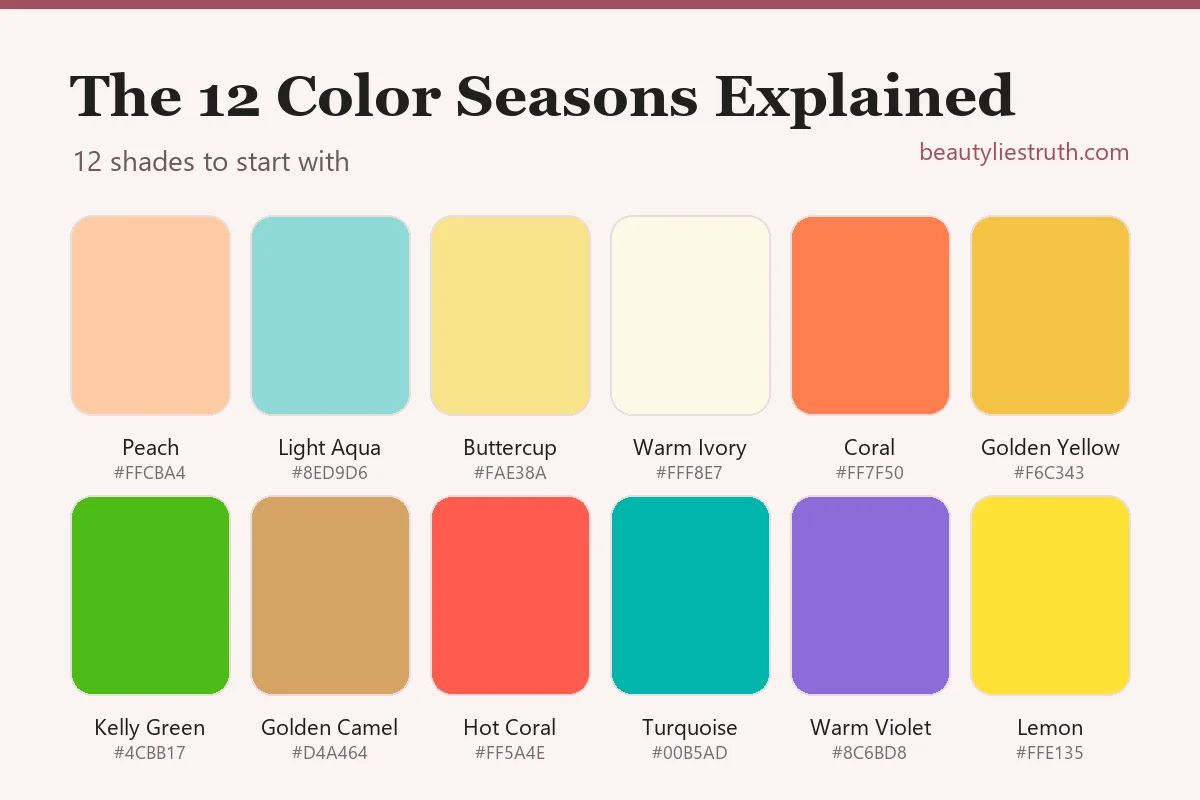
Color seasons sort people into 12 groups by the natural coloring of their skin, hair and eyes. Each season has its own palette of clothing and makeup shades that sit in harmony with that coloring. The system starts with four families named Spring, Summer, Autumn and Winter. Each family then splits into three seasons by its strongest trait, such as light, deep, soft or bright.
Two people with the same brown hair can land in opposite seasons. One looks best in dusty sage. The other needs crisp emerald. This page walks through all 12 of them, shows sample swatches with hex codes, and links to the full palette for each one.
What are color seasons?
Color seasons are the groups used in seasonal color analysis, a method that matches a person’s coloring to a set of flattering shades. The idea went mainstream with Carole Jackson’s book Color Me Beautiful in 1980. Personal color analysis hit its peak in the early 1980s, then came back strongly in the 2010s (color analysis history).
The early system used only four seasons. That left plenty of people stuck between two. The 12-season version fixes this by naming one dominant trait for each person. A Soft Summer and a True Summer are both cool. But one wears grayed, smoky shades and the other wears clearer blues and roses.
So a seasonal color palette is really a shortcut. It tells you which colors share your own balance of warmth, depth and clarity.
The three color traits behind every season
All 12 color seasons are built from three traits of color: hue, value and chroma. Albert Munsell described color this way, and the same ideas still frame how color is measured today.
Hue: warm or cool
Hue decides whether a shade leans yellow or blue. Springs and Autumns sit on the warm side. Summers and Winters sit on the cool side. A camel coat reads warm. A blue-gray coat reads cool.
Value: light or deep
Value is how light or dark a color is. On the Munsell scale it runs from 0 for absolute black to 10 for absolute white (Munsell value and chroma). Light seasons live near the top of that scale. Deep seasons live near the bottom.
Chroma: soft or bright
Chroma is how clean or grayed a color looks. A chroma of 0 means no color at all, just gray. Soft seasons wear dusty shades with some gray mixed in. Bright seasons need clear, saturated color that almost glows.
The 12 color seasons at a glance
The 12 color seasons line up neatly once you know each one’s main trait. The chart below shows where each season falls on warmth, depth and clarity. Several seasons go by two names, which is why “Cool Summer” and “True Summer” describe the same group.
| Season | Also called | Main trait | Undertone | Depth | Clarity |
|---|---|---|---|---|---|
| Light Spring | No other common name | Light | Warm | Light | Clear |
| True Spring | Warm Spring | Warm | Warm | Medium | Clear |
| Bright Spring | Clear Spring | Bright | Warm-neutral | Medium | Very clear |
| Light Summer | No other common name | Light | Cool | Light | Soft |
| True Summer | Cool Summer | Cool | Cool | Light to medium | Soft |
| Soft Summer | Muted Summer | Soft | Cool-neutral | Medium | Very soft |
| Soft Autumn | Muted Autumn | Soft | Warm-neutral | Medium | Very soft |
| True Autumn | Warm Autumn | Warm | Warm | Medium to deep | Soft |
| Deep Autumn | Dark Autumn | Deep | Warm-neutral | Deep | Rich |
| Deep Winter | Dark Winter | Deep | Cool-neutral | Deep | Clear |
| True Winter | Cool Winter | Cool | Cool | Medium to deep | Clear |
| Bright Winter | Clear Winter | Bright | Cool-neutral | Medium | Very clear |
Screens shift color, so treat every hex code on this page as a close guide rather than an exact match. Fabric checked in daylight is the real test.
Spring color seasons: warm and clear
The Spring color seasons share warm, clean shades that look fresh, never dusty. Think of tulips and new leaves. Springs usually have a golden or peachy glow to the skin and some sparkle in the eyes.
Light Spring
Light Spring is the palest of the warm seasons. Hair is often golden blonde or light strawberry, and the overall look is delicate. Heavy black swamps this season fast. Peach, light aqua and warm ivory do the opposite. The full light spring color palette covers outfits and makeup.
True Spring (Warm Spring)
True Spring is warmth at full strength with medium depth. Golden or copper hair and warm brown or green eyes are common. Coral, golden yellow and grass green look right here. See the warm spring color palette for the full range.
Bright Spring (Clear Spring)
Bright Spring has high contrast, often dark hair with bright eyes and warm skin. Clarity matters more than warmth. Dusty colors make this person look tired. Hot coral and clean turquoise wake the face up.
Summer color seasons: cool and soft
The Summer color seasons wear cool shades with a gentle, slightly hazy quality. Picture a beach at dusk. Summers often have pink or rosy skin, ash-toned hair and gray, blue or soft hazel eyes.
Light Summer
Light Summer is pale and cool, with low contrast between hair, skin and eyes. Ash blonde hair is typical. Powder blue and soft pink look natural. Strong black and orange look harsh. The light summer color palette goes into more detail.
True Summer (Cool Summer)
True Summer is the coolest of the Summers. It has medium depth and no warmth at all. Denim blue, rose and soft navy work. Gold and camel tend to turn the skin sallow. Both names point to the same group, and the true summer color palette covers its full set of shades.
Soft Summer
Soft Summer is the most muted of the cool seasons. It sits close to neutral, and its colors look smoky. Mousy brown hair and gray-green eyes are common. Bright white and neon look loud on this person. The soft summer color palette shows the full set.
Autumn color seasons: warm and rich
The Autumn color seasons wear warm, earthy shades with depth and a little dust in them. Picture spice jars and turning leaves. Autumns often have golden or olive skin with brown, auburn or dark blonde hair.
Soft Autumn
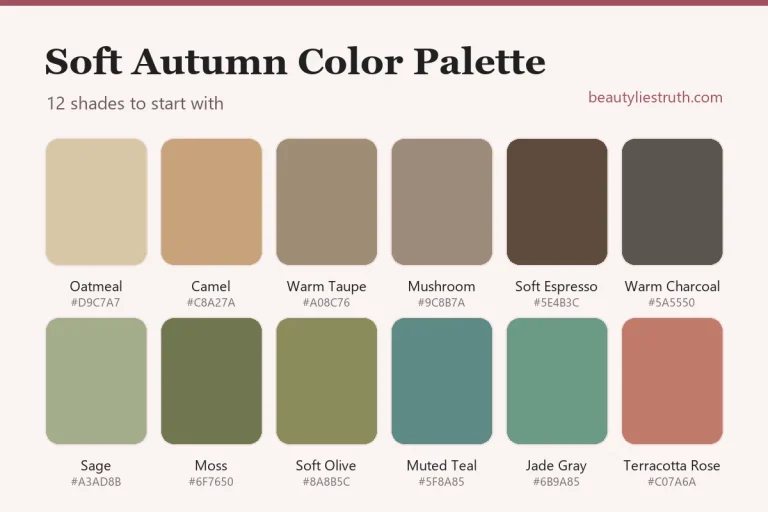
Soft Autumn is the gentlest Autumn. It is warm but muted, and it borders Soft Summer. Camel, sage and muted teal look polished. Icy pastels and pure black drain this face. The full soft autumn color palette covers neutrals and makeup.
True Autumn (Warm Autumn)
True Autumn is the warmest of all 12 seasons. Rust, olive and mustard sit right at home. Copper and auburn hair are common. Cool pinks and icy blues fight the skin. The true autumn color palette has the full list.
Deep Autumn (Dark Autumn)
Deep Autumn pairs warmth with real depth. Dark brown hair, dark eyes and golden or olive skin are typical. Brick red, forest green and espresso look rich. Pale pastels wash this person out. See the deep autumn color palette for outfits and makeup.
Winter color seasons: cool and clear
The Winter color seasons wear cool, clear shades with strong contrast. Think of fresh snow next to a dark evergreen. Winters often have dark hair, bright eyes and cool or neutral skin, though light-haired Winters do exist.
Deep Winter (Dark Winter)
Deep Winter is dark first and cool second. Black looks natural here, which is rare. Burgundy, emerald and plum carry the palette. Camel and peach look muddy. The deep winter color palette lists the best and worst shades.
True Winter (Cool Winter)
True Winter is the coolest Winter, with high contrast and no warmth. True red, royal blue and pure white look sharp. Orange and golden brown fall flat. The true winter color palette has the complete range.
Bright Winter (Clear Winter)
Bright Winter is the most vivid season in the system. Clarity beats everything else. Electric blue and hot pink look clean, while dusty mauve looks dull. Bright Winter and Bright Spring are easy to mix up because both need saturated color.
Sister seasons: why two color seasons can look alike
Color seasons that share a main trait often get confused, so it helps to know each season’s sister. Light Spring and Light Summer are both pale. Soft Summer and Soft Autumn are both muted. Deep Autumn and Deep Winter are both dark. Bright Winter and Bright Spring are both vivid.
In each pair the deciding question is warmth. Hold a gold fabric and a silver one under the chin in daylight. The one that makes the skin look even and clear points to the right side of the pair.
How do I determine my color season?
To find your place among the color seasons, check three things in natural light with a bare face. First, decide if your undertone is warm or cool. Next, judge whether your coloring is light, medium or deep. Then compare a dusty fabric with a bright one. The trait that stands out most points to one of the 12 seasons.
A free color season analysis quiz walks through those same questions step by step. It helps to answer with a friend nearby. People tend to misjudge their own depth.
A black-and-white photo helps with value. If the face, hair and eyes look close in gray, the coloring is low contrast, which hints at a light or soft season. Strong jumps from light to dark point to a deep or bright one. For a broader look at which shades suit you, see the guide to what colors look good on me.
Are there 12 or 16 color seasons?
Color seasons come in both 12 and 16-season systems. The 12-season model splits each of the four seasons into three, and it is the most widely used. Some analysts add a fourth sub-season to each family to reach 16, usually by splitting the true or bright groups. The 16 seasons still sit on the same warmth, depth and clarity scales.
For most people, the 12-season system gives enough detail to shop with. Extra sub-seasons matter more to professional analysts than to someone choosing a sweater.
How to use your seasonal color palette
Your color season matters most near the face, where a seasonal color palette affects skin tone the most. Tops, scarves, glasses frames and lipstick matter more than shoes or trousers. A person can wear a favorite off-season color below the waist with almost no effect.
Start with neutrals from the palette, since those make up most of a wardrobe. Then add two or three accent shades. The guide to color analysis outfit ideas shows how to combine them by season.
For anyone who wants a palette made for their own photos, the personal color season palette service builds one from scratch. The season pages linked above are the place to start, and the right one usually feels obvious once the swatches sit next to a bare face.
Beauty Lies Truth publishes hair and personal color guides for readers in the US. Updated guides are checked against published sources, such as the American Academy of Dermatology, and those sources are linked in the text.