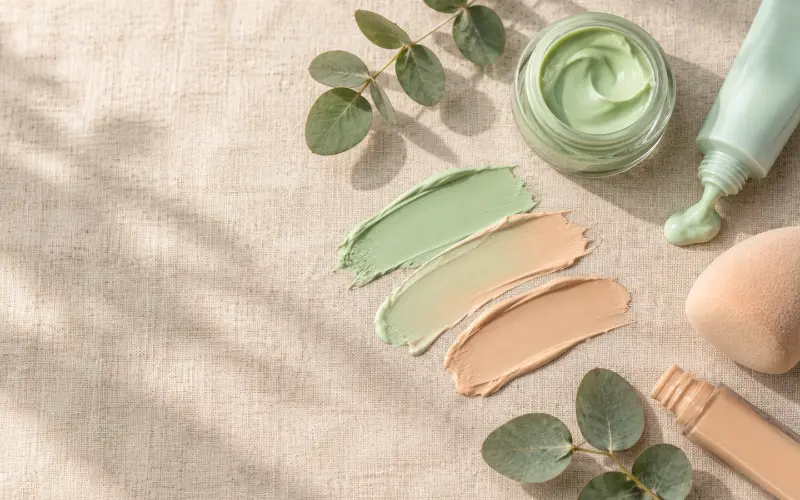
Green concealer cancels a red blemish. A green sweater makes the same blemish louder. Not a contradiction. Once you see why, you’ll know more about dressing around a breakout than any list of colors to avoid can tell you.
Everyone knows the rule. Green cancels red. It’s true, but only in one spot: right on top of the red. Move that green a few inches away and it does the opposite.
Why green works in a tube and fails in a sweater
The colors that hide redness on your skin aren’t the colors that hide it from across a room. Two different things are going on.
Green corrector works by mixing. The pigment sits over the red. The two cancel out toward neutral. The National Rosacea Society has been steering people to green-tinted foundations and concealers since 2000.
A green top never touches the red. It works on your eye instead. And your eye runs the other way.
Your eye adds the opposite of whatever sits next to your face
Why colors hide redness in one spot and show it off in another was worked out in 1839. By a French chemist, of all people. Chevreul called it the law of simultaneous contrast. Put one color beside another and it shoves its neighbor toward the far side of the color wheel.
So a green surround shoves your skin toward red. Green does not cancel the red here. Green just pushes the skin next to it toward red, and on a green sweater the skin next to it is your face.
So if a green sweater ever made your face look red in a photo, it was the green, not you.
Black and white are the surprising offenders
Plain neutrals are where most advice on colors that hide redness goes wrong. The same rosacea advice that tells you to use green on the skin also says plain black and plain white make redness look worse, and that soft blue, soft yellow and khaki are better. But black and white have no color, so how can they push your skin toward red?
They do not push. Black and white have no color of their own, so your skin is the only color your eye can see, and the red in your skin is all your eye looks at.
A plain black top is the one most people wear on a bad skin day. It is also the one that makes the red look worst.
Four dials control how strong the effect gets
Whether a color hides redness or makes the red look worse is not a yes or no thing. The color theory course says four things make the push stronger or weaker. Think of them as four dials.
| Dial | Turns the effect up | Turns it down | What that means in a closet |
|---|---|---|---|
| Purity | A bright, clean color. | A dusty, soft color. | A dusty green pushes your skin less than a bright green. |
| Area | A lot of the color near your face. | A little of the color. | Keep the bright color below your shoulders, or keep it small. |
| Separation | The color right on your skin. | A collar or necklace between the color and your skin. | Put something between the color and your skin to break the push. |
| Value | A color as light as your skin. | A color much lighter or darker than your skin. | A color that is as light as your skin pushes the most. |
Separation is the dial most people can use the most, because you do not have to give up the color. A necklace or a collar between the color and your skin makes the push a lot weaker. If you go with a necklace, first check which metal suits your undertone.
Fresh breakouts and old marks need opposite corrections
Choosing colors that hide redness assumes the red mark is red. A lot of the time it is not. A pimple can leave a flat mark in one of two colors, and dermatologists say they are different colors with different causes.
The pink or red mark is post-inflammatory erythema. The pimple made the blood vessels in the skin get wider, and the wide blood vessels make the skin look pink or red. The brown mark is post-inflammatory hyperpigmentation. The pimple pushed melanin deeper into the skin, and the melanin makes the skin look brown.
So how do you tell the pink mark from the brown mark? Press gently on the mark. A pink mark from erythema does not blanch when you press it. Most color guides do not tell you that.
The color of the mark changes the color you put on it. Green cancels pink, but green on a brown mark makes the brown mark go grey. Peach is closer to what a brown mark needs. If you are not sure which mark you have, the skin tone chart can help, and so can the guide to naming your skin color accurately.
When color is the wrong tool
Colors that hide redness can only do so much. Color can change how a breakout looks. Color cannot change what the breakout is doing in your skin.
If a breakout hurts, goes deep, spreads or leaves scars, color is not the fix. That is a skin problem, not a clothes problem. A dermatologist can give you acne treatment for the cause of the breakout, and no color can do that. If you keep getting marks, go sooner. It is easier to stop a mark than to fade a mark. Until then, calming inflamed skin gives your color a better base to sit on.
Where this fits with your color season
Your season and the colors that hide redness are two different things. A color season analysis tells you which colors look good with your coloring, but it thinks your skin is one even color.
This page is for when your skin is not one even color. A color can be in your season and still make a breakout look red, because the colors that suit you were picked for your undertone, not for the red on your skin.
Questions people ask
Does wearing green make redness worse?
Yes, most of the time. That is a surprise if you use green on your skin. Green on the skin mixes with the red and cancels it. Green next to the skin does the opposite and pushes your skin toward red. So it is where the green is, not the green, that matters.
What color cancels out redness?
Green cancels redness, but only as makeup on top of the red. For clothes it is the other way. Soft blue, soft yellow and khaki near your face make redness look calmer. Bright, clean colors near your face make redness look worse, because a bright color pushes more.
Why does my skin look worse in a plain black top?
Black has no color of its own, so your skin is the only color your eye can see. That means the red in your skin is the first thing your eye sees. Give your eye something else to look at, like a print, a knit, or a second color near the neckline.
Should I wear pink if I have acne?
Pink is safer than you might think. Pink pushes the skin next to it toward green, and green makes red look calmer. But pink can also make your skin look a little flat or grey. A dusty pink does this less than a bright pink, because a dusty color pushes less.
What to change first
Start with the biggest block of color near your face. That is where hiding redness is won or lost. One good top does more than a lot of makeup.
Next, make the color less bright. Keep the color, but pick the dusty version of it. A dusty version of a color you already have will push your skin a lot less than the bright version.
The simple things still matter too: washing brushes and anything that touches your face, keeping your skin properly hydrated so makeup has less to cling to, and a simple moisturizer at night.
And if you want this worked out for your face, not for all faces, that is what a personalized approach is for.
BeautyLiesTruth publishes hair and personal color guidance built on primary research. Color claims are tested by draping under controlled daylight, and every figure is traced to a published source rather than to another blog.