
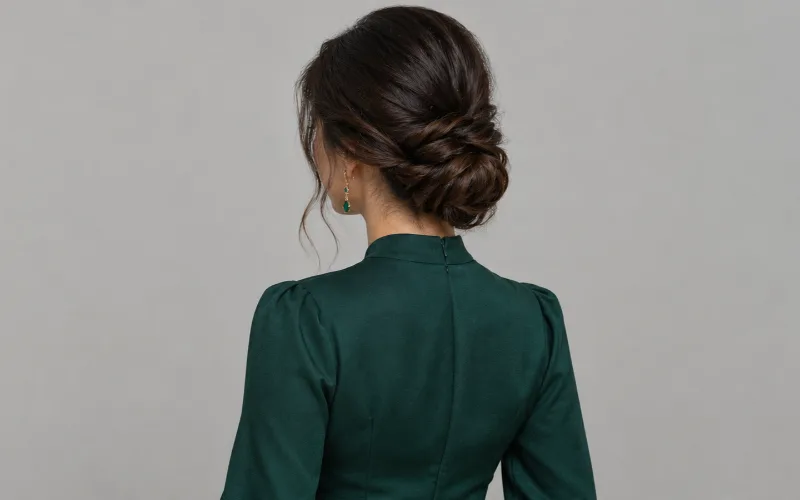
Hairstyles for a formal dress come down to one rule: volume goes in one place, not two. If the dress carries its drama at the neckline or the shoulders, the hair goes up or back. If the neckline is quiet, the hair can be the event. What no gallery tells you is what the dress does to your hair while you are wearing it, which is where the real damage happens.
There are a thousand photographs of formal hair online and almost no information in them. Nobody mentions that a tight updo worn for eight hours, set with long-hold product and taken down at two in the morning, is three things dermatologists specifically advise against.
Hairstyles for a Loud Neckline Have One Job, Which Is to Get Out of the Way
Hairstyles should go wherever the dress is not. Look at where the gown already carries weight, then put the hair somewhere else. A statement ruffle organza gown already holds every bit of volume the look needs at the collarbone, so hair swept up or back works with it rather than fighting it for the same space. Reverse that for a plain strapless bodice, where hair down is the only thing filling the gap between jaw and neckline.
| Neckline | Hair goes | Why |
|---|---|---|
| Ruffled, high or collared | Up or swept back. | The drama is already at the collarbone. Hair down competes for the same inches and hides the detail. |
| Strapless or sweetheart | Either works. | Nothing above the bust, so hair decides the shape. Down fills the gap, up makes the shoulders the line. |
| Halter | Up or back. | A halter draws one vertical line. Hair down cuts across it. |
| Off the shoulder | Down or half up. | The shoulder line is the point. A severe updo reads bare rather than deliberate. |
| One shoulder | Swept to the bare side. | Balances the asymmetry rather than doubling it. |
| Boat neck | Up. | A wide horizontal line plus hair down shortens the neck in photographs. |
One caveat on the table. What your hair can actually do is set by what it is, not by what suits the dress. Fine straight hair needs grip to hold an updo at all, curly hair loses definition the moment it is pinned flat, and 4C coils hold a sculpted shape better than anything else here. The hair types chart covers the range.
Hairstyles That Survive a Full Evening Use Habits Dermatologists Warn About
Hairstyles built to last eight hours tend to combine tight tension, heavy hold product and added hairpieces, and the American Academy of Dermatology names all three among the habits that damage hair. Its advice is to wear hair loosely pulled back, use covered elastics made for styling rather than bare bands, choose light hairpieces that will not pull, and pick a style that does not need long-hold product at all.
For one evening that is a manageable trade. The problem is repetition. DermNet lists tight chignons, weaves and the weight of long hair among the causes of traction alopecia, which starts as itching, redness and short broken hairs and turns permanent if the tension keeps returning. Four times a year is fine. Monthly through a wedding season is not, and a sore scalp afterwards is the signal to space things out.
Hairstyles Pulled Too Tight Announce Themselves Long Before They Damage Anything
Hairstyles that pull hard enough to last the night usually give you a headache first, and that is the most useful warning you will get. Research cited by Medical News Today found roughly 54 percent of women in a 2004 study had headaches from wearing a ponytail, with a 2020 study putting prevalence around 40 percent. In that later work, people with a history of migraine who wore a ponytail for 60 minutes developed headaches meeting migraine criteria. The pain generally eases within an hour of loosening the hair.
The practical version: if it aches at hour two, it has six more to go and it will not settle. Ask for it to be loosened at the hairline before you leave, not at the venue, because once the product has set, loosening it means starting again.
Hairstyles Worn Down Have to Survive the Fabric They Sit Against
Hairstyles worn down spend the whole evening in contact with the bodice, and fabrics differ enormously in how they treat hair. Sequins have drilled holes with hard rims, beading catches at the metal setting rather than the stone, and organza has a crisp cut edge along every ruffle and seam. Smooth fabric does none of this. The metal in your jewelry is worth checking at the same time, since clasps and drop earrings catch hair in exactly the same way.
| Bodice fabric | What it does to hair worn down | Verdict |
|---|---|---|
| Sequins and paillettes | Drilled holes and hard rims. The worst of the group for fine hair. | Up. |
| Beading and crystal | Catches at the metal setting rather than the stone. | Up, or swept forward. |
| Organza and taffeta | Crisp cut edges along every ruffle and seam. | Up, or expect some breakage. |
| Tulle and lace | Open structure that fine strands thread into. | Up or half up. |
| Velvet | Grips rather than snags. Static and flyaways instead. | Down, with product. |
| Satin, silk, crepe | Smooth, with nothing to catch on. | Down works. |
The test takes ten seconds and almost nobody does it. Put the dress on, let your hair down, turn your head slowly side to side, then look down and back up. If you feel one catch, you will feel it two hundred times over an evening.
Hairstyles for an Event Need a Takedown Plan, Not Just a Setting Plan
Hairstyles come out worse than they go in, because the takedown happens late and in a hurry. Remove every pin before touching the hair, which takes longer than you think and is the step people skip. Then work conditioner or oil through the lengths while the product is still in, and detangle from the ends upward with a wide-tooth comb, which is what the AAD advises for tangles generally. Never pull. Get it out before you sleep in it, because a night spent on a set updo adds friction to hair that has already had enough.
Questions People Ask About Hairstyles for Necklines
Should I Wear My Hair Up or Down With a Strapless Dress?
Either, because a strapless neckline is the one case with no competing detail. Down fills the space between jaw and collarbone and reads softer. Up makes the shoulders and collarbone the line of the look. Let the bodice fabric break the tie, since hair down against sequins or beading will catch all night.
What Hairstyle Goes With a High Neckline?
Up or swept back, nearly always. A high or collared neckline already occupies the space hair would fill, so leaving it down crowds the face and hides the detail. A low bun or a sleek twist keeps the neckline readable.
How Do I Stop My Hair Catching on a Beaded Dress?
Wear it up, or sweep it forward over one shoulder so the lengths sit against skin rather than fabric. If it must stay down and back, a light smoothing cream reduces the friction, but it does not remove the snag points.
How Do I Take an Updo Out Without Breaking My Hair?
Pins out first, all of them, before you touch the hair itself. Then oil or conditioner through the lengths, then detangle from the ends upward with a wide-tooth comb. Washing it out before detangling makes the tangles tighter, not looser.
What to Do Before the Event
Hairstyles go wrong on the night for reasons you can find out a week earlier.
- Try the style and the dress together, not separately. The neckline changes what the hair looks like.
- Do the head-turn test with your hair down before deciding to wear it down.
- Say something if it hurts in the chair. Loosening at the hairline costs nothing then and everything later.
- Put pins, a wide-tooth comb and a small oil somewhere you will find them at 2am.
None of this is an argument against a dramatic style. It is an argument for choosing one that comes out as easily as it went in. Knowing your own hair decides most of it, and the hair type quiz sorts that quickly. If you are working with a shorter length, a fringe or a softer front does more for a neckline than a difficult updo will, and an updo that bares your ears makes earrings part of the decision rather than an afterthought.
How this was checked: the guidance on tight styles, hairpieces, long-hold product and gentle detangling comes from the American Academy of Dermatology; the traction alopecia causes and warning signs come from DermNet; the ponytail headache figures come from studies cited in medically reviewed reporting by Medical News Today. Claims about any named dress are limited to what that product page states. How specific fabrics behave against hair, and all styling and takedown guidance, reflect standard practice rather than clinical research, and are written as such.

BeautyLiesTruth publishes hair and personal color guidance built on primary research. Color claims are tested by draping under controlled daylight, and every figure is traced to a published source rather than to another blog.