
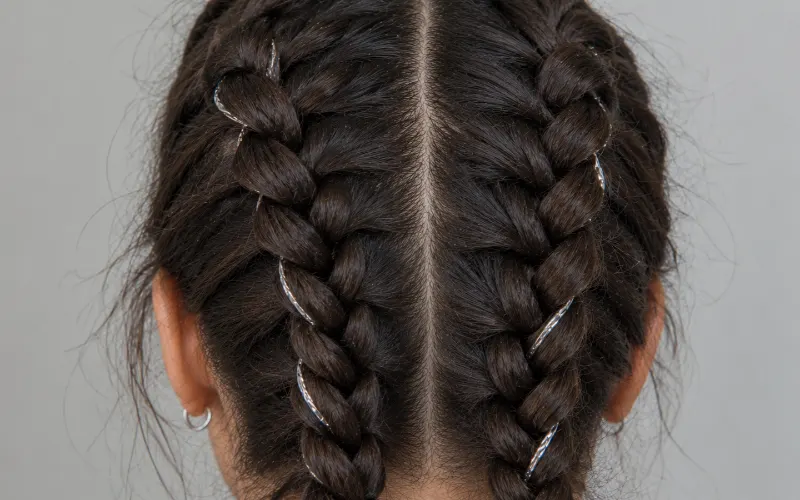
Festival hair fails for three reasons, and none of them is the style you chose. Dry shampoo builds up faster than a weekend allows, a braid worn tight for seventy-two hours is more tension than a hairline can absorb, and glitter is engineered not to come off. Plan the takedown at the same time as the look, and most of this stops being a problem.
Search for festival hair and you get twenty-five photographs. None of them is taken on day three, which is the only day that tells you anything. What follows is the part the galleries skip.
Festival hair usually fails on day two, and dry shampoo is why
Festival hair almost always survives day one. Day two is where it goes, and the cause is the thing everyone packs to prevent it. The American Academy of Dermatology advises washing with regular shampoo and water after one or two uses of dry shampoo. A three-day festival is two or three consecutive uses with no water in between, which is past that line by design.
What that does is specific rather than vague. Product that sits on the scalp can clog pores and cause itching, burning or tenderness, and the AAD notes that relying on dry shampoo while skipping water washing can lead to seborrheic dermatitis, an itchy scaly rash. Product left in can also contribute to breakage and shedding. If your scalp is already prone to irritation, a festival is the worst possible week to find that out.
Two things help more than packing a bigger can. Arrive on day-two hair rather than freshly washed, because clean hair will not hold a style anyway. And apply dry shampoo at night, let it sit while you sleep, then brush it out in the morning, which leaves far less sitting on the scalp than spraying and going.
Festival hair braided tight is a tension problem, not a styling one
Festival hair gets braided tight because tight lasts, and that is exactly the trade being made. The AAD is clear that hairstyles which pull on the hair can cause hair loss, and a festival braid is not worn for an evening. It is worn for three days, slept in, sweated in, and tightened further by the swelling and friction of all that.
The usable rule is physical rather than aesthetic. If it hurts on day one, it fails by day three, and pain is not the style settling. Braid to the scalp rather than into it, and keep the hairline looser than the rest. What your hair can take also depends on what it is: curly hair and 4C coils hold a braid for completely different lengths of time, and the hair types chart covers the range.
| Style | Holds for | What it costs you | Best for |
|---|---|---|---|
| Two Dutch braids | Two to three days. | Tension along the parting if pulled tight. | The default. Braid to the scalp, not into it. |
| Space buns | A day, less if you dance. | Little, unless the elastics are tight. | Day one, or a reset on day two. |
| Cornrows or feed-ins | The whole weekend. | The most tension of anything here. | Worth it only if a professional does them. |
| Slicked ponytail | A day. Gel plus sweat fails fast. | Breakage at the hairline from the slick-back. | Short sets, not camping. |
| Loose and down | Hours. | Nothing, except tangles and sun. | Indoor events and the drive home. |
Festival hair reads completely differently under colored light
Festival hair gets designed in a bathroom mirror and seen under saturated colored LED, and those two lighting conditions do not agree about anything. Under a red stage wash, green and blue tones in hair go flat and dark. Under ultraviolet, pale blonde and bleached hair lights up while dark hair disappears into the background entirely. Your daylight color palette is a useful thing to know and almost irrelevant here.
The light that matters most is the light nearest your face, which at these events is rarely the stage. It is the crowd, where gloving puts color-changing LEDs at face level and in motion, inches from your hairline, cycling hue every few seconds. Nothing you chose for hue survives that. What does survive is contrast and shape, which is why metallic strands, a bright streak against dark hair and metal that suits your undertone all read under every light in the building. If you are planning a bold color for the weekend, previewing it beats discovering in the dark that it vanished.
Festival hair glitter needs its removal planned before it goes on
Festival hair glitter is engineered to stay put, which is the whole problem and also the point. It is worth knowing what you are buying. Loose plastic glitter came off EU shelves on 17 October 2023 as part of a push to cut microplastic pollution across member states by 30 percent by 2030, with biodegradable, glass, metal and water-soluble versions exempt. One UK brand says its glitter breaks down in water in 27 days. A 2020 study found that even glitter sold as eco-friendly can still affect aquatic ecosystems, so the honest position is that this is better rather than solved.
Removal is oil first, always. Work a cheap oil through dry hair, concentrating on the roots where gel-based glitter sits, let it loosen the adhesive, then shampoo twice. Never scrub at dry glitter, because you are dragging hundreds of tiny flat edges along the cuticle. Gel-applied glitter roots come out in one wash. Anything set with spray adhesive takes three.
Festival hair needs a recovery plan, not just a look
Festival hair is not finished when the festival is. Take the style down before you sleep, however late it is, because another night of tension on hair that has had three already is where the damage compounds. Clarify first, then condition heavily, and expect to shed more than usual in that first wash. That is three days of normal shedding arriving at once rather than something going wrong. Give the scalp a few days of proper rest and nothing tight before styling it again.
Questions people ask about festival hair
How do you get glitter out of your hair?
Oil on dry hair first, worked into the roots, then two shampoos. The oil lifts the adhesive so the glitter slides off the strand rather than being dragged along it. Scrubbing dry glitter is what causes the breakage people blame on the glitter itself.
Can you wear the same braids for a whole festival?
Yes, if they were not painful on day one. Tension is cumulative and sleeping in a style tightens it, so anything that hurt at the start will be worse by the end. Loosen the hairline rather than the whole braid if you need to buy a day.
How many days can you use dry shampoo?
The AAD advice is to wash with shampoo and water after one or two uses. A festival pushes past that, so the realistic goal is minimizing what sits on the scalp rather than hitting the number: apply at night, brush it out, and clarify as soon as you are home.
Does bleached hair glow under blacklight?
Pale blonde and bleached hair usually brightens noticeably under ultraviolet, and dark hair does the opposite and drops away. If glowing is the goal, the effect comes from how light the hair already is, not from the color you put on top of it.
What to pack for festival hair
- Festival hair survives on four things, and a bigger can of dry shampoo is not one of them.
- A cheap oil, decanted small. It does glitter removal, ends and frizz.
- Soft fabric elastics and a few spares. Nothing with a metal join.
- A scarf or bonnet, which is the only thing that protects the style overnight.
- Clarifying shampoo waiting at home, not in the bag.
None of this asks you to pick a duller look. It asks you to pick one that can be dismantled. If you are not sure which row of the table applies to you, the hair type quiz sorts it quickly, and knowing your porosity tells you how long any of it will hold. Anything still sore or flaking a week later belongs with a dermatologist rather than another product.
How this was checked: the dry shampoo guidance, including the one-to-two-use advice, the clogged pore effects and the seborrheic dermatitis risk, comes from the American Academy of Dermatology, as does the link between pulling styles and hair loss; the glitter restriction, the 2030 microplastic target and the biodegradable exemptions come from Forbes reporting on the EU rule. How hair behaves under ultraviolet and colored LED, and the styling and removal guidance, reflect standard practice rather than clinical research, and are written as such.
BeautyLiesTruth publishes hair and personal color guidance built on primary research. Color claims are tested by draping under controlled daylight, and every figure is traced to a published source rather than to another blog.