
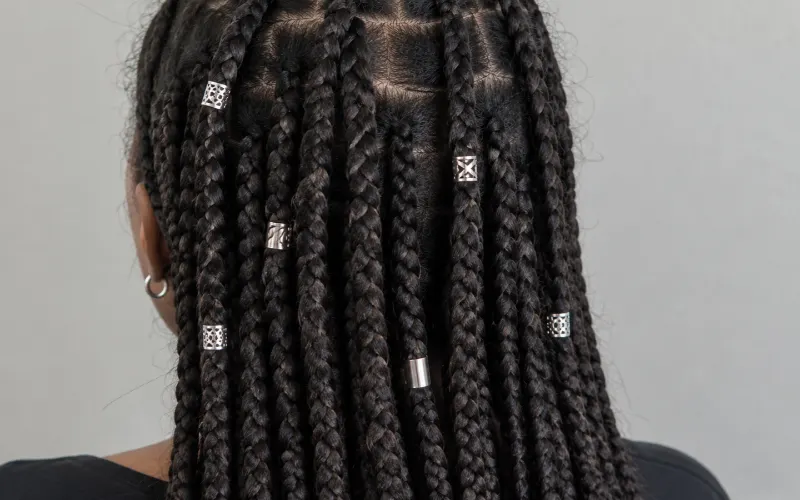
Hair jewelry does not damage hair by being metal. It does it by adding weight to a style that is already pulling, and by catching the cuticle on a rough edge every time it moves. Choose light pieces with smooth interiors, size them so they slide instead of grip, and take them out before the style comes down rather than during.
You notice it on takedown. The braids come out fine until you reach the places a cuff was sitting, and there is a cluster of short broken hairs at that exact height. The metal did not cause that. The sizing and the removal did.
Hair jewelry damages hair in two ways, and neither one is the metal
Hair jewelry causes problems through weight and friction, and the weight matters because the style underneath is already pulling. The American Academy of Dermatology is direct that hairstyles which pull on the hair can cause hair loss, and DermNet lists the weight of excessively long hair among the causes of traction alopecia. Jewelry pulls the same lever: every cuff is a small load hanging off follicles already under tension.
Friction is the other half, and the one that shows up fastest. A seam or a burr inside a cuff drags across the cuticle every time the piece shifts. Run a fingertip around the inside before you buy. If you can feel the join, your hair will find it too.
| Mechanism | What it acts on | What you see | What fixes it |
|---|---|---|---|
| Weight | The follicle, by steady downward pull. | Soreness, bumps, thinning at the hairline. | Fewer and lighter pieces, none near the edges. |
| Friction | The cuticle, where a rough edge drags. | Short broken hairs where the cuff sat. | Smooth interiors only. Check with a fingertip. |
| Force on removal | The whole strand at once. | Snapped braids, hair left in the cuff. | Open the crimp, slide down, never up. |
Hair jewelry has a weight limit, and it is lower than it looks
Hair jewelry gets heavy faster than people expect, because the load is counted per braid rather than per head. Thirty small cuffs weigh almost nothing in your palm. Spread across thirty partings they are thirty separate pulls, and the ones nearest the hairline act on the hair least able to take it.
A practical ceiling: let no more than a third of your braids carry anything, and keep the heavier pieces off the front. DermNet notes that tight braids commonly cause loss on the temporal scalp, and describes the fringe sign, where a thin rim survives along the hairline while the area behind it thins. That rim is the warning, not the reassurance. Itching, redness, scaling or bumps along a parting mean the style is too heavy or too tight, and an irritated scalp is worth taking seriously rather than styling over.
Hair jewelry sits against the scalp for days, which is where the metal starts to matter
Hair jewelry stays in far longer than a necklace does, and usually touches skin the whole time, which makes the alloy a real question rather than a style one. The AAD puts nickel allergy at more than 18 percent of people in North America, including 11 million children in the United States, and names surgical-grade stainless steel, 18, 22 or 24 karat yellow gold, pure sterling silver and platinum as safer choices. The same reaction that shows up behind an earring will show up on a scalp, and it is harder to spot under hair.
Plating is the thing to ask about. A plated charm is fine until the plating wears through, and then the base metal is what sits on your scalp. Buying from a supplier that states the alloy rather than the color is the whole difference. Wholesale suppliers such as Wholesale Jewelry Website list 316 surgical stainless steel and .925 sterling silver by name, two of the metals on the AAD list, and stock the charms and jump rings most loc jewelry is assembled from. If you are choosing between gold and silver tones, metal and undertone is a separate question worth getting right once.
Hair jewelry should slide on, not be forced on
Hair jewelry that has to be forced is the wrong size, and forcing it is where most breakage happens. A cuff should slide down the braid under its own weight and stop where you want it, held by a light crimp rather than clamped shut. Squeeze with fingers first, reach for pliers only if you must, and stop the moment it stops sliding. Finer strands tolerate less of this, and knowing what your hair is made of is a better guide than the packaging.
Removal is the dangerous half and nobody writes about it. Open the crimp before you move the piece. Slide it down and off the end, never up toward the root, because up gathers loose hair and snaps it. If a cuff will not move, cut the braid below it rather than pull.
Hair jewelry behaves differently depending on what it has to grip
Hair jewelry holds a mature loc in a completely different way than a fresh braid, which is why one piece can be right in one style and wrong in another. Curly hair in twists, 4B coils and 4C locs all give the metal something different to sit on. The hair types chart covers where you fall.
| Style | How the jewelry holds | What to watch |
|---|---|---|
| Fresh box braids | Light crimp on the braid, mid-length or lower. | Already under tension on day one. Add the least here. |
| Mature locs | Slides on and holds by friction. Often needs no crimp. | Weight adds up, and locs hold water. Dry fully first. |
| Twists | Sits in the groove, so it slips more. | Over-crimping to stop the slipping is the damage. |
| Knotless braids | Grips along the braided length. | Lighter roots, finer ends. Keep charms off the tips. |
| Loose or heat-styled hair | Pins and clips rather than cuffs. | Avoid hinges and serrated edges. Those break hair fastest. |
Hair jewelry should come out before the style does
Hair jewelry left in through a wash and a night of sleep does the most damage for the least payoff. Metal traps water against the hair, which matters most in locs, where slow drying is already the problem. Take pieces out before washing and put them back on dry hair. Overnight, remove them or cover the style, since the same friction that wrecks hair against a pillowcase is worse with metal in the mix.
Questions people ask about hair jewelry
Does hair jewelry damage your hair?
Not on its own. Weight, tight crimping and forcing pieces off cause the damage, and all three are avoidable. A few light cuffs on a loose style is a different proposition from forty heavy charms on tight braids.
Can you sleep in hair jewelry?
Better not to, and if you do, cover the style with a bonnet or scarf. Metal against a pillow means friction plus weight for eight hours, and the cuffs press into the scalp wherever you lie.
How do you get hair cuffs out without breaking hair?
Open the crimp with your fingers or the tip of a pair of pliers, then slide the piece down the braid and off the end. Never work it up toward the root. If it will not budge, cut below it. A braid costs less than a follicle.
Can you wash your hair with jewelry in?
You can, but it is not worth it. Metal slows drying where drying matters most, and pieces catch on each other while hair is at its most fragile. Take them out, wash, dry, put them back.
What to check before you buy hair jewelry
- Hair jewelry is worth buying carefully once rather than cheaply three times.
- The named alloy, not the color. Surgical stainless, sterling or solid gold, rather than “gold tone”.
- A smooth interior. Feel the inside seam before it goes anywhere near your hair.
- Weight in the hand, multiplied by how many you plan to wear at once.
- An opening wide enough to slide over the braid you actually have, not the one on the packaging.
None of this makes hair jewelry risky. It is a styling choice with a weight budget, and the budget is smaller than people assume. If you are unsure which row applies to you, the hair type quiz sorts it quickly, and anything sore, flaking or thinning along a parting belongs with a dermatologist rather than a different cuff.
How this was checked: the link between pulling styles and hair loss comes from the American Academy of Dermatology; the traction alopecia detail, including the weight of long hair, the temporal scalp pattern and the fringe sign, comes from DermNet; the nickel allergy figures and the list of safer metals come from the AAD. Claims about any named supplier are limited to what that supplier states publicly. Sizing, crimping and removal guidance reflects standard styling practice rather than clinical research, and is written as such.

BeautyLiesTruth publishes hair and personal color guidance built on primary research. Color claims are tested by draping under controlled daylight, and every figure is traced to a published source rather than to another blog.