
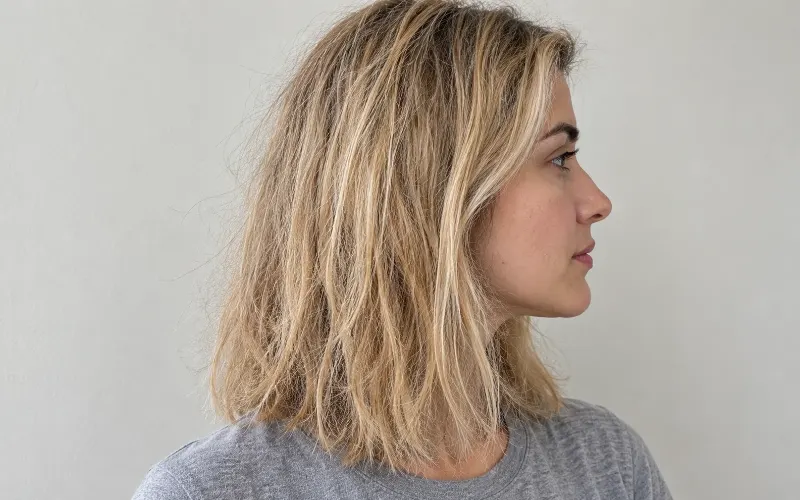
High porosity hair has a raised or chipped outer layer, called the cuticle. Water and products rush in through the gaps, then leak right back out. That’s why it can feel dry an hour after washing.
Most of it comes from damage like bleach or heat, though tight coils can lean that way by nature. You can’t seal the cuticle shut again, but you can make it behave. Not sure where yours sits? The hair type quiz reads porosity along with your curl pattern.
What Is High Porosity Hair?
High porosity hair is hair whose cuticle no longer lies flat. Picture roof shingles after a storm, lifted and cracked at the edges. Water slips under them fast and slips back out just as fast. That’s why the strand swells when wet, then turns dry and brittle. Underneath, the cortex loses protein faster too.
What Are the Signs of High Porosity Hair?
You’ll usually spot high porosity hair in the shower. It soaks through almost at once. Then it dries fast and feels rough or straw-like within hours. It looks dull and frizzy, with knots at the ends. Humidity makes it puff up and drop its curl. Even a rich leave-in seems gone by lunch.
Color is another giveaway. Toner grabs fast on porous blonde and rinses out within a few washes. Colorists check porosity before lightening for this reason. It’s also why purple shampoo can tint very porous ends lilac.
Breakage is the sign most people miss. Short snapped bits with no white bulb mean the length is breaking, not shedding. The hair shedding vs breakage guide shows the difference.
What Causes High Porosity Hair?
Most high porosity hair comes from damage. Bleach is the biggest culprit. It opens the cuticle on purpose to reach the pigment, and repeat sessions leave it chipped.
Permanent color and relaxers lift the cuticle too. Hot tools add more. So does the sun. UV wears away the thin oily film on each strand, and sun damaged hair is the rough, faded result. Rough towel drying and hard water chip in too.
Is curly or coily hair naturally high porosity?
Often, yes. Every bend in a curl or coil lifts the cuticle a little. Tight 4C hair can test high porosity without ever seeing bleach. Plenty of coily heads still run low, though. Your spot on the curl types chart is a hint, not an answer.
How Do You Test for High Porosity Hair?
The float test is the best-known check for high porosity hair, but it only gives a rough read. Drop a clean, product-free strand into room-temperature water. Sinking fast points to high porosity. Floating for minutes points to low.
The catch? A trace of oil or a tiny air bubble can keep any strand afloat. Cosmetic scientist Dr. Amber Evans notes that float and spray tests “have limitations but can potentially give a general idea under controlled conditions.” The hair porosity guide explains why the float test fails.
How else can you test for high porosity hair?
A mist test reads closer to real life. Spritz a dry section and watch. If the water vanishes and the strands swell, that’s high porosity behavior. Fast-drying hair that still feels thirsty says the same.
Can one head have mixed porosity?
Yes, and long hair usually does. Porosity changes along a single strand. Roots are new and tend to be tighter. Ends have lived through every wash and heat pass. They run higher. Put protein and heavier sealing on the ends, and keep the roots light.
High Porosity vs Low Porosity Hair
High porosity hair and low porosity hair sit at opposite ends of one scale, with medium porosity in the easy middle.
| Trait | Low porosity | Medium porosity | High porosity |
|---|---|---|---|
| Cuticle | Tight and flat | Mostly flat | Raised or chipped |
| Water | Beads on top | Soaks in steadily | Soaks in almost at once |
| Drying | Slow | Average | Fast, then feels dry |
| Float test (rough read) | Floats a long time | Hovers mid-glass | Sinks fast |
| Products | Sit on top and build up | Absorb well | Seem to vanish |
| Main need | Light products and gentle warmth | Upkeep | Protein, then a seal |
Two people at the same spot on the hair types chart can land at opposite ends here.
Does High Porosity Hair Mean It’s Unhealthy?
High porosity hair isn’t automatically unhealthy. Porosity from bleach or heat does mean damage, and those lengths are weaker. Porosity that comes with a tight coil pattern is structure, not sickness. With the right routine, either kind can look healthy and hold a style.
The upside? It takes color and deep conditioner fast and dries quickly. Good or bad? Neither, just trade-offs.
Can High Porosity Hair Be Fixed?
Damaged high porosity hair can’t be fixed for good. Hair past the scalp is dead keratin. A chipped cuticle won’t grow back, and split ends won’t knit together. You can treat it, though. Protein fills gaps for a while. Conditioner and oil smooth the surface and slow water loss. New growth comes in at your natural porosity.
Even the strongest high porosity hair treatment, from bond builders to salon fillers like hair botox, can’t rebuild the cuticle itself. For damaged lengths, regular trims are the only permanent fix.
How to Care for High Porosity Hair
A high porosity hair routine has two jobs: put water and protein back in, then slow their escape.
Wash gently, and check the pH
A good high porosity hair shampoo is mild. Hair itself sits near pH 3.7, yet in a 2014 study of 123 shampoos, about 62% tested above pH 5.5. High pH raises the negative charge on the strand. More charge means more friction, and more friction means frizz.
The authors suggest keeping hair products at 5.5 or lower. Few brands print pH, and sulfate-free doesn’t mean low pH. A pH strip settles it for any of the best natural shampoo picks.
How often should you wash high porosity hair?
Less often than straight, oily hair. For curly and textured hair, the American Academy of Dermatology advises shampooing when the scalp needs it, and at least once every two to three weeks. Condition every time, root to tip. A co-wash can freshen curls in between.
Balance protein and moisture
Protein treatments patch the gaps in a lifted cuticle. Look for hydrolyzed keratin or wheat protein on the label, and use them every few weeks. Can high porosity hair get too much protein? It can. Very strong treatments used too often leave hair stiff and straw-like. That’s when a moisture mask takes over for a while.
Layer, then seal
Layering is how moisture stays in longer. The LOC method goes liquid or leave-in first, then oil, then cream. LCO swaps the last two.
The best high porosity hair oils are heavy ones. Avocado oil and shea butter top most lists, with castor oil for very dry ends. Coconut oil, like avocado, can soak partway into the strand. Oils don’t add water, though. They slow its exit.
Cool rinses won’t close anything
A cold final rinse is old salon advice. Smoothing the cuticle is what adds shine, trichologist Anabel Kingsley told Forbes, and “neither cold nor hot water does this.” Rinse cool if you like it. A weak apple cider vinegar rinse makes more sense. It’s acidic. That fits the pH research.
Dry it and heat it with care
In a 2011 dryer study, hair dried from 15 cm away (about 6 inches) with the dryer moving showed the least damage of the heated groups. At 5 cm, the air hit 95°C (203°F) and cracked the cuticle. Air-drying for over two hours caused its own swelling damage inside the strand.
The hair was untreated, so bleached hair may differ. The authors still preferred the moving dryer to a long air-dry, cracks and all. Can you still flat-iron it? Yes, with a heat protectant and a low or medium setting.
Protect it at night
Cotton pillowcases rub all night. Satin or silk cuts the friction, and so does a bonnet. Routines by texture are in how to protect hair while sleeping.
What Should You Avoid With High Porosity Hair?
High porosity hair does worst with anything that lifts the cuticle further. Bleach on top of bleach does the most harm. Close-range heat and harsh, high-pH shampoo come next. Skip rough towel rubbing, and don’t pile protein into every wash.
Watch glycerin in muggy weather. It pulls in extra water, and porous hair puffs. If you color, learn how to choose a hair colorist who strand-tests first.
Best Products for High Porosity Hair
The best high porosity hair products either put something back in or slow water on its way out. Read the label, not the brand.
A creamy leave-in does most of the daily work. Fatty alcohols like cetearyl alcohol near the top are a good sign. They soften rather than dry. Light silicones such as amodimethicone cling to rough spots and cut friction. A clarifying wash clears any buildup.
For a high porosity hair treatment at home, coat dry ends in coconut oil before you shampoo. It cuts how much water the strand soaks up. Less swelling means less wear.
High Porosity Hair Examples by Hair Type
High porosity hair shows up differently from one texture to the next. Over-lightened blonde is the textbook case: gummy when wet, snapping when dry. Knowing your hair types helps, but porosity matters more for products.
Coily and curly hair
On type 4 hair, it shows as coils that feel dry again by morning. High porosity curly hair like 3C hair loses its spiral by day two.
Wavy and fine hair
High porosity wavy hair drops its S-shape by midday. Heavy butters flatten it, while lighter creams and a gel hold better. The wavy hair types guide breaks down each pattern.
Fine high porosity hair needs protein and moisture but can’t carry heavy oils. A light leave-in and a drop of oil on the ends usually work. The fine hair guide shows how to check strand size. On straight hair, daily flat-ironing turns the ends porous first.
BeautyLiesTruth publishes hair and personal color guidance built on primary research. Color claims are tested by draping under controlled daylight, and every figure is traced to a published source rather than to another blog.