
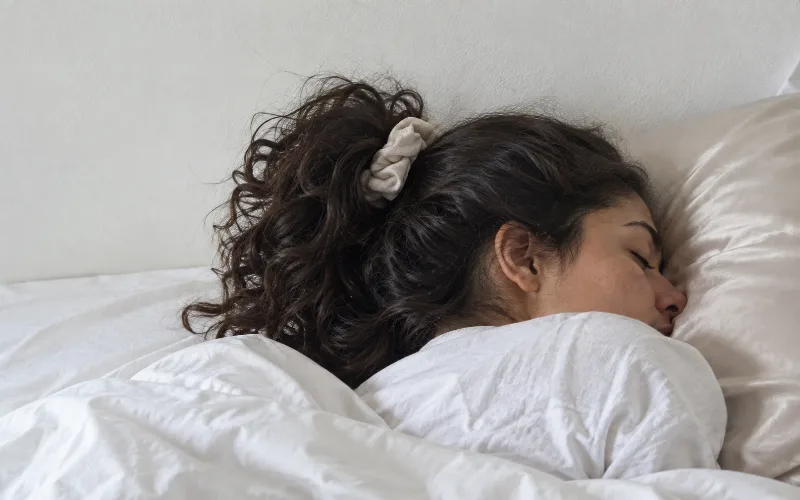
Three things damage hair overnight: friction against the pillow, tension from whatever is holding it, and moisture pulled out by dry air. A smooth pillowcase fixes the first, a loose style fixes the second, and covering the ends fixes the third. Which of the three matters most depends on your hair type, which is why one piece of advice does not work for everyone.
You did everything right before bed and still woke up to frizz on one side, a flat patch at the back, and short broken hairs standing up along your part. Seven or eight hours of your head moving against fabric will do that.
The fix is not complicated, but it is specific. Fine straight hair and tightly coiled hair fail in completely different ways overnight, and the routine that saves one will do nothing for the other.
What actually happens to hair while you sleep
Friction comes first. Every time you turn over, hair drags across the pillow, and cotton has enough grip to lift the cuticle, rough it up and tangle strands around each other. That is where morning frizz and split ends come from.
Tension is the one people underestimate. A tight bun or elastic held for eight hours pulls at the follicle all night, and the American Academy of Dermatology names buns, tight ponytails, braids and hair coverings among the styles that can lead to traction alopecia. Its advice is blunt and easy to apply: if the style feels painful, it is too tight. The hairline is where the damage shows up first, usually as short broken hairs across the forehead.
Moisture loss is the third. Heated or air conditioned bedrooms run dry, and cotton absorbs whatever oil and product you put on your ends before bed. Hair that starts the night conditioned can finish it parched.
Silk, satin, and what the evidence actually says
Worth being straight about this, because most pages on the subject are written by companies selling silk. A medically reviewed GoodRx article on silk pillowcases puts it plainly: there is not research to back up the claims made for them. What it does say is that a silk surface is smooth enough that it is less likely to snag or kink hair overnight, and that silk absorbs less moisture than cotton, so oils and products stay where you put them.
So the mechanism is sound even if the trials are thin. Less grip means less friction, and less absorption means less dryness. That is a reasonable basis for a purchase, and a weaker basis than the marketing suggests.
On silk against satin: silk is a fiber, satin is a weave. A polyester satin pillowcase delivers much of the same smooth surface for a fraction of the price, though it does not breathe as well and tends to sleep warmer. Buy either with confidence. Just do not pay silk prices for something labeled silky or silk-like, which usually means polyester.
Whichever you choose, wash it properly and often. Hand wash or use a gentle cycle in a mesh bag, and hang it to dry rather than putting it in the dryer. Pillowcases also collect oil, product and bacteria faster than people think, which is covered in the guide to skin and environmental hygiene.
Match the method to your hair type
This is where most advice falls down. Fine, straight type 1 hair mainly needs to avoid tangling and dents, curly type 3 hair needs its curl pattern kept off the pillow, and coily type 4 hair such as 4C needs moisture held in above everything else.
| Hair type | What goes wrong overnight | What to do |
|---|---|---|
| Type 1 and 2A, fine and straight | Tangles at the nape, flat roots, oil spreading fast. | Loose high bun or a soft pineapple on top of the head, held with a fabric scrunchie. Silk or satin case. Nothing tight. |
| Type 2B to 3C, wavy and curly | Frizz, flattened curl pattern, second-day definition gone. | Pineapple on top of the head, or one loose braid. Silk or satin case, or a bonnet if the pineapple will not stay. |
| Type 4, coily | Moisture loss and breakage, worst at the ends. | Bonnet or scarf nightly. Moisturize and seal the ends first, then twists or braids to keep strands from tangling on each other. |
Moisture loss and breakage, worst at the ends.
Bonnet or scarf nightly. Moisturize and seal the ends first, then twists or braids to keep strands from tangling on each other.
Two rules apply whatever your hair does. Use a soft fabric scrunchie rather than a thin elastic, since the AAD specifically recommends covered bands and loosely pulled-back hair. And place the tie at the very top or the very end of the length, never in the middle where it presses against the pillow all night.
The strap nobody thinks about
If you wear a sleep mask, the strap matters more for your hair than the fabric over your eyes does. A thin elastic band has to squeeze to stay put, and it sits across the temples and the back of the head, the same zones where tension damage shows up first. If you have ever taken a mask off to find a dented line and a few short hairs standing up along it, that is what was happening.
What to look for is a wide, flat, adjustable band rather than a stretchy one, so the mask holds position without gripping. Drowsy Sleep builds its masks that way, with a padded adjustable band and a mulberry silk face, which is the combination that keeps pressure off the hairline. Any mask works the same way in principle: if it leaves a mark by morning, it is too tight, exactly as it would be with a ponytail.
Do not sleep on soaking wet hair
Hair is at its weakest when it is wet, which is why the AAD tells people with straight hair to let it dry a little before combing. Going to bed drenched means hours of that fragile hair being dragged around a pillow, and a damp scalp under a bonnet is a good way to invite irritation.
Damp is fine and often useful for curls. Soaking is not. If you wash at night, get it to roughly eighty percent dry before you style it for bed.
Questions people ask
Is it better to sleep with hair up or down?
Up, as long as it is loose. A high pineapple or soft top knot keeps length off the pillow and stops it tangling underneath you. Hair worn down gets more friction, and hair tied tightly gets tension damage instead.
Does a silk pillowcase really help hair?
The mechanism holds up. Silk grips hair less than cotton and absorbs less moisture from it, so there is less friction and less dryness. There is no strong research proving the benefit, so treat it as a sensible upgrade rather than a treatment.
Silk or satin pillowcase, which is better?
Silk is a fiber and satin is a weave, so a polyester satin case gives you a similar smooth surface far more cheaply. Silk breathes better and sleeps cooler. Either beats cotton for friction.
Why do I wake up with short broken hairs at my hairline?
Usually tension rather than friction. Tight elastics, tight braids, a headscarf or a sleep mask strap pressing on the same spot every night will all do it. Loosen whatever sits there and see if it settles over a few weeks.
None of this takes extra time once it is habit. Tie it loosely, cover the ends if they need it, and put something smooth under your head. It pairs well with a cut that already holds its shape overnight, and with the rest of what good sleep does for your face. If you are unsure which row of the table applies to you, the hair type quiz sorts it in a couple of minutes.

BeautyLiesTruth publishes hair and personal color guidance built on primary research. Color claims are tested by draping under controlled daylight, and every figure is traced to a published source rather than to another blog.