
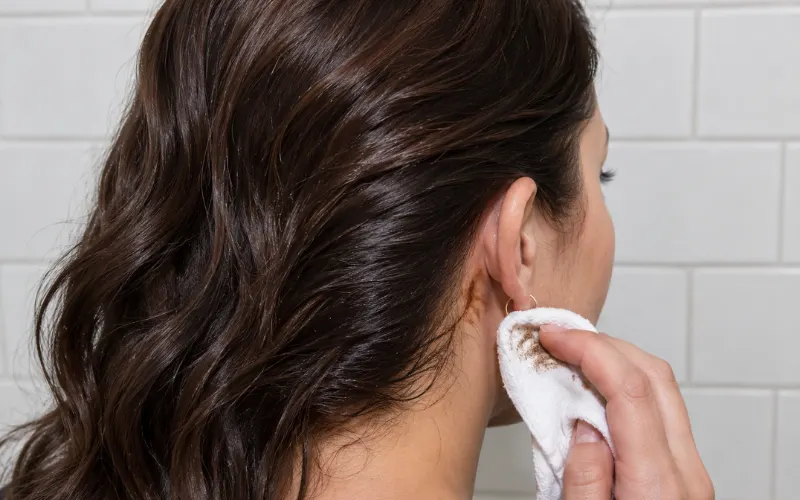
Wipe it now. Caught in the first thirty seconds, a drip comes away on a damp cloth. Nothing left behind.
Ten minutes on, the same drip wants oil. Two goes at it. A day of fading. Most of this article exists because nobody wipes at the right moment.
One other thing decides how hard this gets. Which dye you used.
How Do You Get Hair Dye Off Skin?
Four steps, and most stains give up at two. Soap and warm water first. Then micellar water or makeup remover on a cotton round. Then oil, worked in and left a full minute. Baking soda cut with dish soap is the last resort, and that one is for hands and arms only.
Soap, warm water, soft cloth. Light pressure. Your hairline just sat under developer for 30 to 45 minutes. It is already inflamed. Scrubbing now does more damage than the stain will.
Nothing? Micellar water on a cotton round. Press flat. Count to five. One swipe, then rinse. Use cotton rounds, not tissue. Tissue shreds and leaves fibres in the colour.
Still there. Oil next. Olive, coconut, baby oil, petroleum jelly, whatever is open in the bathroom. Work it in. Leave it a full minute. Most people wipe at twenty seconds and decide it failed.
Baking soda cut with dish soap is the last step. Equal parts. Loose paste. Small circles, 30 to 60 seconds, rinse warm.
Hands and arms. Never the face.
Does Dawn Dish Soap or Vaseline Remove Hair Dye From Skin?
Both work, and so does toothpaste. Each carries a condition nobody mentions. Dish soap is a degreaser and performs best mixed into baking soda. Vaseline is slow but safe near the eyes. Toothpaste works by abrasion, so plain paste only.
Dish soap is a degreaser. That is the whole mechanism. It lifts the oily base the pigment floats in. Alone it is mediocre. Stirred into baking soda it does the heavy lifting. Dry hands afterwards either way, so moisturise.
Vaseline is slow. It is also the only thing here you can use near an eye.
Toothpaste is abrasion. Nothing cleverer. Plain opaque paste. Not gel. Skip the whitening range. The peroxide in those irritates more than the stain did. Below the jaw only.
Does Permanent Dye Come Off Skin?
Yes. Slowly.
It develops inside the outer dead layer. Never reaches living tissue. Day one resists everything. Nobody is still stained a fortnight on.
Blacks and dark browns cling longest.
How to Get Black, Blue or Henna Dye Off Skin
Chemistry decides the method. Black permanent dye, blue semi-permanent and henna all stain skin differently, and each needs a different approach. Almost every guide skips this. It is also why a trick that worked for somebody online does nothing at all for you.
| Dye type | How it stains | What lifts it |
| Permanent and demi | Develops inside the outer skin layer | Oil, then baking soda paste. Patience. |
| Semi-permanent brights (blue, red, purple, Splat, Arctic Fox) | Large pigment sits on the surface | Rubbing alcohol or an oil-based remover. Lifts quickly. |
| Henna | Binds to keratin in the skin itself | Nothing removes it. It fades as skin sheds. |
Permanent colour is oxidative. Small colourless molecules soak in, meet the developer, and become large coloured ones. They are now stuck where they formed. You cannot dissolve them out. Oil and mild abrasion lift the dead cells holding them. Slow by definition.
Brights are the opposite. Blue across a forehead looks permanent. Alcohol on a pad clears it in about four seconds. The pigment is a big molecule. It sits on top. It was never built in place.
Henna is the hard one. Lawsone, the dye in it, bonds to keratin in your skin. No solvent reaches it. Exfoliate gently and give it a week. Anyone promising faster is selling something.
What Not to Use on a Hair Dye Stain
Don’t scrub. The skin there is already inflamed from developer. A loofah trades a brown smudge for broken skin.
You can get hair dye off skin without bleach, and you should. Bleach, ammonia and neat acetone are all out for the same reason. Chemical burns. Weeks of irritation. To shift something that was leaving anyway.
Getting Hair Dye Off Your Face, Hands, Scalp and Nails
Micellar water along the hairline. Work with the edge, not across it. Damp cotton bud for the fold behind the ear. Everybody misses that patch. Check the back of your neck in a mirror too. You cannot see it. That is where drips land.
Scalp: leave it. Two washes.
Nails are the worst of the four. Dense keratin. The colour settles in the ridges. Oil and a soft brush take a day or two. Acetone takes a minute, and the top of the nail plate with it. If you go that way, keep it on the nail.
Beard dye behaves the same way as scalp colour, so treat stained skin around a beard with oil or micellar water rather than anything abrasive.
Sink is a separate job. Bleach cleaner, any brand.
How to Get Hair Dye Off Skin When Dried
Dried stains need softening first. Warm damp cloth, held flat over the mark, a minute or two. Then oil. Past about a day this becomes waiting, and a stain that has survived two washes is already going.
Do Hair Dye Stain Removers Work?
They do. Salon wipes use measured doses of mild solvent. No guesswork. On a fresh mark they do what olive oil does. At ten times the price. On a dark stain oil has already failed to move, that is fine value.
Removing Hair Dye From Sensitive or Eczema-Prone Skin
Stop at step two. Soap and water, then oil or micellar water. Nothing past that.
No baking soda. No alcohol. No toothpaste. All three strip the barrier. A stripped barrier rebuilds slowly. Moisturise while damp and let the colour fade.
How to Stop Hair Dye Staining Your Skin
Prevention beats removal, and it takes about thirty seconds.
Thin line of petroleum jelly, thick conditioner or barrier cream. Hairline, both ears, back of the neck. Gloves on. Check them for splits first. The thin ones in box kits tear constantly. Damp cloth beside you. Wipe each drip as it lands.
Previously lightened hair takes colour faster and drips more. It catches people on a second or third home colour, not a first. Test yours with the hair porosity guide. The hair type quiz reads porosity alongside pattern, width and density.
When a Hair Dye Reaction Needs a Doctor
A stain is cosmetic. A reaction to the dye is not, and it is worth recognising early.
PPD causes most of them. It is standard in permanent colour. DermNet records symptoms arriving from a few hours to a few days after contact. Usually an itchy rash. Upper eyelids, or the rims of the ears. Marked redness, blistering and swelling across eyelids, face or neck signals a severe one. Sensitisation is generally permanent. React once, react next time.
Get help for blistering. Real swelling. A rash spreading past where the dye touched. Any difficulty breathing. Systemic reactions to PPD are rare. They are also documented.
Reacting after every appointment? Raise it with your colourist before the next booking. For shade choice, see the colour analysis quiz. For holding the result once it is in, the purple shampoo guide.

BeautyLiesTruth publishes hair and personal color guidance built on primary research. Color claims are tested by draping under controlled daylight, and every figure is traced to a published source rather than to another blog.