
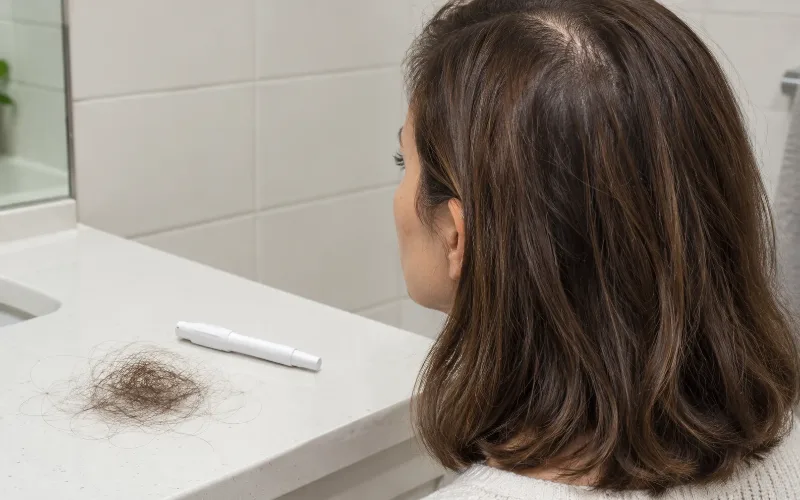
Ozempic has not been shown to damage hair follicles. What it produces is rapid weight loss. Rapid weight loss is a documented trigger for shedding.
That distinction matters. One is a drug side effect. The other is a body reacting to fast weight loss. Any method that drops weight that fast does the same thing.
What the Research on Ozempic and Hair Loss Actually Shows
Evidence linking Ozempic to hair loss is thinner than the headlines suggest.
Sodhi and colleagues took a random sample of 16 million patients. A health claims database. They compared 1,926 semaglutide users against 1,348 on bupropion-naltrexone. Both groups followed to a hair loss diagnosis.
| Group | Adjusted hazard ratio | 95% CI | Significant? |
| Overall | 1.52 | 0.86 to 2.69 | No |
| Women | 2.08 | 1.17 to 3.72 | Yes |
| Men | 0.86 | 0.05 to 14.49 | No, and very imprecise |
Read the overall row first. The confidence interval crosses 1. No statistically significant association across all users.
Three caveats the coverage skips. This is a preprint. Not peer-reviewed. The authors write that “future studies are required to ascertain the association.” And version two notes two problems. Results changed with the diagnosis codes used. The outcome switched from alopecia areata to hair loss partway through.
So: one unreplicated preprint. Non-significant overall. A real signal in women. Any page claiming studies confirmed GLP-1 hair loss is overstating it.
Why Ozempic Causes Shedding Rather Than Balding
Ozempic hair loss is almost certainly telogen effluvium. A shedding pattern, not a balding pattern.
Telogen effluvium starts with a physical shock. It pushes growing follicles into resting phase at once. Those hairs release together, months later.
The American Academy of Dermatology lists the documented triggers. First on that list is losing 20 pounds or more. High stress, surgery, high fever and recovering from illness follow.
Anyone losing real weight on a GLP-1 has met that first trigger by definition, and reduced appetite does the rest, because eating less means less protein, iron, zinc and vitamin D.
Shedding 50 to 100 hairs a day is normal anyway. Telogen effluvium is more than that. From a scalp with normal density.
When Ozempic Hair Loss Starts, and When It Stops
Shedding on Ozempic starts two to four months after the weight loss accelerates. Not at the first injection.
That delay confuses people. A full hair cycle sits between trigger and symptom. By the time hair appears in the drain, the dose has been stable for weeks.
The AAD puts normal fullness back within six to nine months. Once the trigger clears. Regrowth comes in finer, then thickens.
Ongoing stress extends it. So does losing weight fast, because the trigger never stopped.
Is Ozempic Hair Loss Worse in Women?
Women were the only group with a significant effect in the semaglutide study.
The hazard ratio in women was 2.08. Interval 1.17 to 3.72. In men, 0.86. Interval 0.05 to 14.49, too wide to mean anything.
Two things at once. The women’s result is the paper’s strongest finding. It also comes from a preprint with the wobble above. Asignal, not a settled fact.
Women also shed visibly sooner at the same rate of loss, because female pattern density is distributed differently and a widening part shows up faster than diffuse thinning.
Do Wegovy, Mounjaro and Zepbound Cause Hair Loss Too?
The mechanism applies to every GLP-1 that produces fast weight loss. That covers the class.
| Brand | Molecule | Class |
| Ozempic, Wegovy | Semaglutide | GLP-1 agonist |
| Mounjaro, Zepbound | Tirzepatide | GLP-1 and GIP agonist |
| Saxenda, Victoza | Liraglutide | GLP-1 agonist |
Ozempic and Wegovy are one molecule at different doses. Mounjaro and Zepbound are likewise one molecule, two names.
So the brand on the pen matters less than the speed of loss. Shedding tracks the weight curve.
Semaglutide or Tirzepatide: Is One Worse for Hair?
No study has compared semaglutide against tirzepatide for hair loss.The claims study looked only at semaglutide. Bupropion-naltrexone was the comparator. Tirzepatide was not in it.
Tirzepatide does produce greater average weight loss in trials. If rapid loss is the mechanism, faster loss means more shedding. A reasonable inference. Not a measured finding.
So anyone calling one drug safer for hair than the other is guessing.
Does a Higher Ozempic Dose Mean More Hair Loss?
No dose-response relationship for Ozempic hair loss has been established.
The titration schedule exists to limit nausea. Not hair effects. Higher doses do produce more weight loss, which loops back to the actual trigger.
So the useful question is not the dose. It is pounds per month.
Can Ozempic Make Pattern Baldness Worse?
Telogen effluvium and pattern hair loss are different processes. They can run at once.
Shedding is temporary and recovers. Androgenetic hair loss is progressive and does not. Someone with early pattern loss who sheds heavily can end up with permanently less coverage. The shed exposes thinning already underway.
That scenario wants a dermatologist, not a supplement. The thinning hair guide covers the assessment. The hair types overview covers how patterns get classified.
How to Tell Ozempic Shedding From Other Hair Loss
Three checks separate shedding from thinning. Worth doing before you change anything.
Count the hairs. Do not estimate. Shedding means well above 50 to 100 a day, from a scalp that still looks dense.
Look at where it comes from. Telogen effluvium is diffuse. Pattern loss concentrates at the part, the crown or the temples.
Check the texture of what remains. Shedding leaves survivors the same thickness. Pattern loss miniaturizes them, so the hair gets finer over time.
That last one is the most reliable. Also the most often missed. The hair type quiz reads texture, density and porosity together. That is your baseline for three months from now. The hair types chart places your pattern. Fine hair is not thinning hair. The two get confused constantly. Nutritional shortfalls change how hair behaves too, and the hair porosity guide covers testing for it.
A flaking or inflamed scalp is a separate problem. Separate answers too. The dandruff guide covers it.
What to Eat to Protect Hair on Ozempic
Protein is the lever most people on Ozempic are missing. Appetite suppression cuts it first.
General weight-loss guidance sits around 1.2 to 1.6 grams per kilogram daily. Above the adult minimum, to protect lean tissue. Hair is keratin, so the same intake matters.
Eating less also means less iron, zinc and vitamin D. Those are the deficiencies linked to shedding. A smaller plate reaches them fast.
Ask a prescriber for bloods rather than guessing. Ferritin, serum iron, zinc, vitamin D, thyroid function. Thyroid matters because hypothyroidism sheds hair on its own. Easy to miss alongside a new medication.
Slowing the rate of loss is the other lever. Also the one people least want to hear. The weight loss is the point.
Do Biotin Supplements and Minoxidil Help?
Biotin only helps actual biotin deficiency. That is rare.
Supplementing without one has no established effect on hair. High-dose biotin also interferes with some lab assays. Thyroid and cardiac tests among them. Mention any supplement before bloods are drawn.
Topical minoxidil is different. Real evidence behind it for pattern hair loss, and it gets used during shedding episodes. One catch. It increases shedding for the first few weeks before it helps.
Correcting a measured deficiency beats supplementing on spec, because iron, zinc or vitamin D replacement only works when the level is actually low. The guide to supporting skin and hair covers the inputs that matter.
Should You Stop Ozempic If Your Hair Falls Out?
That is a decision for whoever prescribed it. Stopping gives no quick answer anyway.
Hair cycles slowly. A change made this week surfaces in two to four months. Quitting and watching the drain for a fortnight tells you nothing. The shedding in progress was triggered months ago. It continues regardless.
Ozempic is also prescribed for type 2 diabetes. And for cardiovascular risk reduction. Not only weight. Stopping has consequences unrelated to hair.
The productive conversation covers rate of loss, protein intake and bloodwork. All three change without stopping the drug.
Frequently Asked Questions
Will my hair grow back if I stop Ozempic?
Telogen effluvium is temporary. The AAD puts normal fullness back within six to nine months, once the trigger clears. Recovery depends on the weight loss stabilizing, not on stopping the drug. Pattern hair loss underneath will not reverse on its own. That is why telling the two apart matters.
What vitamins should I take for Ozempic hair loss?
Correcting a measured deficiency is what works. Ask for ferritin, serum iron, zinc, vitamin D and thyroid function first. Protein matters more than any supplement. Biotin only helps actual deficiency, which is rare, and high doses interfere with several lab tests including thyroid panels.
What are the side effects of taking Ozempic for weight loss?
The common ones are gastrointestinal. Nausea, vomiting, diarrhea, constipation. Worst during dose increases. Rarer but serious concerns include pancreatitis and gallbladder problems. The label also carries a thyroid tumor warning from rodent studies. Hair shedding is not a labeled side effect. It reads as a weight-loss effect.
Does Ozempic affect thyroid function?
Semaglutide carries a boxed warning about thyroid C-cell tumors. From rodent studies. Not established in humans, and different from thyroid hormone function. Thyroid disease is still worth testing for when hair sheds. Hypothyroidism sheds hair on its own, and the timing looks like a drug effect.
How long does it take to lose 20 pounds on Ozempic?
It varies widely by starting weight and dose. Trial averages run over months, not weeks. The figure matters for one reason. Twenty pounds is the AAD’s first listed shedding trigger, so hitting it fast is what raises the risk, whatever the drug happens to be.
Why do Reddit threads blame Ozempic directly?
Because the timing feels conclusive from the inside. Shedding arrives two to four months after the weight loss accelerates. By then the drug is the obvious variable. Threads rarely separate three groups. People shedding from rapid weight loss. People with undiagnosed pattern loss. People who overhauled their diet at once.

BeautyLiesTruth publishes hair and personal color guidance built on primary research. Color claims are tested by draping under controlled daylight, and every figure is traced to a published source rather than to another blog.