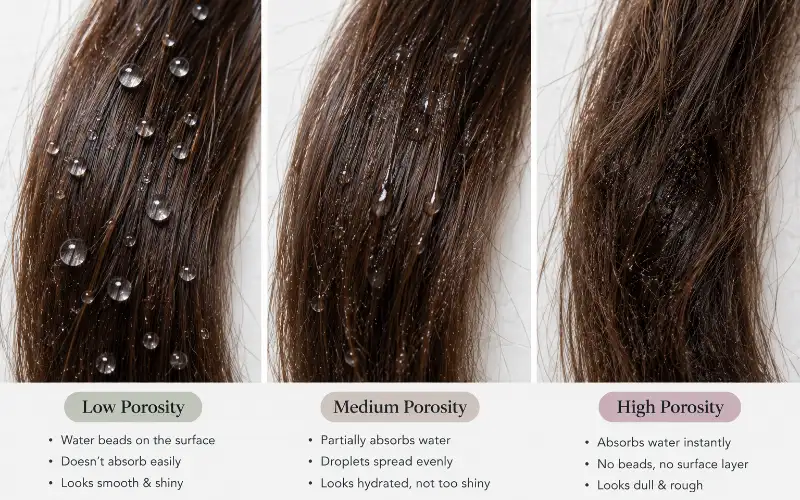
Hair porosity describes how readily water crosses into the hair shaft and how long it stays there once inside. Low porosity resists water going in and, having taken it in, holds onto it. High porosity absorbs quickly and loses it just as quickly.
What almost every guide on this subject leaves out is that porosity is mostly acquired rather than inherited. Hair leaves the follicle water repellent by design. Porosity measures how much of that design is still intact.
What Hair Porosity Actually Measures
The outermost surface of a healthy strand is not keratin. It is a single layer of fatty acid called 18-methyleicosanoic acid, bonded to the cuticle and roughly one nanometre thick. Cosmetic chemists shorten it to 18-MEA, and it is the reason water beads on virgin hair instead of soaking in.
The effect is measurable rather than theoretical. Researchers testing hair surfaces recorded a water contact angle of 95.75 degrees on virgin hair, meaning a droplet sat up on the fibre rather than spreading across it. On hair with the 18-MEA removed, the droplet lost its shape the moment it touched the strand and no angle could be recorded at all.
That reframes the usual explanation. Lifted cuticle scales are real and they do matter, but the first thing lost is the lipid film, and once it has gone water enters across the whole surface rather than through gaps at the edges of scales.
The Three Levels of Hair Porosity
| Water going in | Water staying in | Usual cause | |
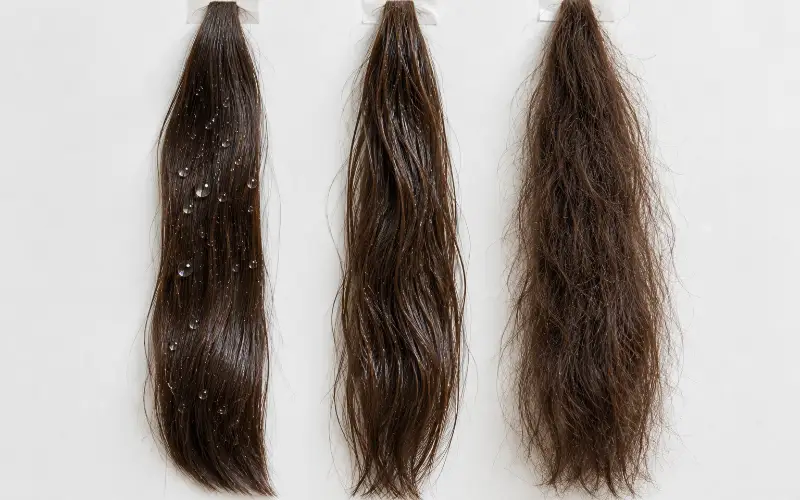
| Low | Slow, beads on the surface | Held for a long time | Intact lipid layer, often untreated hair |
| Medium | Moderate and even | Held for a reasonable time | A functioning cuticle with light wear |
| High | Fast, absorbs almost instantly | Lost quickly | Bleach, relaxer, heat, UV and age |
Low Porosity Hair Characteristics
Water beads and rolls off before it soaks in. Products sit on the surface and build up instead of absorbing. Wash day takes longer because the hair resists getting properly wet, and drying afterwards takes longer still. Conditioner can feel like it is coating rather than conditioning.
Low porosity is frequently a sign of healthy, undamaged hair, which is worth saying plainly because it is usually presented as a problem to fix.
High Porosity Hair Characteristics
Water disappears into the strand almost on contact. Hair soaks through in the shower quickly and air dries quickly too. Frizz appears in humidity, colour fades early, and the ends tangle and snap more than the mid lengths.
Running a finger up a single strand towards the root gives the clearest signal, because high porosity hair feels rough and slightly bumpy rather than smooth.
Medium Porosity, the Level Nobody Writes About
Most heads land here, and it attracts almost no content because there is very little to sell to it. Medium porosity takes water at a steady rate, holds a style, accepts colour predictably and tolerates most product weights. A guide claiming every reader is either low or high is describing a marketing split rather than a population.
How to Determine Hair Porosity
Two tests are worth doing, and both need clean hair with no product, oil or silicone on it. Residue is what ruins porosity testing, so the strand has to come from freshly washed, fully dried hair.
The Spray Bottle Test
Mist a small section of clean dry hair with room temperature water and watch for thirty seconds to a minute. Droplets that sit on top without moving indicate low porosity. Droplets that soak in within about a minute indicate medium. Water that vanishes on contact indicates high porosity.
This is the most reliable home test because it measures the thing porosity is actually defined by, which is the rate water crosses the surface.
The Slide Test
Take one clean shed strand, hold it at the tip and slide a finger and thumb upward towards the root. A smooth slide suggests an intact cuticle and low to medium porosity. A rough, catching or bumpy slide suggests raised and damaged scales, which is high porosity.
The slide test is quick and it works well as a confirmation of the spray result. It reads texture rather than absorption, so it is a second opinion rather than a replacement.
Why the Float Test Fails
The glass of water test, where a strand is dropped in and watched to see whether it floats or sinks, is the most repeated porosity test online and the least trustworthy. Google’s own summary for this topic now flags it as inaccurate because of oil and residue, and the New York Society of Cosmetic Chemists describes the qualitative home tests as having limitations and offering only a general idea under controlled conditions.
The mechanism explains why. A healthy strand is water repellent by design, so floating is the correct behaviour of undamaged hair. A damaged strand carrying sebum, silicone or leave-in residue is also water repellent, because that residue restores the surface the bleach removed. Both float. Surface tension alone will hold a light, fine strand on the water film regardless of what its cuticle is doing, and static picked up from a comb changes the result again.
Salon practice reflects this. Colourists assessing porosity before a service go by how the hair feels wet, how fast it takes water at the basin and how quickly it swells, not by floating a strand in a cup.
How Porosity Is Measured Properly
Laboratories do not use any of the home tests. Dynamic vapour sorption tracks how much water a weighed sample takes up at controlled humidity. Gas adsorption measures pore size within the fibre directly. Fibre swelling measures how far a strand expands in diameter once saturated.
Those methods produce the figures the home tests only gesture at. Normal porosity hair reaches about 75 percent of its maximum water uptake within four minutes, which is the sort of number no glass of water can give anyone.
What Causes High Porosity Hair
Bleach is the largest single cause, followed by relaxers, permanent colour, repeated flat ironing and sustained sun exposure. Each of these strips or degrades the 18-MEA layer, and mechanical wear from brushing and towel drying finishes the job along the older lengths.
Chemistry alone does not do all of it. One study of hair surfaces found the advancing contact angle fell from around 120 degrees on untreated fibres to roughly 100 degrees after bleaching, then down to about 70 degrees once those bleached fibres had also been weathered. Bleaching opened the door and time, friction and UV walked through it, which is why porosity climbs from mid length to ends on a head that has been coloured once.
Age contributes as well, and so does genuine inheritance at the margins. Very tightly coiled patterns tend towards higher porosity because each bend in the fibre is a point where the cuticle lies less flat. The 4C hair guide covers why that geometry also concentrates mechanical stress.
Is High or Low Porosity Hair Better?
Low porosity is closer to undamaged, which makes it the healthier state rather than the better one. It comes with real inconveniences, chiefly product buildup and hair that refuses to get wet on wash day.
High porosity is the harder one to live with, since it needs sealing, more frequent conditioning and protein to hold together. Medium porosity is the easiest by a distance. None of the three is a goal, because porosity is a condition report rather than a hair type.
What Is the Worst Hair Porosity to Have?
High porosity, on the grounds of maintenance rather than appearance. Colour will not hold, humidity undoes a style within the hour, and the fibre loses water fast enough that the ends stay permanently dry.
There is a second problem that gets less attention. Highly porous hair takes water in so readily that it swells and contracts with every wash, and repeated swelling weakens the fibre over time. That cycle is called hygral fatigue, and it is the reason very porous hair sometimes worsens under a routine built entirely around adding more moisture. It shows up most often on the tighter patterns where moisture routines run heaviest, 3C hair among them.
How to Improve Your Hair Porosity
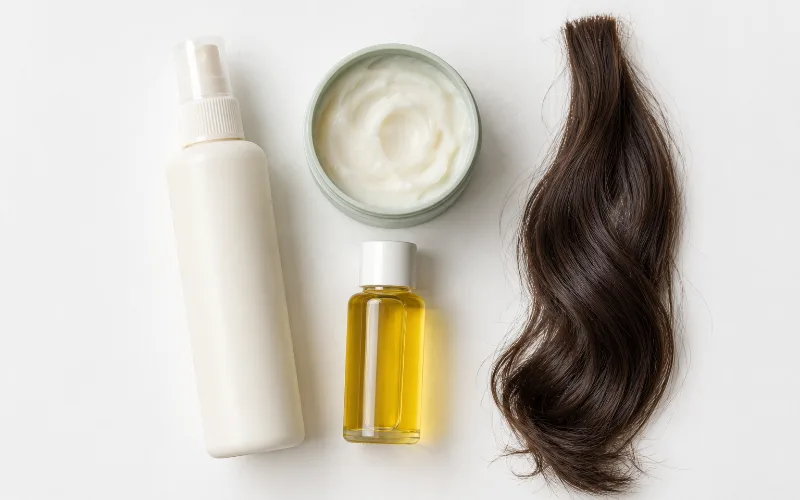
Porosity cannot be lowered back to its original state, because the lipid layer does not regrow on hair that has already left the scalp. What can be done is replacing its function and preventing further loss.
For high porosity, that means protein treatments to fill the damaged cortex, a leave-in to hold water in, and a sealing oil or cream applied over damp hair rather than dry. Bond builders work on the same principle. Restoring a lipid-like layer measurably helps: bioconjugated fibres in the study above returned to 9.98 percent moisture content against 10.13 percent for virgin hair and 8.19 percent for stripped hair.
For low porosity, the fix runs the other way. Use lightweight, water-based products, apply conditioner to damp rather than soaking hair, and add gentle warmth during a deep conditioning treatment so the cuticle relaxes enough to let anything in. Heavy butters and most oils will sit on the surface and build up. Clarifying every few weeks does more for low porosity hair than any moisture product.
Why Knowing Your Porosity Is Worth the Five Minutes
It decides product weight, which is the single most common thing people get wrong. The same cream that saves high porosity ends will flatten low porosity hair for two days. It also predicts how colour will take, how long a blow dry will last and whether protein will help or make things brittle.
Porosity Is Not a Hair Type
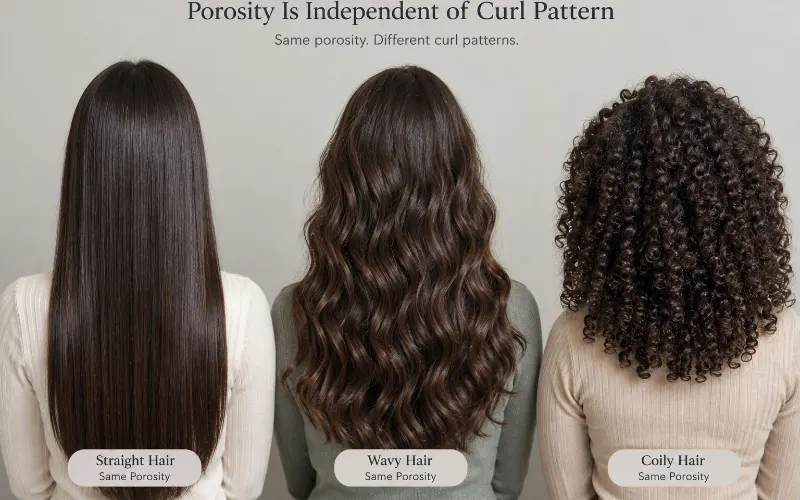
Curl pattern and porosity are independent measurements, which is why the hair types chart cannot tell anyone how to wash their hair. Straight 1A hair can be highly porous after a bleach, and type 4 hair can be low porosity and entirely undamaged.
Three separate things decide a routine. Curl pattern decides shape, covered across the hair types guide and the curl types chart. Strand width decides how much weight the hair can carry before it collapses, covered in the guide to fine hair. Porosity decides what the hair will let in and how long it keeps it.
That combination is why two people with identical 2C hair can need completely different products, and why a routine borrowed from someone with the same curl pattern so often fails. The hair type quiz reads pattern, width, density and porosity together rather than treating the curl code as the whole answer.

BeautyLiesTruth publishes hair and personal color guidance built on primary research. Color claims are tested by draping under controlled daylight, and every figure is traced to a published source rather than to another blog.