
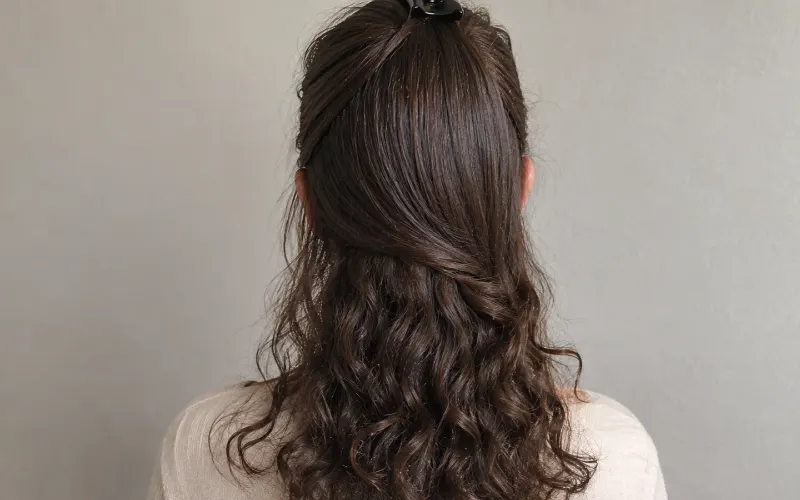
Irish curls describe hair where the top layer sits straighter or looser than the layers underneath it. The canopy reads as straight or softly waved, while the sections at the nape, behind the ears and under the crown form tighter waves or curls.
It is not a hair type, it is not rare, and the link to Ireland does not survive contact with the genetics. All three are worth going through, because the term has travelled far enough that nobody stops to check what is behind it.
Are Irish Curls Rare?
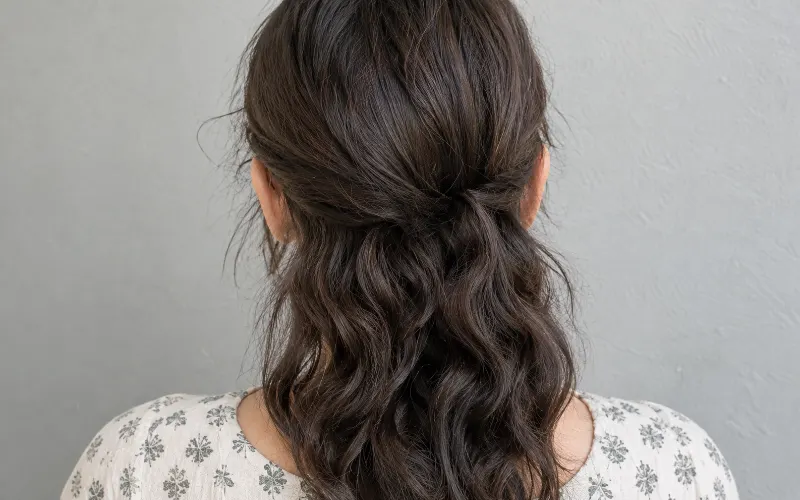
No, and the people who see the pattern professionally say so directly. Curly hair specialist Libby Brenner, asked about the trend, described it as ordinary salon traffic: “It’s very common and I see it quite often in my chair.”
The reason it feels like a discovery is that most people have never seen their own under-layers dry untouched. Blow drying, brushing and a fixed parting all flatten the canopy, and the tighter pattern below only shows itself once someone stops heat styling and lets everything air dry. What gets described online as finding out you have Irish curls is usually hair that has been doing this the whole time.
Why the Top Layer Is Straighter Than the Rest
Two things stack up, and neither is genetic.
The first is weathering. The canopy takes the sun, the friction of brushing, the towel and the heat, while the under-layers sit protected. That damage strips the lipid layer that keeps the cuticle water repellent, and once it goes the fibre behaves differently. In one study of hair surfaces, the advancing water contact angle fell from around 120 degrees on untreated hair to roughly 100 degrees after bleaching, then to about 70 degrees once those fibres had also been weathered. A cuticle in that state holds a curl far less well than a sheltered one.
The second is weight. This pattern turns up most often on dense, coarse hair, and a heavy canopy with no layers cut into it pulls its own curl out by sheer mass. That is why the same head can look straight on top in March and wavy in July, and why a cut changes the result more than any product does.
So the gradient is a damage and weight story with a curl pattern underneath it, not a separate texture. The guide to hair porosity covers what that lipid loss does to the rest of a routine.
Where the Term Came From
The term is recent and it has a traceable origin. It surfaced on TikTok through creator LiterarilyLiz, who used it to describe a pattern she associated with Celtic ancestry, and it spread through the curly hair side of the platform from there. Irish outlet Stellar was covering it as an established trend by September 2024.
Its author walked the framing back almost immediately. She clarified that she “only mean[t] its a hair pattern that shows up a lot in people who have Celtic ancestry” and apologised to anyone who read it as a claim that the pattern was exclusively Irish, or that every Irish person had it.
That clarification did not travel as far as the term did, which is how a loose observation about one creator’s own hair became a named hair type inside a year. The beauty press picked it up through 2025, the hashtag kept running, and by the time anyone asked what the evidence was, the name had already stuck.
Why it is called Irish curls, then, comes down to one creator’s read on her own ancestry and nothing more. The naming follows the same route as a French braid or German chocolate cake, where a place name attached itself to something that has no particular connection to the place.
Are Irish Curl-s Actually Irish?
The genetics point the other way, which is the part no coverage of this trend has picked up.
Curl in European populations is shaped substantially by the trichohyalin gene. A genome-wide study of 4,845 people found that variants in TCHH account for around 6 percent of the variance in hair morphology among Europeans, and the researchers noted that the straight-hair variants sit at their highest frequency in Northern Europeans.
Northern Europe is where the straight-hair allele is most common, not least common. Naming a curl pattern after Ireland runs directly against the one piece of population genetics that covers the region. No study has ever examined Irish hair as a category, and no dataset ranks any national population by curl pattern beyond the broad regional figures covered in the most common hair type guide.
The pattern itself shows up everywhere. It is a consequence of how hair sits on a head and what the weather does to the outside of it, which is not an ancestry trait.
What Hair Type Are Irish Curls?
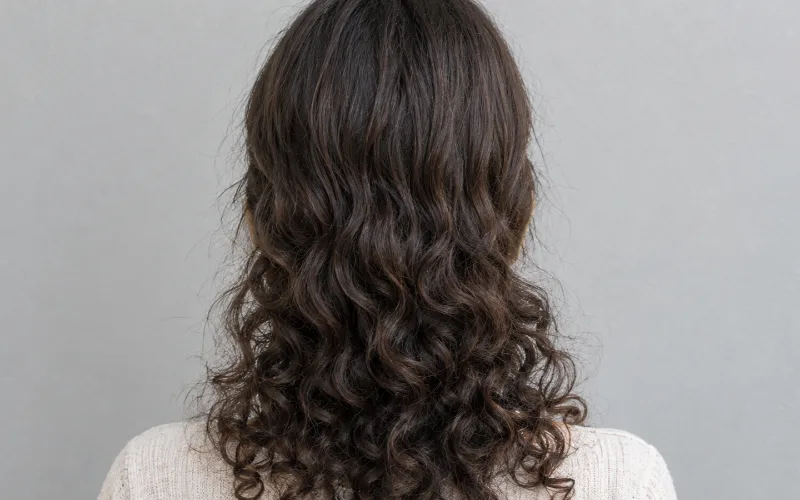
There is no code for it, because the whole point of the pattern is that one head carries two. The usual arrangement:
| Layer | Typical codes | What it looks like |
| Canopy | 1B to 2B | Straight with a bend, or a loose open S |
| Mid lengths | 2B to 2C | Defined S waves, some frizz |
| Nape and under-crown | 2C to 3B | Tighter waves through to loose ringlets |
Someone with the full spread might read as 1B hair on top and 3A hair underneath, which is why a single code never fits and why product recommendations built on one code keep failing.
Most heads with this pattern sit inside the wave family overall. The wavy hair types guide covers the 2A to 2C range, and the hair types chart sets all twelve codes side by side for comparison.
Do I Have 2C or 3C Hair?
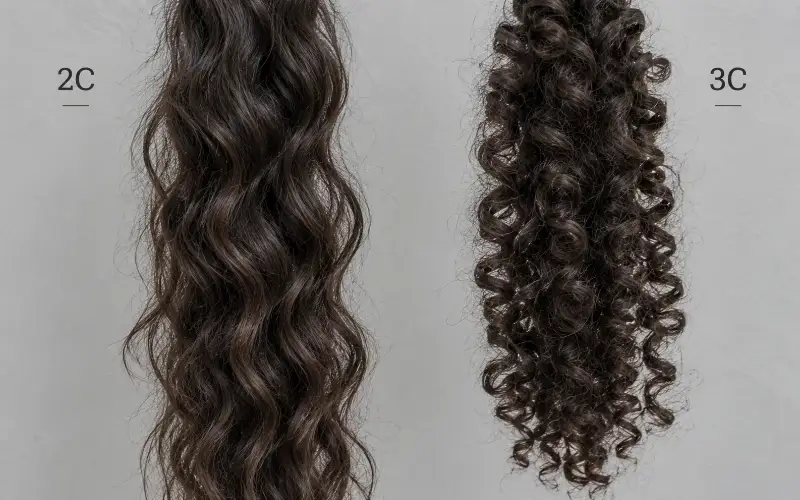
The two are far enough apart that the test is quick. 2C hair forms defined S waves that lie against the head, with the bend visible but the strand still broadly flat. 3C forms corkscrews with a circumference close to a pencil, and the strand wraps into a tube rather than an S.
If the under-layers of hair described as Irish curls read as anything, it is usually 2C or 3B hair, rarely 3C. Anyone landing on 3C from a canopy that reads as straight is almost certainly measuring a piece that has been pulled tight by shrinkage rather than looking at the curl itself.
Irish Curls on Hair That Reads as Straight
A canopy that looks completely straight sits at one end of the same spectrum, and it is the version people find hardest to believe about themselves. The giveaway is the nape. Lift the top section at the back of the head after a wash, leave it alone while it dries, and look at what the shortest hairs there are doing.
Straight on top with waves underneath usually means a 1B canopy sitting over 2A hair or 2B beneath. It is common on dense hair, on hair that has been blow dried for years, and on anyone who wears a heavy fringe or a tight ponytail. Weight and friction flatten the outer layer long before the hair itself changes.
Three weeks without heat is enough to find out. The canopy will not transform, but it will usually start bending, and the gap between the two layers narrows once the outermost fibres stop being cooked every morning.
What Is the Rarest Hair Type?
Unanswered, and worth saying plainly because the question keeps appearing next to this trend. No published dataset ranks the twelve consumer codes by prevalence, so every list naming a top three rarest is repeating other lists rather than citing a count. The rarest hair type page traces where those claims originated.
Irish curls are not a candidate for rarest under any reading. A mixed canopy is closer to the default condition of wavy hair than to an exception.
What Haircut Is Best for Irish Curls?
Layers, and enough of them to matter. The problem is weight sitting on top of the curl, so removing bulk from the canopy lets the lower sections spring up and closes the gap between the two textures.
Long layers cut into dry hair, section by section, work better here than wet cutting, because a curl cut wet will sit somewhere different once it dries. A curly specialist cut is worth the premium on this pattern specifically, since the whole job is judging where each section lands when it is dry.
Blunt one-length cuts do the opposite. They add weight exactly where the hair is already too heavy and widen the difference between canopy and nape.
How to Treat Irish Curls
Keep the products light. Mousse and a soft-hold gel give the canopy something to form around without dragging it flat; heavy creams and butters sized for tight curls will grease the top section and do nothing for it.
On shampoo, a sulphate-free formula with a light conditioning base suits the mixed pattern best, since the canopy needs cleansing more often than the drier ends underneath. Clarify every few weeks if lightweight products are still building up.
For drying, scrunch upward with a microfibre towel or cotton tee rather than rubbing, then diffuse on low heat and low speed with the head tipped so the canopy sections hang free. Air drying works too and is gentler, but it usually leaves the top layer flatter.
Protecting the canopy from further weathering is the one thing that stops the gap widening: UV protection in summer, less heat, and a silk pillowcase all do more than any treatment sold for the pattern.
Can You Get Rid of Them, and What Are Reverse Irish Curls?
Not really, and the attempt usually makes it worse. Straightening the under-layers to match the top means heating the healthiest hair on the head until it is damaged enough to match the most damaged hair, which is a poor trade.
The realistic direction runs the other way, encouraging the canopy back towards the pattern underneath by cutting weight out, cutting heat, and letting the fibre recover what it can. That is what people online mean by reverse Irish curls, where the top layer holds more curl than the sections beneath it. It usually happens on hair where the under-layers have been flattened by friction against a collar or a pillow rather than by sun.
Neither version is a defect. Mixed texture is what most wavy heads look like once heat comes out of the routine, and the codes only ever described one strand at a time anyway. The hair type quiz reads pattern, strand width, density and porosity together, which is the combination that actually decides what to put on hair like this.

BeautyLiesTruth publishes hair and personal color guidance built on primary research. Color claims are tested by draping under controlled daylight, and every figure is traced to a published source rather than to another blog.