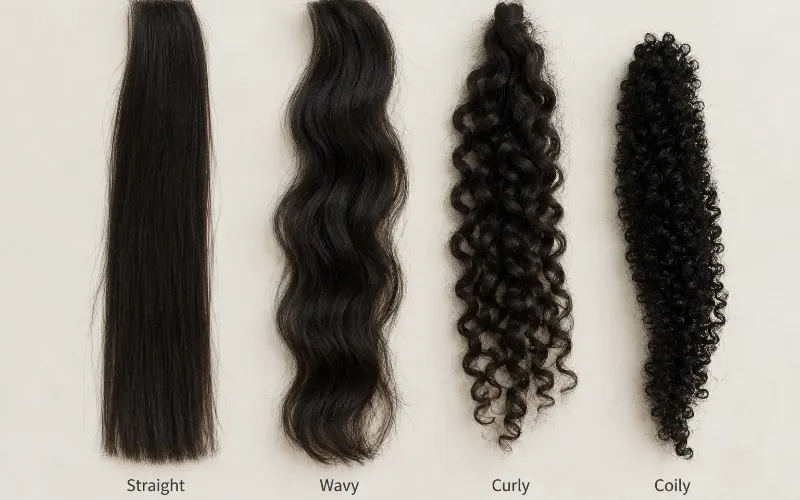
Straight hair is the usual answer, and for once the usual answer holds up. Type 1 is the most widespread curl pattern worldwide, mostly because the regions where straight hair predominates are also the regions holding the largest populations.
What almost no page on this question does is show the measurement behind the claim. One exists, it is recent, and it is more interesting than the headline.
What the Largest Study Actually Found
A multinational survey published in Clinical, Cosmetic and Investigational Dermatology in February 2025 recorded hair characteristics for 19,461 people across the United States, France, Brazil, India, China, Mexico, Japan, South Africa and Indonesia. Participants reported curl degree on a visual scale as straight, wavy, curly or kinky, alongside thickness and condition.
Straight and wavy hair together came out as the predominant pattern across the sampled countries. The variation between them was enormous, which is the part worth carrying away. Straight or wavy hair accounted for 86.6 percent of participants in China and 84.3 percent in Japan. Curly hair reached 42.6 percent in Brazil and fell to 5.5 percent in China. Kinky hair reached 59.4 percent in South Africa and 0.9 percent in Japan.
Nine countries is not the world, and self-reporting against a picture is not a laboratory measurement. It is still the closest thing to real prevalence data anyone has published, and it is more than any of the beauty sites answering this question have cited.
The Most Common Hair Type by Region
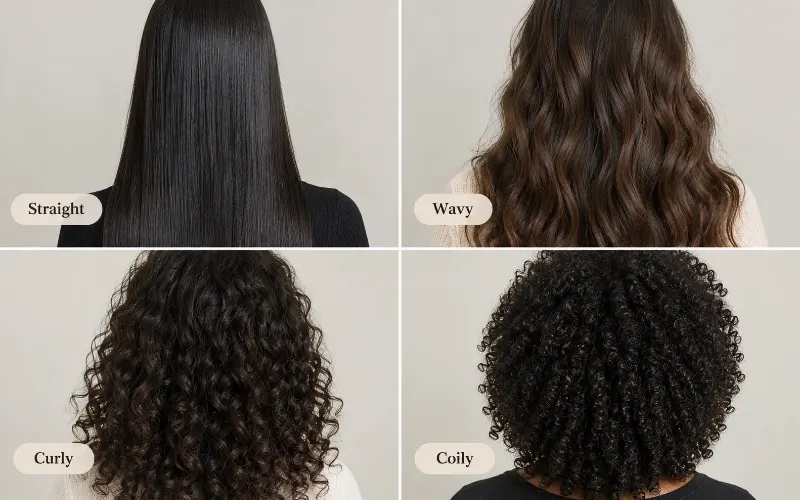
Asia gives the clearest result. The straight and wavy share in China and Japan sits above 85 percent, and combined with the population sizes involved, that is the single biggest reason straight hair leads globally.
Africa runs the other way. South Africa returned the highest kinky proportion in the study at 59.4 percent, which matches what the type 4 hair guide describes as the dominant family across much of the continent and the African diaspora.
The Americas are the most mixed. Brazil produced the highest curly share of any country surveyed at 42.6 percent, a reflection of centuries of population mixing rather than any single ancestral pattern. The United States sits mixed too, which is why wavy hair is so often named the most common American type in consumer surveys.
Europe was represented by France alone, so anyone stating a European figure with confidence is extrapolating. The honest position is that straight and wavy dominate the continent with curly well represented around the Mediterranean, and that no published dataset breaks it down properly.
The Most Common Hair Type for Black People
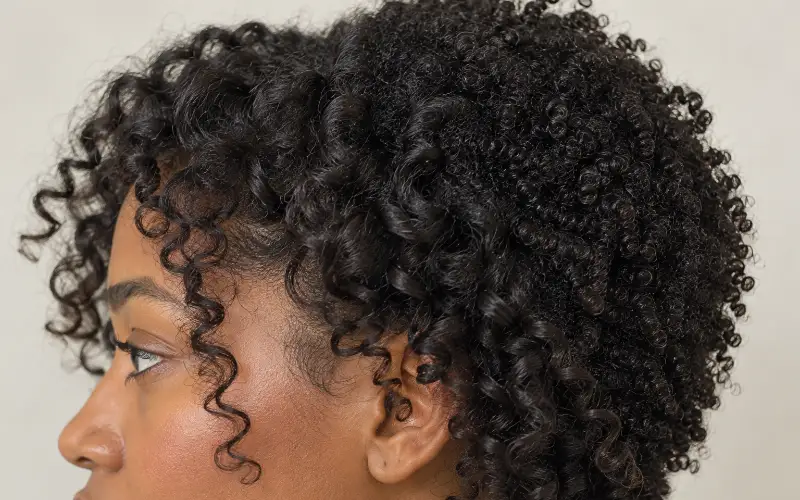
Type 4 is the dominant family, and the range inside it is wider than most guides admit. The South African figure of 59.4 percent kinky hair in the study above leaves a substantial minority with curly and wavy patterns, and across the African diaspora the spread runs from type 3 through every type 4 code.
Treating Black hair as one texture is the most common error in this space. A 3C hair corkscrew and a 4C hair zigzag need different handling, different product weight and different detangling, and plenty of heads carry both at once. The hair types chart sets all twelve codes side by side.
Most Common Hair Type for Men and Women

The same study found that curly hair was significantly more frequent among women, while kinky hair was significantly more frequent among men.
That gap is unlikely to be biological. Women in most of the sampled countries are far more likely to straighten, relax or chemically treat their hair, and they are also more likely to be looking closely enough to notice a wave. Self-reported curl on a treated head is reporting the result, not the follicle. The finding says as much about grooming culture as about hair.
Why Straight Hair Became So Common
The interesting history sits in genetics rather than in beauty. A variant of the EDAR gene, EDAR V370A, is carried by most people of East Asian descent and produces thicker, straighter hair along with other changes to skin and sweat glands.
Researchers at University College London modelled when it appeared and placed its origin in central China, with a most likely estimate of about 30,900 years ago and a range running from roughly 13,000 to 39,500 years. The work was published in Cell in 2013 and used a mouse model carrying the human variant to confirm what it does.
One variant spreading through a population that later grew very large is most of the answer to why straight hair leads the global count. It is a fact about demography and one gene, not a statement about which hair is normal.
Where the Type Numbers Came From
The 1A to 4C labels have a much shorter and much less scientific history. Andre Walker published the system in 1997 in a mass-market book, while working as Oprah Winfrey’s stylist, and designed it to help readers match products rather than to describe hair biology.
The measured research runs in parallel and has never used those codes. A L’Oreal Recherche team led by Roland de la Mettrie assessed hair from 1,442 people across 18 countries for Human Biology in 2007, building eight categories from curve diameter, curl index and wave count specifically to classify hair without reference to ethnicity.
So two systems exist side by side. The one with the numbers everyone quotes has no prevalence data attached, and the ones with real measurements do not use those numbers. The hair types guide covers the full consumer system and what each code means.
Hair Type and Hair Texture Are Different Counts
Curl pattern and strand width are separate measurements, and the most common answer differs for each. Straight leads on pattern. Medium leads on strand width, with fine and coarse sitting either side of it.
The two are independent, which is why a person can have the most common pattern and an uncommon texture at the same time. The guide to fine hair covers how to test width, and why the fine, medium and coarse scale has no agreed measurement behind it either.
What Is the Rarest Hair Type?
Unanswered, despite how often it gets answered. No published dataset ranks the twelve consumer codes by prevalence, so claims naming 1A or any other code as rarest are repetition rather than evidence. The rarest hair type page traces where that claim came from.
Worth noticing that the commonness question has better data behind it than the rarity question, because broad categories can be surveyed while twelve self-reported codes cannot.
What Ethnicity Has Type 1 Hair?
Straight hair occurs everywhere. It is most prevalent across East Asian populations, where the study figures above put it above 85 percent, and it is also common across Europe, South Asia, the Middle East, indigenous American populations and plenty of mixed-heritage backgrounds.
The reverse claim does not hold either. No ethnicity has one hair type, and the variation inside any single group is wider than the average difference between groups, which is exactly what the de la Mettrie work set out to demonstrate.
What Is the Hardest Hair Type to Have?
A fairer question than which is prettiest, and it does have an answer. Tightly coiled hair takes the most time and the most care, because each sharp bend in the strand concentrates mechanical stress at that point and scalp oil cannot travel the length of a coil to reach the ends.
Fine straight hair is difficult for the opposite reason. It carries almost no weight before it flattens, shows scalp oil within a day, and drops a set within hours. Difficulty is about the mismatch between a routine and a pattern rather than a ranking of the patterns themselves.
Is 1B Hair Rare, and Am I 1C or 2A?
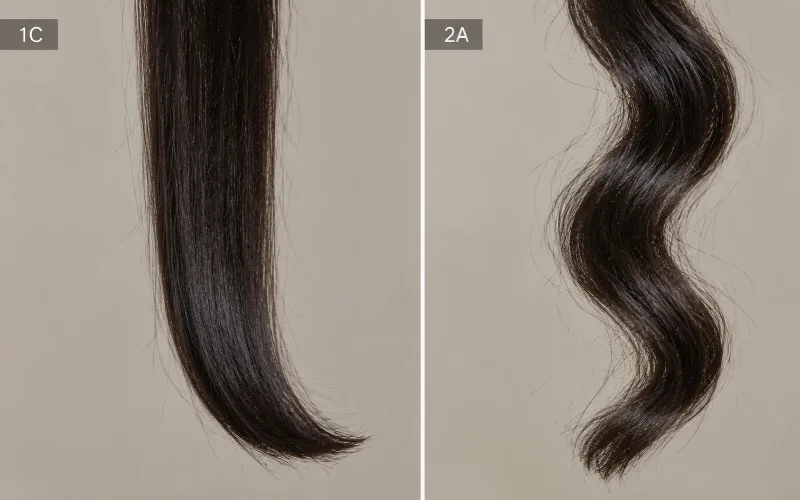
Neither question has a prevalence answer, but both have an identification answer. 1B is straight hair with a soft bend at the ends and medium strand width, covered on the 1B hair page.
The 1C and 2A line is the one people cross most often. A 1C hair strand bends once or twice and stops. A 2A hair strand forms an open S and then forms another below it. The repeat is what makes it a wave.
Common or rare, the code decides very little on its own. Strand width, density and porosity decide most of a routine, and the hair type quiz reads all four together.
BeautyLiesTruth publishes hair and personal color guidance built on primary research. Color claims are tested by draping under controlled daylight, and every figure is traced to a published source rather than to another blog.