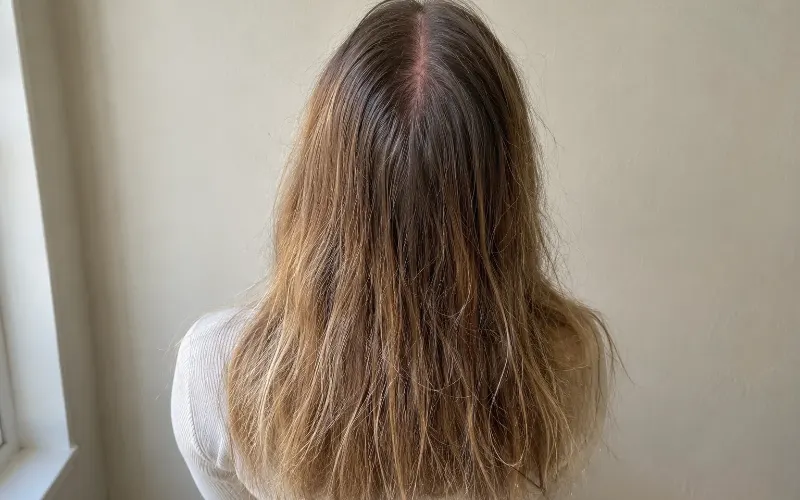
Sunlight does two separate jobs on your head. UVB breaks down the protein in the hair fiber, and UVA shifts its color. Neither reverses, because a strand of hair is not living tissue and cannot repair itself. The scalp underneath is living skin, so it burns, it heals, and it is the only one of the two that sunscreen protects.
You notice it in August. The ends feel like straw, the color you paid for has gone brassy, and the skin along your part is pink and tight. Three different problems, and the advice that fixes one does nothing for the others.
UVB and UVA do not damage hair the same way
Researchers at the State University of Campinas exposed dark brown, blond, red, black and curly hair to different slices of the spectrum, then measured what came off the fiber. The results, published in the Journal of Photochemistry and Photobiology B, were clear. Every hair type lost more protein after irradiation, and UVB caused two to five times more protein loss than UVA plus visible light. Color went the other way. UVA drove that change, lighter hair shifted more than dark, and the biggest contributor was luminosity: hair got brighter, not a different hue.
| Wavelength | What it hits | What you notice | What helps |
|---|---|---|---|
| UVB | Keratin protein. Two to five times more loss than UVA. | Straw texture, ends that snap. | Physical cover. A hat, or length kept up. |
| UVA | Melanin inside the fiber. | Color lifting and brassiness, worst on blonde and red. | Same cover, plus a same-day salt and chlorine rinse. |
| Both, on skin | Burns and inflames the scalp. | Pink, flaking skin along the part. | Broad-spectrum SPF 30 or higher, reapplied. The only job sunscreen does. |
.
One finding is worth keeping, because nobody selling a product mentions it. Across the exposures tested, the study found no significant change in the fiber’s mechanical properties. The straw feeling after a beach week is protein loss and a roughened cuticle, worsened by salt and chlorine, not a strand gone weak.
The fiber cannot repair itself, but the scalp can
Hair above the follicle is dead keratin. No blood supply, no cell turnover, no repair mechanism. Conditioners smooth the cuticle and bond builders patch broken links, but neither rebuilds lost protein, and nothing returns a sun-lifted strand to its original color. Knowing what your hair type actually is matters here, because diameter and porosity decide how fast damage shows.
The scalp is the opposite. It is skin, so it burns, inflames, peels, recovers, and over decades collects the same photoaging you see on a face. That sets the order of operations. Cover the fiber, because you cannot fix it. Treat the scalp, because you can.
Your part line is the real risk
The Skin Cancer Foundation is direct about this. Skin cancers are commonly found on the scalp, and their guidance singles out the spot almost nobody thinks about: where you part your hair, and anywhere the hair is thin or there are bald patches. They also name why it matters, which is that it is hard to spot a problem somewhere you never look.
Cleveland Clinic dermatologist Wilma Bergfeld, MD, recommends a spray or lotion sunscreen at SPF 30 or higher on an exposed scalp, reapplied every couple of hours, and avoiding direct sun between 10 a.m. and 4 p.m. when UV is strongest.
If you burn up there, expect a delay. GoodRx notes that scalp sunburn usually appears four to six hours after exposure and worsens over the next one to three days, which is why people go back out on day two thinking they got away with it. Calm the inflammation rather than picking the flakes off. How fast you burn depends partly on your own skin tone, though no tone is exempt.
The sunscreen problem nobody admits
Scalp sunscreen fails for a practical reason, not a scientific one. People stop using it. A thick mineral cream in a dark part reads as flaking, and a heavy lotion collapses the roots on day one. The Skin Cancer Foundation guidance reflects that, pointing toward oil-free, water-resistant formulas and noting that sticks are easier to apply.
This is where lightweight Korean fluids beat a general-purpose body sunscreen. A rice-based formula such as Beauty of Joseon sunscreen, rated SPF50+ PA++++, is thin enough to draw along a part without the white cast that makes mineral cream look like dandruff. That is the difference between a product you own and one you use. Whatever you buy, check three things: broad spectrum, SPF 30 minimum, and light enough that reapplying does not ruin your hair.
A hat beats sunscreen on the scalp
If you only change one thing, change this. The Skin Cancer Foundation calls a hat, especially one labeled UPF 50+, probably the best protection available for the scalp. It does not rub off, it needs no reapplying, and it covers the part completely. Wear sunscreen under it too if the weave lets daylight through, or if you are out near water or snow.
The catch is that it covers the scalp and the hair under the brim, and nothing else. A ponytail out the back takes full exposure. Hats solve the skin problem, not the fiber problem. Bangs or a longer front layer, of the sort in these low-maintenance medium length cuts, also shift where the part sits.
Color-treated hair fades faster, and that is UVA
Because UVA drives the color change, and lighter hair shifted most in testing, bleached, highlighted and copper hair are the most exposed. Reds go first, since those dye molecules are small and sit shallow. If you are picking a shade to maintain through a summer, previewing it with a hair color app is cheaper than finding out in week three that it turns orange in daylight.
Protecting color is mostly the same work as protecting the fiber: a leave-in with UV filters, length kept off the shoulders, salt and chlorine rinsed out the same day, and steady hydration, since dry hair is more porous and releases dye faster.
What changes by hair type and style
Where the damage lands depends on how much scalp is exposed. Fine straight hair and tightly coiled hair sit at opposite ends of that, with everything on the hair types chart in between.
| Hair or style | Exposure lands on | Priority |
|---|---|---|
| Fine or thinning, visible part | Mostly scalp. | Sunscreen on the part every time. A hat on long days. |
| Thick, long, dark | Mostly fiber. | Length up in strong sun. Sunscreen on the part only. |
| Braids, cornrows, tight twists | Scalp, in strips. | Sunscreen down the exposed rows, or a scarf. Reapply after swimming. |
| Fades, shaved sides, thinning crown | Scalp, continuously. | Treat it like a face. SPF 30 minimum, every two hours. |
| Type 4 coils | Fiber first, but already dry. | Moisture and protective styling. Sunscreen where the scalp shows. |
.
Questions people ask
Does hair block UV from reaching the scalp?
Partly, depending on density and color. A thick dark canopy blocks a good deal. Thin, fine or light hair blocks much less, and a part is a bare strip of skin however thick the rest is. Both Cleveland Clinic and the Skin Cancer Foundation name thin and light hair as higher risk.
Can sun-damaged hair be repaired?
Not the damaged part. The fiber is not alive and has no repair mechanism. Masks and bond builders improve how it looks and behaves, which is worth doing, but the only permanent fix is growing the length out and cutting it off.
Does the sun lighten hair permanently?
Yes. UVA oxidizes the melanin inside the strand, and that section stays lighter until it grows out. A toner can mask the tone left behind, but the pigment that was destroyed is gone.
Does sun exposure cause hair loss?
Not directly. UV does not attack the follicle the way it attacks the fiber. It burns and inflames the scalp, and repeated inflammation is a poor environment for growth. Sudden or patchy shedding is a separate problem, and belongs with a dermatologist rather than a sunscreen.
The short version
- Hat first. UPF 50+ if you are buying one, with a brim wide enough to cover the part.
- Broad-spectrum SPF 30 or higher on the part and any exposed scalp, every couple of hours. Light enough that you will bother.
- Nothing repairs the fiber. Cutting the damaged ends off is the only reset.
None of this asks for a new routine, just a hat and one step on the part. If you are unsure which row applies to you, the hair type quiz sorts it in a couple of minutes. Anything sore, crusting or not healing on the scalp belongs with a dermatologist, not a product.
How this was checked: the protein loss and color change figures come from a 2004 study in the Journal of Photochemistry and Photobiology B; the scalp and part-line guidance comes from the Skin Cancer Foundation; the SPF and timing advice is attributed to a Cleveland Clinic dermatologist; the sunburn timeline comes from a medically reviewed GoodRx article. Anything split by hair type reflects standard styling practice rather than clinical research, and is written as such.
BeautyLiesTruth publishes hair and personal color guidance built on primary research. Color claims are tested by draping under controlled daylight, and every figure is traced to a published source rather than to another blog.