
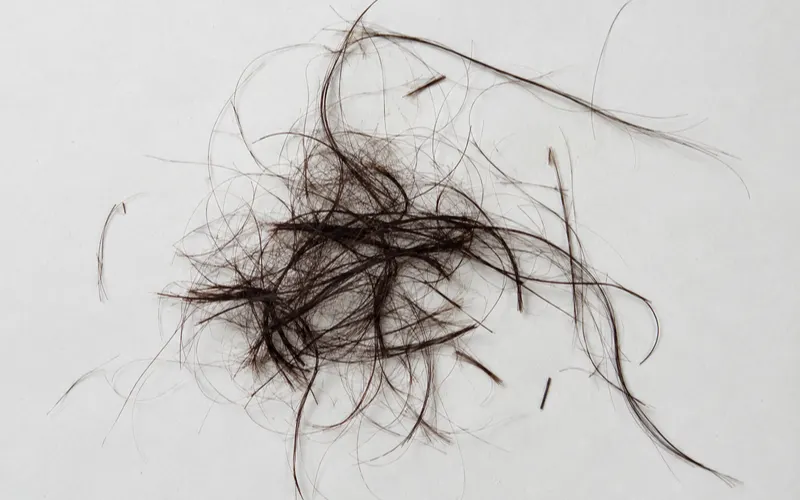
Pick one of the hairs off your shoulder and look at the end. A shed hair is full length and has a small pale bulb on one end, because it came away at the root. A broken hair is shorter than the rest of your hair, has no bulb, and usually ends in a ragged point. Shedding is your body reacting to something that happened months ago. Breakage is your styling routine, happening now.
Most people notice the same thing first. Hair on the pillow, hair in the drain, hair on every dark sweater. What they cannot tell is whether it is falling out or snapping off, and the two have almost nothing in common.
One of them needs time and a doctor. The other needs you to put the flat iron down.
The bulb test
Hold a few of the loose hairs against a plain background. A shed hair has a tiny white or pale bulb at one end. That is the root, and it means the strand finished its cycle and released. It will also be roughly as long as the rest of your hair. A broken hair has no bulb, and it is noticeably shorter, because it snapped somewhere along the shaft.
If most of what you collect is full length with bulbs, you are shedding. If it is short pieces with no bulb, plus short flyaways around your part that never seem to grow, you are breaking.
| Shedding | Breakage | |
|---|---|---|
| Where it happens | At the root. The whole hair leaves the scalp. | Along the strand. The hair snaps partway down. |
| What the strand looks like | Full length, with a small pale bulb on one end. | Shorter than your hair, no bulb, often a ragged or split end. |
| Where you notice it | Brush, shower drain, pillow. | Short flyaways around the hairline and part, ends that will not grow past a point. |
| What it usually means | Something happened to your body a few months ago. | Something you are doing to your hair right now. |
| How long it lasts | Three to six months, then it settles on its own. | Until the handling changes. |
| What helps | Time, food, and dealing with the trigger. | Less heat, less tension, gentler handling. |
.
How much shedding is normal
More than people expect. The American Academy of Dermatology puts normal daily shedding at 50 to 100 hairs. On wash day several days of that arrives at once, so the pile in your hands can look alarming and still be ordinary.
Hair type changes how that looks, not how much it is. Fine, straight type 1 hair shows every strand on the floor, while tightly coiled type 4 hair holds shed strands inside the curl until detangling day, so a week of it arrives at once. The hair types guide walks through the families.
Why shedding shows up months after the cause
Sudden heavy shedding is usually telogen effluvium, a temporary shift that pushes more hairs than usual into the resting phase at once. The delay confuses everyone: Cleveland Clinic notes the shedding tends to start two to three months after the trigger and runs three to six months.
So the cause has often been and gone. The AAD lists childbirth, high fever, surgery, recovering from illness, significant stress, losing 20 pounds or more, and stopping birth control among the usual triggers. Shedding peaks around four months after the event, and hair usually regains its normal fullness within six to nine months.
Shedding that runs past that, or thinning that shows as a widening part rather than loose strands, is worth taking to a dermatologist. That is a different problem from this one.
What causes breakage
Breakage is mechanical, and the AAD’s list of habits that damage hair reads like most people’s week. Heat tools on the highest setting. Combing hair while it is soaking wet, which is when straight hair is most fragile. Ponytails and buns pulled tight enough to tug at the hairline. Chemical services stacked too close together.
A few of their specifics are worth stealing outright. Use the lowest heat setting that works and keep hot tools to about once a week. Comb textured hair while it is damp and straight hair once it has dried a little, always with a wide-tooth comb. Wear hair loosely pulled back. Stretch relaxers and color to every eight to ten weeks, and if you do both, relax first and wait two weeks. Previewing a lightening service with a free hair color app is cheaper than finding out your hair could not take the lift.
What actually helps
For breakage
Change the handling and the hair stops snapping, though you will be growing out the damage for months. Turn the heat down, use a heat protectant, detangle from the ends upward, swap tight elastics for soft covered ones, and space out chemical services. Trims do not make hair grow faster, but they do stop a split traveling up the strand.
For shedding
Time does most of the work, but food matters more than any product. Cleveland Clinic points to fad diets short on protein and rapid weight loss as common causes, suggests 40 to 60 grams of protein a day, and names zinc, biotin, iron and vitamins A, B, C, D and E among what hair needs. Steady eating and hydration and proper sleep do more here than any bottle on a bathroom shelf.
If meals have been patchy, a daily formula can fill in around them. The beauty drops from Verdant Wellness put biotin, zinc, collagen and hyaluronic acid into one dropper, which is easier to keep up than a handful of capsules. Ask your doctor to check ferritin and vitamin D first, though. A supplement can close a gap but it cannot find one, and iron is the deficiency most often behind shedding in women.
One practical note for any hair, skin and nails formula: they carry far more biotin than an ordinary multivitamin, and Cleveland Clinic advises stopping biotin at least 72 hours before blood work, because it can skew results on thyroid and heart tests. Mention it before a blood draw, particularly if that draw is the one checking your iron.
Questions people ask
How do I know if my hair is breaking or falling out?
Look at a loose strand. A shed hair is full length with a small pale bulb at one end. A broken hair is shorter than your hair, has no bulb, and usually ends in a ragged point.
How much hair loss is normal in the shower?
Shedding 50 to 100 hairs a day is normal. If you wash two or three times a week, several days of that arrives at once, so a shower clump can look far worse than it is.
Why is my hair shedding so much all of a sudden?
Sudden heavy shedding usually traces back two to three months to an illness, fever, surgery, childbirth, rapid weight loss or a stressful stretch. It typically lasts three to six months and settles on its own.
Do hair supplements stop shedding?
They help when a nutritional gap is driving it, which is why testing beats guessing. They will not stop shedding caused by illness, stress or childbirth, and they do nothing for breakage.
Shedding you wait out. Breakage you fix. Working out which one is on your pillow takes ten seconds and saves three months of buying the wrong thing. The hair type quiz is the fastest way to learn how your hair behaves in the first place.
How this was checked: shedding volumes, triggers and recovery timelines come from the American Academy of Dermatology, as does the damage guidance; the telogen effluvium timeline, protein target and nutrient list come from Cleveland Clinic, along with the biotin note. Persistent shedding or a widening part needs a dermatologist rather than an article.

BeautyLiesTruth publishes hair and personal color guidance built on primary research. Color claims are tested by draping under controlled daylight, and every figure is traced to a published source rather than to another blog.