
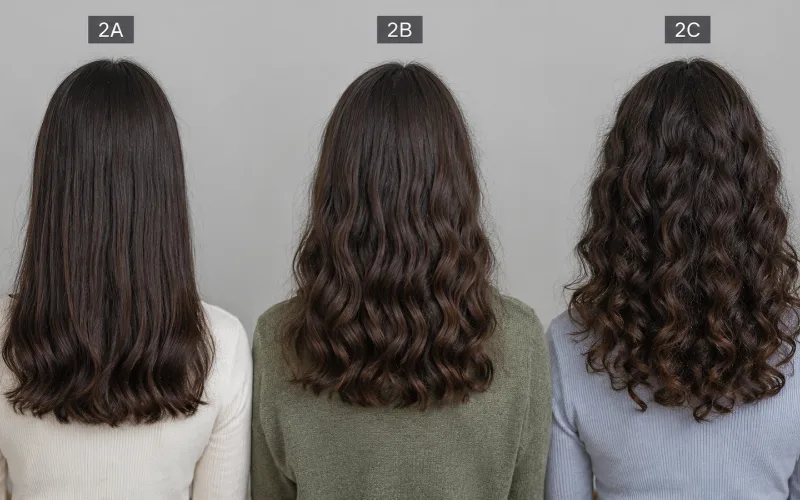
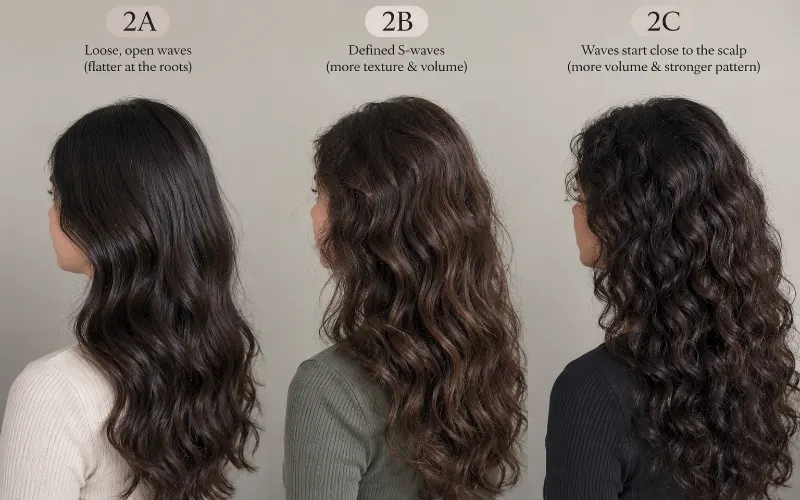
Wavy hair splits into three types. 2A is a loose, open S that only appears near the ends. 2B is a defined S that starts around the mid-length. 2C is a deep S that begins at the root and occasionally tips into a loose spiral.
One measurement separates them, and it is not how wavy the hair looks. It is how far down the strand the first bend appears.
The Three Wavy Hair Types
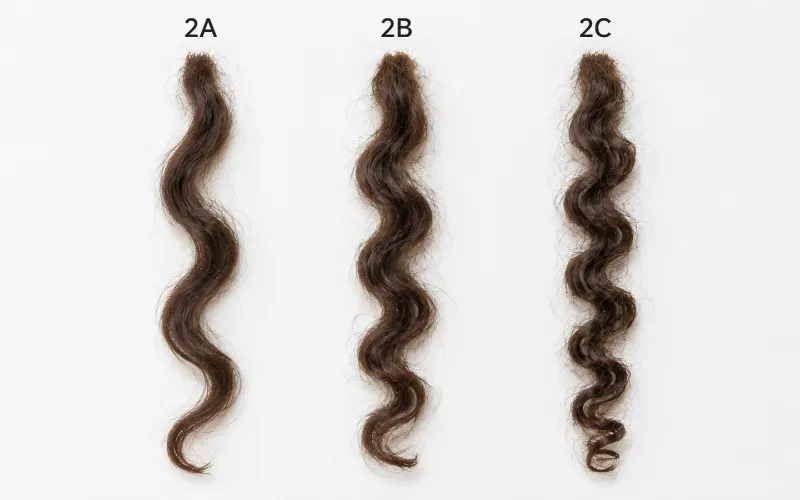
| Wave starts | Shape | Holds a style | Usual complaint | |
| 2A | Below the ears, often lower | Shallow, open S | Drops within hours | Waves gone by afternoon |
| 2B | Around the mid-length | Defined S, repeats evenly | Most of a day | Frizz through the lengths |
| 2C | At or near the root | Deep S, sometimes a loose spiral | Days | Volume and frizz to control |
Weight tolerance rises as you move down the list. 2A collapses under almost anything heavier than a mousse, 2B collapses under a curl cream, and 2C carries one comfortably. That single difference explains most of why one routine works on a friend’s hair and not on yours.
How to Tell What Type of Wavy Hair You Have
Wash, apply nothing, and let the hair air dry untouched. No brushing while damp, no diffuser, no towel rubbing. Product and handling both flatten a wave, and wet hair hangs straighter than it really is, so every shortcut pushes the result one step toward straight.
Then find the highest point on a single dry strand where a bend appears, and read it against the table above. A phone photo of the back of your head, taken in daylight, is easier to judge than a mirror.
Two things commonly skew a reading. A recent blow-dry can suppress a wave for two or three washes, and heavy internal layering can leave the top of the head reading one type and the lengths another, which is a cutting artefact rather than a mixed texture.
Is My Hair 2A, 2B or 2C?
Where the wave starts settles it, and product response confirms it.
2A is the one most often mistaken for straight, because the pattern only shows in the last few inches and any weight erases it. 2B is the middle and the most common self-reported wavy type, with a wave visible from a few feet away. 2C sits on the border of curly, with volume from the scalp outward and enough density to hold against a cream.
Anyone landing between two of them is in normal territory. Plenty of heads carry two wave types at once, usually a looser canopy over a tighter underlayer, and the practical answer is to treat the sections differently rather than to pick a single code.
Wavy or Curly?
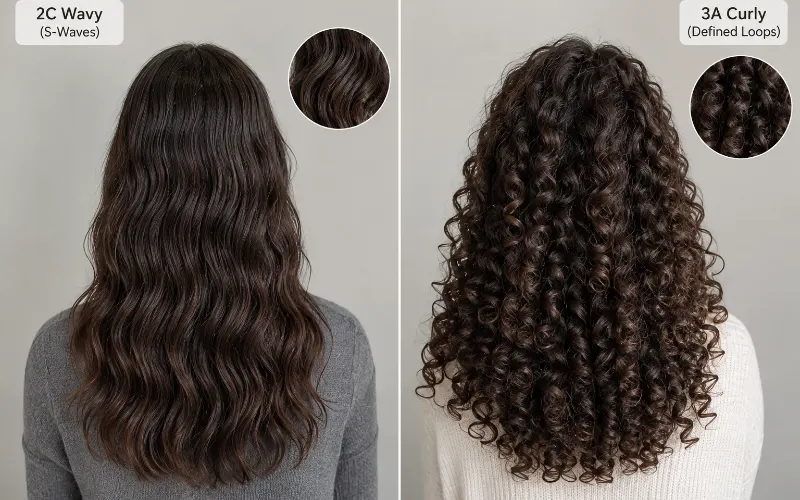
The test is dimensional, not a question of tightness. A wave travels back and forth on one flat plane, however deep its bends get. A curl wraps around an axis and closes into a loop you can see through.
Shrinkage backs it up. 3A hair, the loosest curl type, typically dries about a fifth shorter than it hangs when wet, because a spiral takes up vertical space. 2C loses very little by comparison. Anyone whose hair loses several inches between the shower and the mirror has crossed into type 3.
This boundary catches people constantly, and the reason is that 2C and 3A respond to similar products. Similar routines do not make them the same pattern.
Straight or Wavy? The Other Border
The opposite edge is just as busy, and it turns on whether the bend repeats. A 1C hair strand bends once or twice and then stops. A 2A strand forms an open S and then forms another one below it.
Strand width runs the other way as a tiebreaker, since 1C strands are wide enough to feel when rolled between finger and thumb and 2A strands usually are not. When the two disagree, the repeat test wins, because the number in the code records pattern while the letter records width.
Worth knowing that a great many people who believe they have straight hair are somewhere in type 2 and have never seen it. Brushing, heavy conditioner and blow-drying all suppress a loose wave completely, and the pattern only appears after a wash where none of those happen.
The Wavy Hair Chart, and Reading It on Longer Hair
The wavy chart is the type 2 row of the full 1A to 4C system, three patterns rather than twelve. Charts published for wavy hair alone sometimes attach millimetre ranges to each code, and no published standard assigns millimetre values to these labels, so treat those as illustration rather than measurement. The curl types chart sets all nine curl and coil patterns against each other, and the hair types guide covers the full system including straight hair.
Longer hair, more common among women, makes the reading easier rather than harder, since extra length gives a wave room to complete several repeats and shows the family clearly. The complication is layering, which can leave the crown and the lengths reading differently. Judge from an unlayered section near the nape.
Which Type of Wavy Hair Is Best?
None of them, and no study ranks curl patterns by anything. What does hold up is that hair cut and styled for its actual pattern looks better than hair worked against it.
Pattern also cannot be changed by a routine. A L’Oreal team led by Sophie Thibaut cultured dissected scalp follicles for the British Journal of Dermatology in 2005 and found that follicles growing curved hair were themselves curved at the bulb, and kept that curvature even when grown away from the scalp. What a good routine changes is definition, clumping and how long the shape lasts. It does not move anyone from 2A to 2B.
What Is Low Poo, and Does Wavy Hair Need It?
Low poo is shorthand for a gentle, low-lather or sulphate-free shampoo, and it comes out of the curly girl method rather than from wavy hair care specifically. The idea is that harsh surfactants strip a curl pattern of the oils it needs.
Wavy hair is where that advice most often backfires. A type 2 shaft is smooth enough for scalp oil to travel down quickly, so waves get greasy faster than curls do, and a cleanser too gentle to clear buildup will flatten the pattern within a couple of washes. Most wavy hair wants a light but genuinely cleansing shampoo two to four times a week, plus a clarifying wash every three or four weeks. The American Academy of Dermatology ties wash frequency to how oily the scalp actually gets in its healthy hair guidance, which is a better rule than any method’s fixed schedule.
Products for Wavy Hair
Think in weight classes rather than brands. A lightweight cleanser, a rinse-out conditioner used from the ears down, and a mousse or light gel for hold cover almost every wavy routine. Butters, heavy leave-in creams and most oils are formulated to fill a tight pattern, and an open wave has nothing deep enough to hold them.
Two rules do more than any product choice. Apply to soaking wet hair rather than damp, because water is what lets sections clump together, and then leave it alone while it dries. Scrunch upward, dry without touching, and break the cast once the hair is completely dry. The natural shampoo guide covers which cleansers stay light enough for this family.
Wavy Hair Types for Men

Length is the deciding factor and almost nothing covers it. Under about three inches an open S cannot complete a repeat, so wavy hair reads as an unruly cowlick and usually gets cut off before the pattern can show.
Past four inches the waves appear on their own. Sea salt spray or a light mousse on damp hair brings definition; wax and pomade kill it. The hair types for men guide covers reading short hair and the cuts that suit each pattern.
What the Type Cannot Tell You
Three measurements decide most of a routine and none of them appear on the wavy chart. Strand width, which is how much weight the hair carries before it flattens and is covered in the guide to fine hair. Density, which is how many strands grow per square centimetre. And porosity, which governs the order products go on in.
Two people can both read as 2B and need opposite products. The type 2 hair guide covers the family in more depth, the hair types chart sets all twelve codes side by side, and the hair type quiz reads all four traits together.

BeautyLiesTruth publishes hair and personal color guidance built on primary research. Color claims are tested by draping under controlled daylight, and every figure is traced to a published source rather than to another blog.