
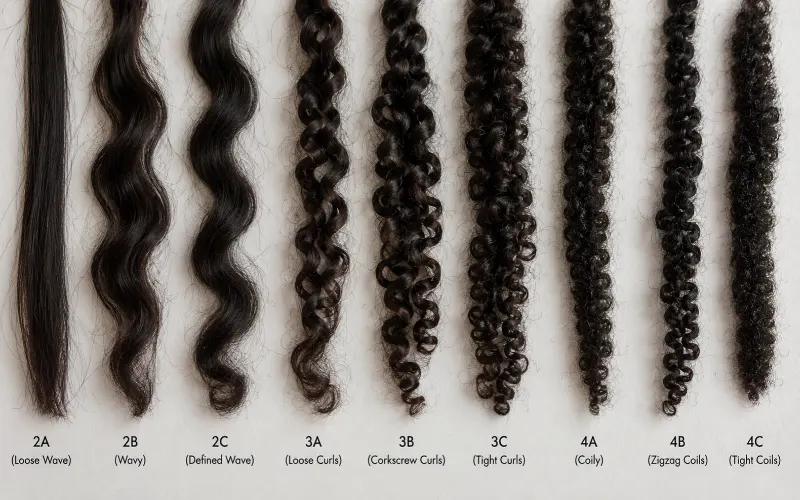
The curl chart runs from 2A to 4C, nine patterns in total. Straight hair sits outside it, since type 1 has no curl to classify, which is why curl charts start at 2A while hair type charts start at 1A.
The number gives the family: 2 is wavy, 3 is curly, 4 is coily. The letter narrows it within that family, running loosest at A to tightest at C.
The Curl Types Chart
| Type | Pattern | Compare the curl to | Shrinkage |
| 2A | Open S from the mid-lengths, nearly straight at the root | No closed loop at all | Very little |
| 2B | Defined S from around the mid-length | No closed loop | Slight |
| 2C | Tight S from the root, occasional loose spiral | Borderline, mostly still flat | Noticeable |
| 3A | Loose, well-defined spiral | A piece of sidewalk chalk | About a fifth |
| 3B | Springy ringlet, densely packed | A marker barrel | Around a third |
| 3C | Tight corkscrew, curls merge into texture | A pencil or a straw | About half |
| 4A | Defined S-shaped coil, springy | A crochet needle | 50 to 60 percent |
| 4B | Sharp Z bends rather than curves | No round equivalent | 50 to 75 percent |
| 4C | Tightest zigzag, no consistent visible coil | No round equivalent | Up to 75 percent |
Household objects rather than millimetres, deliberately. Several charts now publish precise diameter ranges for each code as though they were measured, and no published standard assigns millimetre values to these labels. The object comparisons are the convention because they are honest about their own precision.
How Do I Figure Out My Curl Type?
Wash, apply nothing, and let the hair air dry untouched. No brushing while damp, no diffuser, no towel rubbing. Product and handling both flatten pattern, and wet hair hangs straighter than it really is, so both push a result toward the looser end.
Then read one strand from mid-length to end. A bend that repeats along a flat plane is type 2. A strand that wraps around itself into a loop you can see through is type 3. A strand that changes direction at sharp angles is type 4. Once the family is settled, hold a single dry curl against the object in the chart.
What the Letters Mean
Within the curl families the letter tracks how tight the pattern gets, so A is the widest curl in its family and C the tightest. That rule holds cleanly from 2A through 4C.
It does not hold in type 1, which is the source of a good deal of confusion. Straight hair has no pattern to tighten, so the letter there is commonly used for strand width instead, which is why 1A is described as fine and 1C as coarse. The type 1 hair guide covers that, and the hair types pillar covers all twelve codes including the straight family.
How to Tell If Your Hair Is 2B or 2C
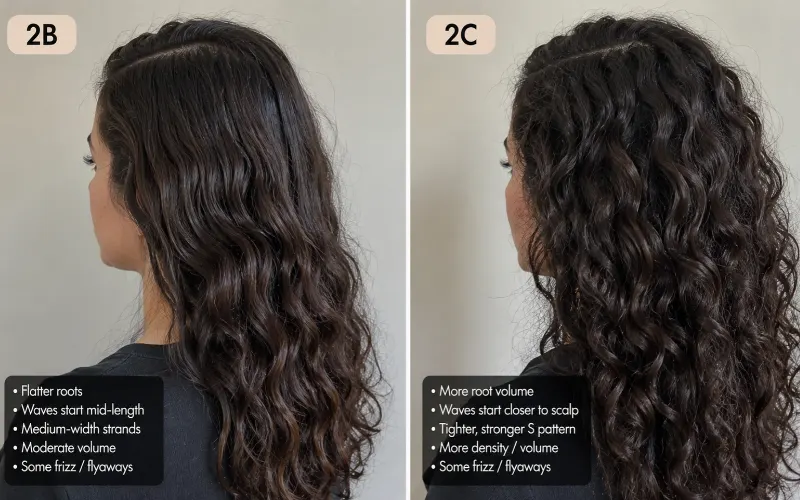
Where the wave starts settles it. A wave that begins at the root, giving visible volume from the scalp outward, is 2C. A wave that stays flat for the first stretch and only shows from around the mid-length is 2B.
Product tolerance confirms it. 2C holds its shape against a curl cream; 2B collapses under the same amount. Judge dry and product free, since a blow dry pushes 2C into looking like 2B.
Curl Type 3A and Curl Type 2C, the Two Most Confused
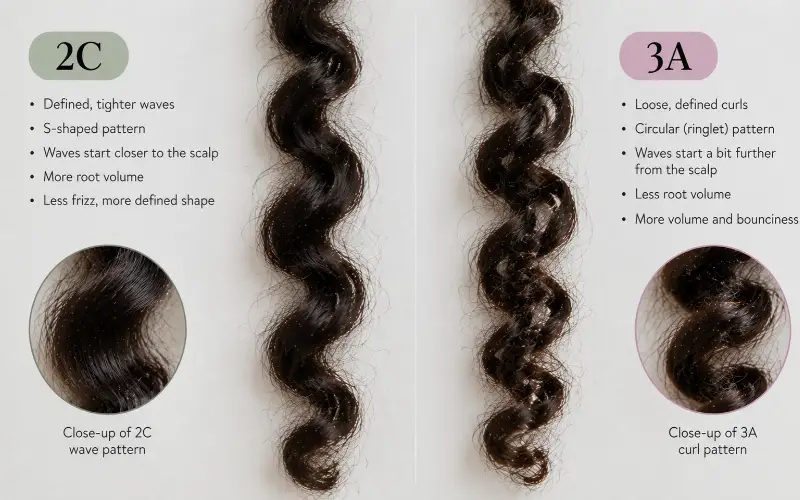
These two sit on either side of the line between wavy and curly, and more people land between them than on any other boundary.
The test is dimensional rather than a matter of tightness. A 2C wave travels back and forth on one flat plane, however deep its bends get. A 3A curl turns around an axis and closes into a loop with a visible circumference, about the width of a piece of sidewalk chalk. Shrinkage backs it up: 3A typically dries a fifth shorter than it hangs wet, because a spiral takes up vertical space, while 2C loses very little.
Most Heads Carry More Than One Pattern, and What “Irish Curls” Means
The chart assumes one pattern per head. Plenty of heads have two or three. Curl shape is set by the follicle, and a L’Oreal team led by Sophie Thibaut cultured dissected scalp follicles for the British Journal of Dermatology in 2005 and found that curved follicles produce curved hair while straight ones do not. Follicle shape varies across a single scalp, so different sections can genuinely grow different patterns.
Irish curls is the popular name for one version of that, where the top layer is straighter and the layers underneath are wavier or curlier. It is a social media term rather than part of the typing system, and despite the name there is no published evidence tying it to Irish ancestry. Two things produce the look. Genuinely varied follicle shape is one. Damage is the other, since the canopy layer takes the most sun, heat and friction and loses definition first while the protected underlayer keeps it.
Either way the practical answer is the same: type the dominant pattern, then treat the sections differently, with lighter product on the straighter canopy and more on the layers beneath.
Curl Types Chart for Women
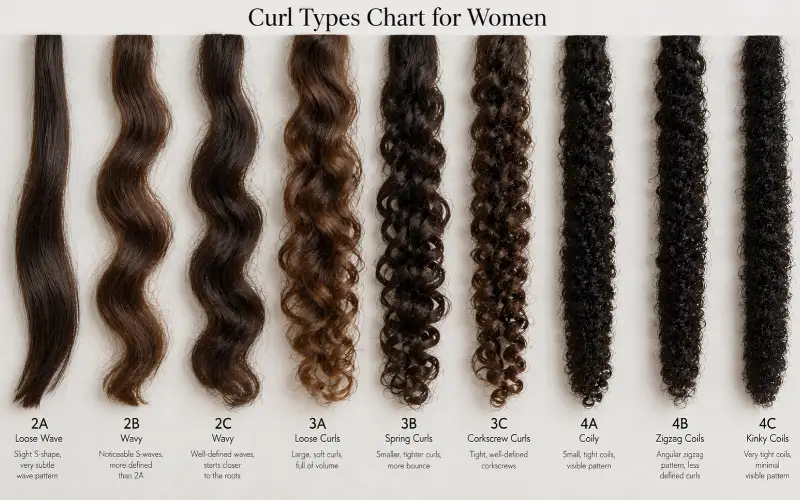
The nine patterns are identical, since curl type describes a strand rather than a person. Length is the only practical difference, and it works in your favour: longer hair gives a pattern room to complete several full turns, which makes the family obvious and the letter easier to judge.
The usual complication is layers. A cut with heavy internal layering can leave the top of the head reading one pattern and the lengths reading another, which is a cutting artefact rather than a mixed texture. Judge from a section that has not been layered, near the nape.
Curl Types for Men
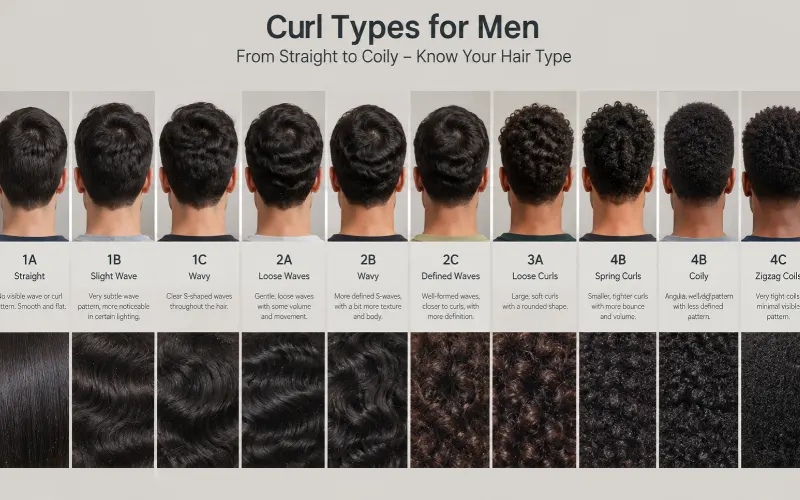
The same nine patterns apply, with one complication. Short hair hides curl, because a wave or curl needs length to complete a full bend, so a 2B head cut to an inch reads as straight.
Judge from the crown or the back where the hair sits longest, or grow it out for six weeks first. Tighter patterns show earlier: a 3C or 4C coil completes a turn within about an inch, while 2A and 3A need four inches or more. The hair types for men guide covers reading short hair and the cuts that suit each pattern.
Curl Types With a Curling Iron
A different thing shares the name. Searches for curl types also return barrel sizes and styling shapes, which describe curls you create rather than curls that grow.
Those are set by barrel diameter and technique. A one-inch barrel gives loose waves, a half-inch gives tight ringlets, and wrapping in alternating directions gives beach waves rather than uniform curls. Neither the barrel nor the technique changes your natural pattern, which is decided at the follicle and returns on the next wash.
What Is the Prettiest Curl Type?
No study ranks curl patterns by attractiveness, and no chart position is better than another. What does hold up is that hair cut and styled for its actual pattern looks better than hair worked against it.
The most common mistake is product weight. A curl cream sized for 3C will flatten 2A completely, and a volumising mousse built for 2A does nothing on 4B. Weight tolerance rises as you move down the chart.
What the Chart Cannot Tell You
Three measurements decide most routines and none of them appear here. Strand width, which is how narrow a single hair is and how much weight it can carry, covered in the guide to fine hair. Density, which is how many strands grow per square centimetre. And porosity, which is how readily the cuticle admits and holds moisture, and which matters more than the code on type 3 and type 4 hair.
Two people can share a curl type and need opposite products. The hair type quiz reads all four together, and the hair types chart covers the full twelve codes including straight hair.

BeautyLiesTruth publishes hair and personal color guidance built on primary research. Color claims are tested by draping under controlled daylight, and every figure is traced to a published source rather than to another blog.