
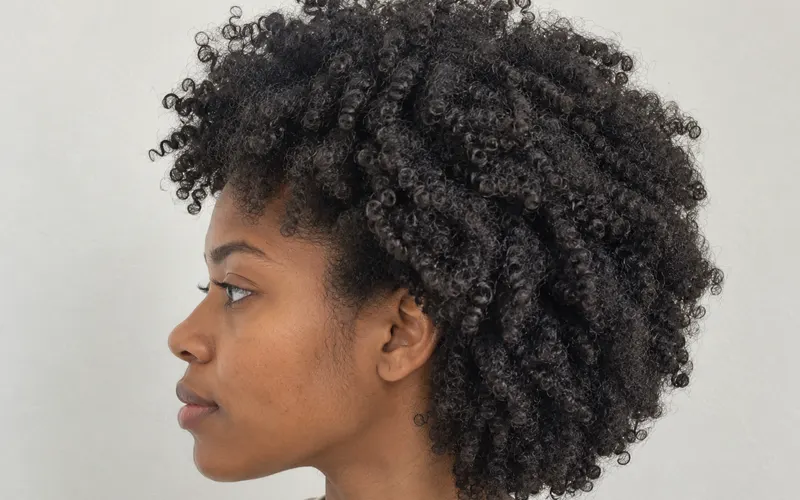
Coily hair grows in tight springs or sharp zig-zags, straight from the scalp. No loose wave section near the root. It is the texture most commonly labeled type 4.
The word gets used three ways, which is most of the confusion. As a texture description. As a classification bracket. And as a polite substitute for kinky. All three appear below, kept separate, because conflating them is how people end up buying products built for a texture they do not have.
Coily Hair vs Curly Hair: The Real Difference
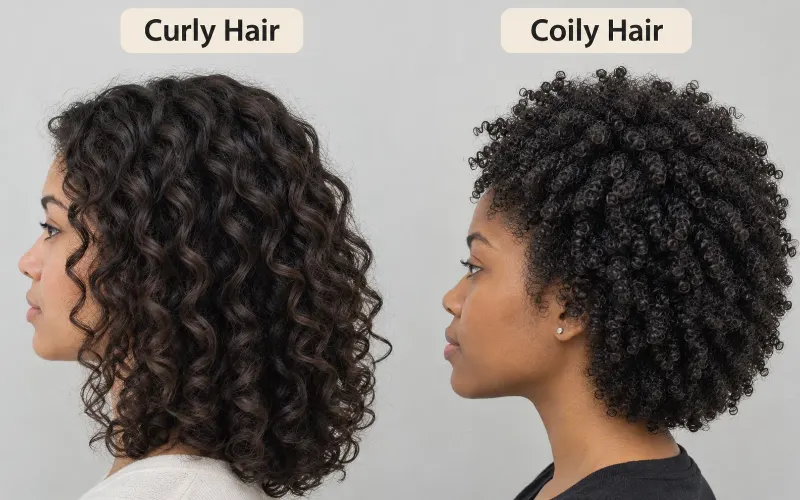
Coily hair and curly hair differ in two things. Pattern diameter, and where the pattern starts.
Curly hair forms loops. Hold a strand straight, let go, and it springs into a ring. Pen-width, or pencil-barrel width. Coily hair wraps tighter than that. Pencil-lead tight. Or it abandons the curve and zig-zags instead.
| Curly (type 3) | Coily (type 4) | |
| Pattern shape | S-shaped loops | Tight springs or Z angles |
| Starts | An inch or two down | At the scalp |
| Diameter | Pen to pencil barrel | Pencil lead or tighter |
| Shrinkage | 20 to 40% | Up to 75% |
| Strand visibility | Visible dry | Can disappear dry |
Shrinkage is the practical giveaway. Coily hair can look several inches shorter than its stretched length. That is not breakage. It is the single most misread feature of the texture.
Coils and curls are not different structures. Both come from an asymmetric follicle. Coily hair just sits further along the same spectrum.
How to Know If You Have Coily Hair
Three checks identify coily hair. Do them on clean wet hair, no product.
Pull one strand straight from the root. Let go. Tight springs rather than loops means coily. A straight first inch, with the pattern starting lower, reads as curly.
Compare against a pencil. Curly patterns wrap around the barrel. Coily patterns wrap the lead, or form angles instead of a circle.
Measure shrinkage. Stretch a strand to full length. Release, then compare. Above roughly half is coily territory.
The hair type quiz runs these alongside density and porosity. Texture alone does not tell you how to treat it.
Coily Hair Types: 4A, 4B and 4C
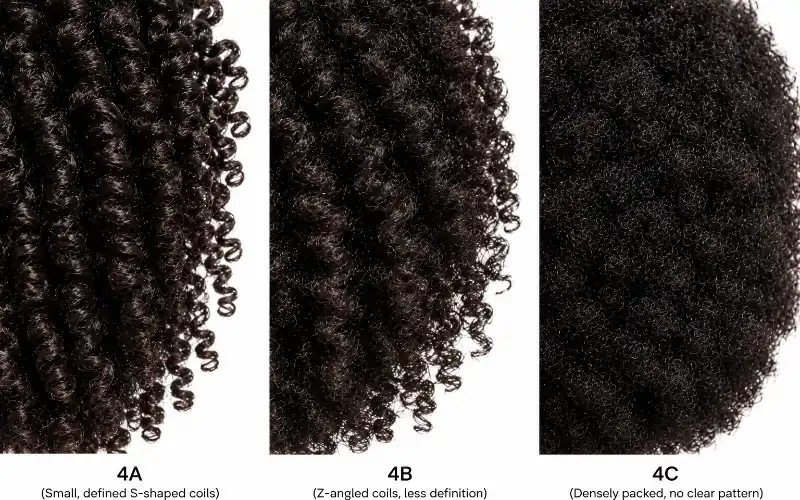
Coily hair splits into three brackets under the common typing system.
4A. Small, defined S-shaped coils. Crochet-needle width, roughly. The pattern holds wet and stays visible dry. Shrinkage moderate. Routines in the 4A hair guide.
4B. Sharp Z angles rather than curves. Less defined. More compressed. Most fragile at the bend points, which is where breakage concentrates. See 4B hair.
4C. Packed tightly enough that no consistent pattern shows without manipulation. Shrinkage highest here. Up to about 75%. The 4C hair guide goes deeper, and type 4 hair covers the bracket whole.
Why the 4A/4B/4C System Has Limits
The coily hair typing system has an origin worth knowing. Every product page treats it as settled science.
The 1A to 4C scale is commercial. A celebrity stylist popularized it in the 1990s. It was never developed as research. It has no published validation. And the lines between 4A, 4B and 4C are drawn by illustration rather than measurement.
The peer-reviewed alternative looks different. De la Mettrie and colleagues studied 1,442 people across 18 countries. They classified hair on four measurable variables, curve diameter, curl index, number of waves and number of twists, and the result held across every country in the sample. That produced eight types rather than four. And it classified hair independently of ethnic origin.
So 4C is useful shorthand. Poor measurement. Two people both calling their hair 4C can have visibly different coil diameters. Neither is wrong. Nothing defines the line.
In practice: treat the letter as a starting point. Then work from porosity and density. Measurable, both. And they change what products do.
Is African Hair Curly or Coily?
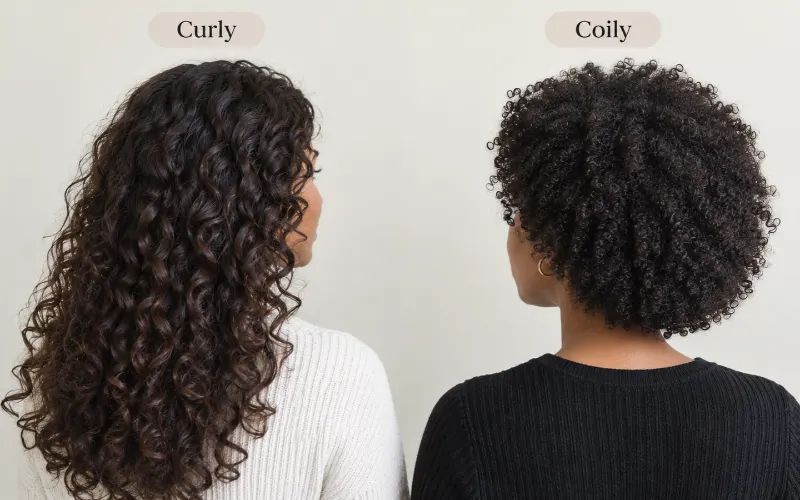
Tightly coiled textures are most common in people of African descent. The reason is follicle shape, not anything about the hair itself.
Follicles are not round. A flatter, elliptical follicle with a curved growth channel produces a flatter strand. That strand coils as it grows. Rounder follicles, straight hair. Thibaut and colleagues demonstrated the relationship between follicle geometry and curl.
Two qualifications matter. Coily hair appears across many populations, not one. And people of African descent have hair across the full range, type 3 and looser included. The de la Mettrie work classified by measurement for that reason. Origin predicts texture poorly at the individual level.
So: often coily. Frequently curly. Sometimes neither.
Can You Have More Than One Coily Pattern?
Most coily heads carry more than one pattern. The norm, not the exception.
Looser coils at the front and crown. Tighter patterns at the nape and temples. That is the common arrangement. Hormones, heat damage and chemical processing all shift the pattern in patches, which is why a head can read 4A at the crown and 4C at the nape on the same day.
Which is why single-type routines disappoint. The nape may need more moisture than the crown. Treating the whole head to the tightest section’s routine weighs down the rest. Sectioning is the fix. Not a different product.
Is Coily Hair Low or High Porosity?
Coily hair runs high porosity more often than other textures. The two are still separate properties.
The mechanism is mechanical. Every bend in a coil lifts the cuticle scales slightly. More bends, more lifted cuticle. Water enters and leaves faster. Which is why coily hair can feel dry hours after a soak.
But plenty of coily hair is low porosity. That hair behaves oppositely. Products sit on top and never absorb, so the heavy butters sold for type 4 hair can leave low-porosity coils greasy and still thirsty underneath. Guessing wrong wastes money either way. The hair porosity guide covers the test.
Porosity determines product weight. Texture determines technique. Different questions.
How to Wash and Moisturize Coily Hair
Coily hair tolerates less frequent washing than other textures. Sebum travels down a coiled strand poorly.
Every 7 to 10 days suits most coily hair. Scalp buildup is the limit on stretching further. Not the hair itself. A clarifying or natural shampoo handles the reset when product accumulates.
Detangle wet, conditioner in, fingers or a wide-tooth comb. Start at the tips. Work upward. Dry detangling is how people lose length. Length they thought was growth failure.
Night protection is not optional at this texture. Cotton pillowcases wick moisture and create friction at every bend. Satin or silk. Or a bonnet.
The LOC and LCO Methods
LOC and LCO are layering orders for coily hair. They exist because water alone does not stay in it.
LOC means liquid, then oil, then cream. Water or a water-based leave-in first, oil to slow evaporation, cream to seal.
LCO swaps the last two. Liquid, cream, then oil. The cream delivers moisture. The oil goes on top as the final barrier.
Which works depends on porosity. High porosity usually does better with LCO. The heavier cream goes in before the oil locks the cuticle. Low porosity often prefers LOC with lighter oils. A heavy cream under oil never penetrates.
Jojoba, argan and grapeseed sit lighter. Castor and shea are heavier. Better suited to high porosity, or thicker strands.
How to Reduce Shrinkage and Retain Length
Coily hair shrinkage is not damage. Reducing it means stretching, not straightening.
Banding, African threading, twist-outs, braid-outs. All stretch the coil while it dries, without heat. Drying in a stretched state is what holds the length.
Length retention is a separate problem from growth. Coily hair grows at the same average rate as any texture. Roughly half an inch a month. What differs is how much survives. Each bend is a potential break point.
Protective styles help. Less daily manipulation. Here is the caveat nobody sells. Styles installed too tightly cause traction alopecia at the hairline, and repeated tension on the same follicles eventually stops them producing hair at all. Permanent, if it runs long enough. Tension at the edges is a warning. Not a sign the style will last.
Is Heat Styling Safe for Coily Hair?
Heat is the fastest route to permanent pattern loss on coily hair.
Silk presses and flat irons break the disulfide bonds that hold the coil shape. Once enough break, the pattern does not come back.
The affected length has to grow out, which on hair retaining three inches a year is a long wait for a decision made in one afternoon. Coily hair shows this sooner than looser textures. The bends already concentrate stress.
Anyone pressing anyway: heat protectant, lowest temperature that works, one pass rather than several. Over a year, frequency matters more than temperature.
Frequently Asked Questions
What is low poo? Low poo means low-lather, sulfate-free cleansing. Usually a cream or gel wash. Removes buildup without stripping. It sits between a traditional shampoo and a conditioner-only wash. Coily hair suits it. Sulfates strip the limited sebum that reaches the ends. An occasional clarifying wash is still needed, to clear product.
Is type 3C hair curly or coily?
3C sits on the boundary. Formally curly, the tightest bracket of type 3. Coils usually pencil-width. They start closer to the scalp than looser type 3. Many people with 3C use coily routines successfully. That says more about the classification than about their hair. Covered in the 3C guide.
Do I have kinky or coily hair?
They describe the same textures. Kinky is the older term. It carries negative history for many people. Coily has largely replaced it in product marketing and salon language. Neither is a separate classification. Nothing in a routine changes on which word gets used.
What are the top 3 rarest hair types?
Type 1A is generally considered the rarest. Then 4C, then 3C. No study has measured prevalence at the sub-letter level, in any population. These rankings come from salon observation rather than data. Worth knowing, before treating any of them as fact. The rarest hair type page sets out what is known.
How do you say coily hair in French?
Cheveux crépus is the standard French term for tightly coiled hair. Cheveux bouclés covers curly. Some product labels keep the English “coily” instead. Which is why the search exists at all. Translated marketing copy is where most of the inconsistency comes from. Expect both on the same shelf.
Is coily hair common in men?
Yes. The care logic does not change. Shorter cuts hide shrinkage and make the pattern harder to read. Typing from a fade is unreliable. Judge it from the longest section you have. The curl types chart and the hair types chart apply regardless of length or gender.

BeautyLiesTruth publishes hair and personal color guidance built on primary research. Color claims are tested by draping under controlled daylight, and every figure is traced to a published source rather than to another blog.