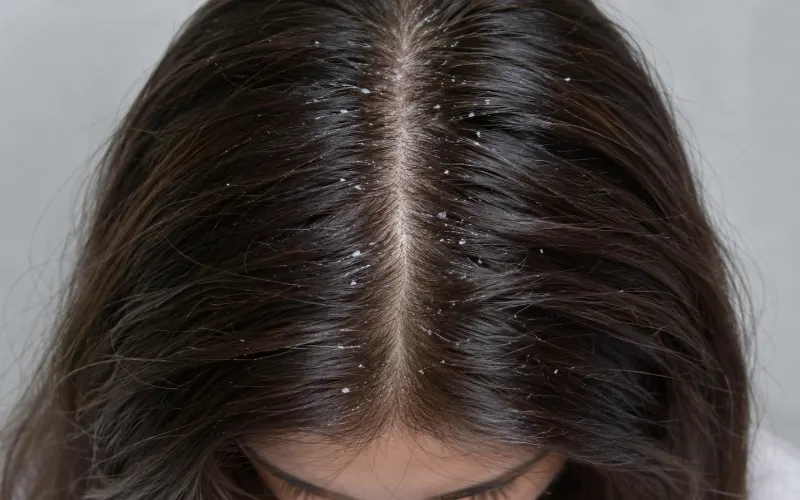
Dandruff is a common, non-contagious scalp condition that produces itching and white or yellow flakes of dead skin. It is not caused by poor hygiene, it is not rare, and the yeast behind it lives on nearly every scalp already.
What most guides leave out is that the treatment schedule changes depending on hair type. Dermatologists do not give fine straight hair and tightly coiled hair the same instructions, and following the wrong one is a common reason dandruff shampoo appears not to work.
What Is Dandruff?
Dandruff is flaking of the scalp caused by skin cells shedding faster than normal, usually with some itching and irritation alongside it. Flakes are white to yellowish, and the oilier the scalp, the larger and greasier they tend to be.
Dandruff is not contagious. It cannot pass from person to person through combs, hats, pillows or contact, because the organism involved is already present on almost everyone’s skin.
It is also extremely common. A 2025 review in the Journal of Cutaneous Medicine and Surgery reports that dandruff and seborrheic dermatitis together are estimated to affect half the world’s adult population, irrespective of gender and ethnicity.
What Causes Dandruff?
Dandruff is caused by an overgrowth of Malassezia, an oil-feeding yeast that lives naturally on human skin. It consumes sebum, releases by-products that irritate the scalp, and the scalp responds by turning over skin cells faster than it can shed them invisibly. The same review identifies M. globosa and M. restricta as the species most often implicated.
Four things make it worse rather than cause it outright.
Oily skin feeds the yeast, which is why dandruff often sits at the mild end of seborrheic dermatitis rather than being a separate condition. Dry skin produces a different flake, smaller and less oily, and gets worse in cold weather and dry indoor heating.
Product sensitivity to dyes, shampoos or styling products can irritate the scalp into flaking. And age matters: flares cluster around infancy, adolescence and adulthood, which tracks with when the skin produces the most oil.
Is Dandruff a Hygiene Issue?
Dandruff is not a hygiene issue, and the research says so directly. The prevalence figure above holds irrespective of gender and ethnicity, which is not what a hygiene-driven condition looks like.
Washing frequency does matter, but not in the way the myth suggests. Leaving oil to build up gives the yeast more to feed on, so washing too rarely can worsen flaking on an oily scalp. Washing too often strips a dry scalp and worsens flaking from the other direction. The right frequency depends on hair type, which the section below covers.
Dandruff vs Dry Scalp vs Scalp Psoriasis
Dandruff, dry scalp and scalp psoriasis all produce flakes and all get treated differently, so telling them apart is the first useful step.
| Flakes | Scalp | Responds to | |
| Dandruff | White to yellow, larger, slightly greasy | Oily, itchy, sometimes red | Antifungal shampoo |
| Dry scalp | Small, white, dry, powdery | Tight and dry, often dry skin elsewhere too | Gentler washing, moisture |
| Scalp psoriasis | Thick silvery scale, sharply edged patches | Raised plaques that can extend past the hairline | Prescription treatment |
The quickest home check is what happens after a gentle wash with a mild shampoo. Dry scalp improves. Dandruff does not. Psoriasis plaques feel thick and raised rather than flaky, often appear behind the ears or at the nape, and need a doctor rather than a shelf product.
Porosity confuses this further, since high-porosity hair can look dry while the scalp itself is oily. The hair porosity guide covers how to test the hair separately from the scalp.
How Do You Get Rid of Dandruff?
Getting rid of dandruff means using a medicated shampoo with an active ingredient that targets the yeast or the scale, then matching the frequency to your hair type.
Five actives are standard: zinc pyrithione, selenium sulfide, ketoconazole, salicylic acid, sulfur and coal tar. The first three reduce the yeast. Salicylic acid and coal tar work differently, loosening and breaking up scale rather than attacking the organism, which is why they suit thick stubborn flaking.
Two application details change the result more than the brand does. The American Academy of Dermatology advises leaving some dandruff shampoos on the scalp for 5 to 10 minutes before rinsing, since contact time is what lets the active work. And coal tar increases the scalp’s sensitivity to sunlight, so a hat or sun protection matters while using it.
How Often to Use Dandruff Shampoo, by Hair Type
How often you use dandruff shampoo depends on your hair type, and this is the part almost every dandruff guide skips. The AAD gives two different schedules.
| Hair type | Wash routine | Dandruff shampoo |
| Fine or straight, oily scalp | Often, possibly daily | Twice a week |
| Coarse, curly or coily | When needed | About once a week, if tolerated |
There is a third instruction that matters even more for textured hair: apply the dandruff shampoo to the scalp only, because the active ingredients are drying to the hair shaft itself.
That makes sense against how these hair types behave. Sebum travels down a straight shaft easily, so fine straight hair reaches the yeast’s food supply quickly and needs frequent washing. On 4C hair and other tightly coiled patterns, oil cannot travel the length of a coil, so the ends stay dry while the scalp is the only oily part, and weekly scalp-only treatment protects length that is already fragile. 3C and 2C sit between the two.
Running the twice-weekly schedule on coily hair is a common and avoidable mistake. It dries out the hair without treating the scalp any better. If you are unsure which band you fall into, the hair type quiz reads pattern, strand width, density and porosity together, and the hair types chart sets out all twelve codes.
What Kills Dandruff Fastest, and How Long Does It Take?
Dandruff responds fastest to ketoconazole and selenium sulfide, because both reduce the yeast population directly rather than only lifting scale.
Expect two to four weeks of consistent use before judging any product, with some improvement often visible inside the first fortnight. Switching products every few days is the most common reason people conclude nothing works, since no active gets the contact time it needs. If flaking has not improved after several weeks of correct use, change the active ingredient rather than the brand, or see a doctor.
Can Dandruff Be Cured Permanently?
Dandruff cannot be cured permanently, and any product promising otherwise is overselling. The yeast behind it is a normal resident of human skin, so the goal is control rather than elimination.
What a permanent fix looks like in practice is a maintenance routine: treat actively until the flaking settles, then keep using the medicated shampoo at a reduced frequency rather than stopping altogether. Most people who say their dandruff came back stopped treating the moment it cleared.
Why Does Dandruff Keep Coming Back?
Dandruff keeps coming back because treatment reduces the yeast population without removing it, and the conditions that let it overgrow are still there.
Three patterns explain most relapses: stopping treatment entirely once flaking clears, using the shampoo at the wrong frequency for your hair type, and tolerance, where one active stops working as well over months. Rotating between two different actives is the standard answer to the third. Cold dry air and indoor heating worsen flaking in winter, which is why it often returns seasonally.
Does Dandruff Cause Hair Loss?
Dandruff does not directly cause hair loss, though severe untreated cases can contribute indirectly, since persistent scratching damages hair at the root and follicle inflammation does growth no favours. Hair lost this way generally regrows once the scalp settles.
Dandruff and genuine hair loss are different problems that often appear together and get confused, particularly in men. The guide to thinning hair covers how to tell them apart, and the men’s hair types guide covers the washing side. Bald scalps still get dandruff, incidentally, because the yeast feeds on sebum from the skin rather than on the hair.
Do Stress, Diet and Home Remedies Make a Difference?
Dandruff is not caused by stress or diet, though stress is widely reported to trigger flares, which fits a condition driven by an organism the immune system normally keeps in check. The dietary evidence is weaker and less consistent.
Home remedies are mixed. Tea tree oil has some evidence as an antifungal and appears in commercial shampoos for that reason. Apple cider vinegar, lemon juice and bicarbonate of soda have little support and can irritate an inflamed scalp. Coconut oil deserves a specific warning: Malassezia feeds on oil, so oiling the scalp gives the yeast more of what it thrives on. The natural shampoo guide covers which daily formulas stay gentle enough to sit alongside treatment.
Can Dandruff Affect Eyebrows and Beard?
Dandruff can affect eyebrows, beards, the sides of the nose and the chest, because the same yeast lives wherever skin produces oil. On the face it is usually called seborrheic dermatitis rather than dandruff, though the cause is the same.
Facial skin is thinner and more reactive than scalp skin, so a scalp-strength product used there can irritate it. Beard and face formulations exist for that reason, and persistent facial flaking is worth a doctor’s opinion rather than self-treatment.
When Should You See a Doctor About Dandruff?
See a doctor about dandruff if several weeks of correct over-the-counter treatment produce no improvement, or if any of the following appear: thick raised plaques, redness spreading beyond the scalp, open or weeping skin, significant hair loss, or signs of infection.
Severe or sudden flaking that does not respond to treatment can indicate seborrheic dermatitis needing prescription strength, scalp psoriasis, eczema or a fungal infection, all of which are treated differently. A dermatologist can distinguish between them in a way no shampoo label or online guide can.
Nothing here replaces medical advice, and persistent scalp symptoms deserve a professional opinion.
BeautyLiesTruth publishes hair and personal color guidance built on primary research. Color claims are tested by draping under controlled daylight, and every figure is traced to a published source rather than to another blog.