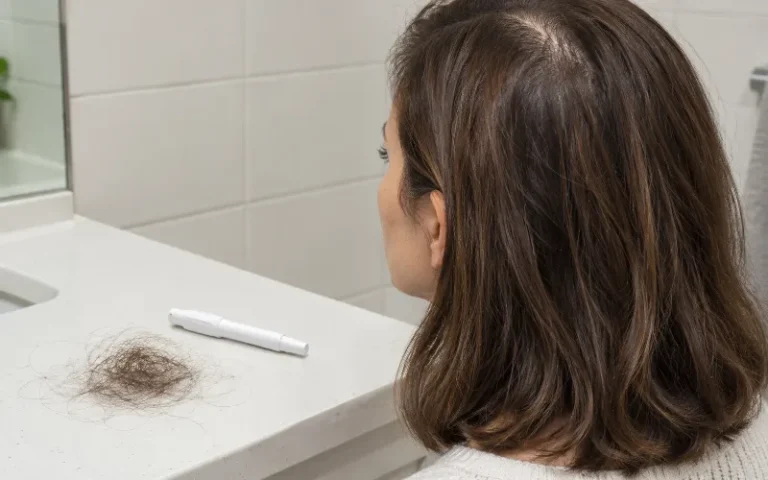
No. One trial has measured hair directly. It found no effect on density, follicle count or thickness over 12 weeks.
That is the short answer. The longer one is better. The study everyone cites as proof of balding never looked at anyone’s hair.
What the 12-Week Creatine Trial Found
Direct evidence on creatine and hair loss comes from one 2025 randomized controlled trial.
Lak and colleagues randomized 45 resistance-trained men aged 18 to 40. Five grams of creatine monohydrate daily, or matching maltodextrin. Thirty-eight finished. Twelve weeks.
Hair was measured, not guessed at. Trichogram testing plus the FotoFinder system. Density, follicular unit count, cumulative thickness. Hormones too: total testosterone, free testosterone, DHT.
Nothing reached significance. No group-by-time interaction for any hormone, or any hair outcome. Testosterone rose in both arms. 124 ng/dL on creatine, 216 ng/dL on placebo. So the change was not the supplement.
The authors call it strong evidence against the claim.
| 2009 study | 2025 trial | |
| Participants | 20 male rugby players | 38 completers, trained men |
| Dose | 25 g/day, then 5 g/day | 5 g/day, no loading |
| Duration | 3 weeks | 12 weeks |
| Hair measured | No | Yes |
| DHT result | Up 56%, then 40% | No change |
Where the Creatine Hair Loss Myth Started
The creatine hair loss claim traces back to one paper from 2009.
Van der Merwe, Brooks and Myburgh took 20 college-aged rugby players. Loading dose: 25 g daily for a week. Then 5 g daily for two more. Double-blind, placebo-controlled, crossover.
DHT rose 56% after the loading week. It held 40% above baseline through maintenance. Both at P < 0.001. The DHT to testosterone ratio climbed 36%, then settled 22% up.
Worth being precise, because most pages are not. That finding was large. It was statistically solid. Calling it a small meaningless study misreads the paper.
It was not a hair study. Nobody counted a follicle. The participants’ hair was never assessed.
Does Creatine Increase DHT?
Creatine raised DHT in one study of 20 men. No study since has reproduced it.
The 2025 trial measured DHT directly. No difference between creatine and placebo. The DHT to testosterone ratio did not shift either.
So the mechanism the whole theory depends on rests on one unreplicated result.
The Loading Dose Nobody Has Tested Against Hair
There is a real gap in the creatine hair loss evidence. It is about dose.
The 2009 study that moved DHT used 25 g daily for a week. The 2025 trial that found nothing used 5 g daily. No loading phase at all.
Different interventions. The trial that measured hair never tested the dose that moved the hormone. Nobody has run a loading protocol and tracked follicles at the same time.
This does not make creatine risky. It means the worst case people imagine is untested. Anyone calling the question closed is overstating it.
Most people take 3 to 5 g daily and skip loading. That is the dose the trial cleared.
Does Creatine Cause Hair Loss in Women?
No direct evidence exists on creatine and hair loss in women. In either direction.
Both studies enrolled men only. Rugby players in 2009. Resistance-trained males in 2025. Not one woman in either sample.
Women do get androgenetic thinning, and DHT is involved. Stretching a null result from 38 trained men to women is an assumption. Not a finding. Pages answering this confidently are guessing.
Female pattern thinning widens the part rather than receding the line. The hair types chart separates texture change from density change. People confuse the two constantly, and fine hair is not thinning hair.
Can Creatine Speed Up Hair Loss If You Are Already Prone?
This is the version of the creatine question worth taking seriously. It has not been tested.
Androgenetic alopecia runs on genetic sensitivity to DHT. Two men at the same DHT level can respond completely differently.
The 2025 trial did not screen or stratify by family history. With 38 completers it could not have found a subgroup effect anyway.
Family history plus active thinning is a dermatologist’s question, not a supplement one. The thinning hair guide covers that assessment. The men’s hair type chart shows where recession starts.
What Actually Causes the Shedding
Most people asking whether creatine causes hair loss noticed hair in the drain first.
Timing is usually the whole story. Creatine rarely gets started alone. It arrives with a new training block, a calorie deficit or a bulk.
Excessive shedding has its own name: telogen effluvium. The American Academy of Dermatology lists its documented triggers.
Losing 20 pounds or more. High stress. High fever. Surgery. Recovering from illness. Stopping birth control.
Two of those describe a body recomposition. Shedding 50 to 100 hairs a day is normal anyway. Telogen effluvium shows up a few months after the trigger, not immediately.
It also stops. The AAD puts normal fullness back within six to nine months, once the trigger clears.
So the usual sequence, creatine then shedding eight weeks later, fits the diet change just as well.
Should You Stop Creatine If You Notice Shedding?
Stopping creatine will not tell you much. It certainly will not tell you quickly.
Hair cycles slowly. A follicle disturbed today reports back a season later. This week’s change surfaces in two to four months.
Quitting and checking the drain a fortnight later reads noise.
Better question: is this shedding or thinning? Shedding means more hairs falling from a scalp with normal density. Thinning means fewer, finer hairs and visible scalp. Different causes. Different answers.
Texture makes it harder to judge. Straight hair shows scalp sooner than curly hair at the same density. The hair type quiz reads texture and density together, which separates the two.
Shedding past nine months is a dermatologist’s question. So is thinning at the part or temples.
Can You Take Creatine With Finasteride or Minoxidil?
No interaction between creatine and finasteride or minoxidil has been documented.
The pathways are unrelated. Finasteride blocks the enzyme converting testosterone to DHT. Minoxidil acts on the follicle and its blood supply. Creatine is a cellular energy substrate.
Anyone on a prescription should clear new supplements with the prescriber. Not with an article.
Is Creatine Good for Hair Growth?
No evidence suggests creatine is good for hair growth.
The 2025 trial measured density, follicle count and thickness. Creatine moved none of them, in either direction. A null result cuts both ways.
What supports hair: protein intake, iron and ferritin status, thyroid function, scalp condition. Not a performance supplement. The guide to supporting skin and hair covers the inputs that matter.
Creatine HCl or Monohydrate for Hair?
No study has compared creatine HCl against monohydrate for any hair outcome.
Both trials used monohydrate. HCl is sold on better solubility and a smaller dose. The hair question has never been asked of it.
Monohydrate is the form with evidence behind it. That includes the evidence it leaves hair alone.
Do Other Gym Supplements Cause Hair Loss?
Creatine gets blamed for hair loss, and it is probably the wrong suspect.
Anabolic steroids and designer prohormones do accelerate androgenetic hair loss. That effect is well established. Some pre-workouts and testosterone boosters carry undisclosed compounds. High-dose selenium can cause hair loss.
Whey protein, caffeine and beta-alanine have no documented link.
Scalp condition matters too. Heavy sweating with infrequent washing irritates a scalp. Low porosity hair holds product and sweat longer. The dandruff guide covers what inflammation does, and does not do, to shedding.
Frequently Asked Questions
Can stopping creatine reverse hair loss?
If creatine was not the cause, stopping it changes nothing. If a diet or training change caused the shedding, the AAD puts normal fullness back within six to nine months of that trigger clearing. Genetic thinning continues either way. It was never about the supplement. Hair cycles make any test slow.
Is creatine good for your hair?
No. The 12-week trial found no change in density, follicular unit count or thickness. Either direction. Creatine looks neutral for hair. Nothing suggests it helps. Nothing in the direct measurement suggests it harms. Both studies were men only, so women have no direct data either way.
What are the risks of taking creatine?
Creatine monohydrate at 3 to 5 g daily is among the better-studied supplements sold. Reported effects are mostly gastrointestinal, usually at loading doses, plus water retention. Hair is not among the documented effects in the trial literature. Anyone with existing kidney disease should ask a doctor first. Not an article.
Why did I gain 10 pounds after taking creatine?
Creatine draws water into muscle cells. The scale moves within a week or two, especially after loading. That is intracellular water and muscle glycogen, not fat. The effect is larger with a loading phase, and it settles once you drop to a maintenance dose of 3 to 5 g.
What do people on Reddit say about creatine and hair loss?
Threads run both ways. Some users report shedding after starting creatine. Others report none, or put it down to stress and diet. Anecdote cannot separate the supplement from everything else that changed at once. Controlled trials exist for that. Men’s hair types also vary enough that two people notice loss at different stages.
Does creatine cause acne, kidney damage or diarrhea? No causal link to acne has been established. Kidney concerns come from creatinine readings. Creatine raises those without indicating kidney damage, though anyone with kidney disease should still check first. Diarrhea and cramping do occur, mostly at loading doses, and usually resolve at 5 g daily.

Beauty Lies Truth publishes hair and personal color guides for readers in the US. Updated guides are checked against published sources, such as the American Academy of Dermatology, and those sources are linked in the text.