
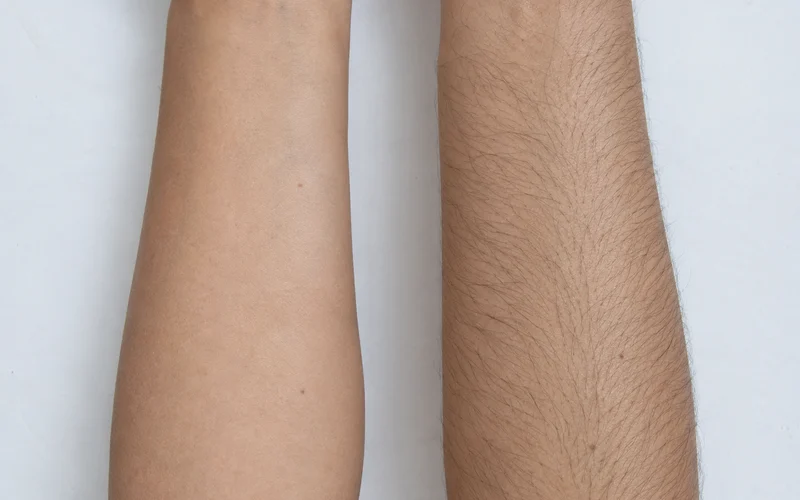
Laser hair removal runs roughly $45 to $600 per session in the United States. It depends on how much surface area gets treated. A full course usually lands between $270 and $3,600.
Those are advertised clinic ranges, not a published statistic. No official body tracks national laser pricing. Anyone quoting a precise average is aggregating menus.
The number that decides what you pay is the session count. That is also the number the industry and the American Academy of Dermatology disagree about.
Laser Hair Removal Cost by Body Area
Laser hair removal is priced by surface area. The bigger the patch, the bigger the bill.
| Area | Per session | Full course |
| Upper lip, chin | $45 to $150 | $270 to $900 |
| Underarms, bikini line | $89 to $250 | $530 to $1,500 |
| Brazilian, full face, half legs | $150 to $350 | $900 to $2,100 |
| Full legs, back, chest | $250 to $600 | $1,500 to $3,600 |
| Full body | $500 to $1,500 | $3,000 to $9,000 |
Upper lip is the cheapest entry point. Full legs and back sit at the other end. Most people treat two or three areas, not one. Real totals stack.
How Many Sessions Do You Actually Need?
How many laser hair removal sessions you need is where the published cost estimates come apart.
Nearly every clinic page quotes 6 to 8 sessions. So does Google’s summary. The American Academy of Dermatology puts it at 2 to 6. Spaced 4 to 6 weeks apart.
That gap is not cosmetic. Session count multiplies every total in the table above. At the AAD’s lower bound, an upper lip course is two sessions and about $90. At the industry’s upper bound it is eight sessions and up to $1,200.
The AAD also gives a figure nobody advertises. Expect a 10% to 25% reduction after the first treatment. That is the honest per-session return. It also explains why one discounted session is close to worthless.
Clinics have a reason to quote the high end, because packages sell upfront. That does not make 6 to 8 wrong for everyone. It does mean your quote is a sales estimate rather than a clinical one.
Why Hair Color and Thickness Change What You Pay
Laser hair removal targets melanin in the hair shaft. So your hair pigment decides how many sessions you need. Session count decides your bill.
The AAD states that treatment “works best for patients with light-colored skin and dark-colored hair.” Dark coarse hair absorbs the energy efficiently. That combination clears fastest.
Blonde, red, gray and white hair carry little or no melanin. There is nothing for the laser to heat. People in that group often need more sessions for a worse result. Some are not candidates at all. Nobody selling a package leads with this.
Fine hair responds less predictably than coarse hair at the same color. A thinner shaft holds less pigment. Texture matters too. Tightly coiled hair grows from curved follicles, which makes complete targeting harder. Straight hair is the easiest to treat. The curl types chart shows where your pattern sits.
Darker skin is treatable now, with the right equipment. The AAD says light hair on light skin can be treated, and so can dark skin. Both need very careful technique. That usually means an Nd:YAG rather than an older alexandrite or IPL. Clinics with that equipment charge more.
Know your own baseline before paying for a consultation. The hair type quiz reads texture, density and porosity. The hair types chart places your pattern. The skin tone chart covers the depth scale clinics use to pick a wavelength.
What Else Moves the Price
Four things move laser hair removal pricing beyond area and session count.
Location first. Med spas in New York or Los Angeles charge more than clinics in smaller markets. That is why near me searches return such different numbers.
Who holds the handpiece. A board-certified dermatologist or plastic surgeon costs more than a licensed aesthetician. The AAD recommends the dermatologist.
The equipment. Dual-wavelength systems combining alexandrite and Nd:YAG cover more skin tones safely. They also cost more to run than older IPL. IPL is cheaper per session, and generally less effective per session.
The pricing model. Some national chains skip per-session billing altogether. They sell a flat rate instead, often $4,000 to $7,000 or more. Unlimited lifetime touch-ups folded in.
Is Laser Hair Removal Permanent?
Laser hair removal is permanent reduction rather than permanent removal. Those are different claims.
The AAD describes patients staying hair-free for “months or even years” after a full series. Regrowth, when it comes, is finer, lighter and sparser. Some patients need periodic maintenance sessions to hold the result.
Budget accordingly. A course is not a one-time purchase for most people. Touch-ups at $45 to $150 a visit add up across a decade.
Electrolysis is the only method generally called permanent hair removal rather than reduction. It destroys each follicle individually instead of relying on pigment.
Does Insurance Cover Laser Hair Removal?
Insurance does not cover laser hair removal. It is classified as cosmetic, which also rules out Medicare, HSA and FSA funds.
There is a narrow exception worth asking about. Sometimes excess hair growth is a symptom of a diagnosed condition.
Sometimes hair drives a recurring medical problem, such as pilonidal disease. Some plans have covered treatment as medically necessary in those cases. It takes a physician’s documentation and a prior authorization, and approval is the exception.
Anyone in that position should ask their own plan directly. Not a clinic’s front desk.
Packages, Flat Rates and Financing
Laser hair removal packages cost less per session than paying per visit. Almost every clinic prices it that way.
The trade is flexibility. Prepaid packages assume you finish the course. They rarely refund well if your hair responds poorly, or if you move. Buying two sessions first costs more per session. It also tells you whether you are a responder.
Most clinics accept third-party healthcare financing, or run monthly payment plans. Flat-rate chains fold the touch-ups in. That suits people expecting maintenance and overcharges anyone whose hair clears in three sessions.
How the Alternatives Compare on Cost
Laser hair removal looks expensive against a single wax. It looks cheap against twenty years of them.
| Method | Typical cost | Lasts | Permanence |
| Shaving | $10 to $30 a month | 1 to 3 days | None |
| Waxing | $30 to $100 a visit, every 4 weeks | 3 to 6 weeks | None |
| At-home IPL device | $150 to $500 once | Weeks, with ongoing use | Reduction, slower |
| Laser (clinic) | $45 to $600 a session | Months to years | Reduction |
| Electrolysis | $30 to $150 an hour, many hours | Permanent per follicle | Removal |
Waxing a bikini line monthly at $50 runs $600 a year. A laser course for the same area tops out around $1,500, then mostly stops.
The arithmetic favors laser within about three years, for anyone with responsive hair.
At-home IPL devices cost less and work less. They run at lower energy than clinic equipment, for safety reasons. That means slower reduction and indefinite maintenance. Reasonable for small areas. Poor value for legs or a back.
Are Cheap Laser Hair Removal Deals Safe?
Cheap laser hair removal deals are a real category. The risk sits in who runs the device.
State rules on who may operate a laser vary widely. In several states a technician needs little formal training. Burns, blistering and post-inflammatory pigment changes are the documented risks. They fall disproportionately on deeper skin tones treated at the wrong wavelength.
Four questions before booking anything cheap. Which laser. Who operates it. What their credential is. Whether they have treated your skin tone before. A clinic that cannot answer the first one is not the place for a bargain.
How Much Is Laser Hair Removal for Men?
Laser hair removal costs men more. The areas are larger, and the hair is usually coarser.
Back and chest fall into the extra-large bracket at $250 to $600 a session. Beard line and neck work sits nearer the medium range, $89 to $250. Beard shaping often needs more sessions than a clean clearance, because the goal is partial.
Coarse dark facial hair responds well to laser. That is why it is common for ingrown hairs and razor bumps. The men’s hair type chart and the men’s hair types guide cover beard texture against scalp texture. The two do not always match.
Is Laser Hair Removal Worth the Cost?
Whether laser hair removal is worth the cost depends almost entirely on your hair color. The honest answer is less flattering than most pages give.
Dark coarse hair on lighter skin is the best case. Few sessions. Long results. The comparison against waxing works out inside a few years.
Blonde, red, gray or very fine hair is the worst case. More sessions, weaker reduction, and a real chance of paying full course price for partial results. A patch test is worth the money before committing to a package.
Everyone in between should ask for a test patch. Then a written estimate based on their own response. Not a menu price. Aftercare matters too, and the guide to supporting skin and hair covers the basics.
Frequently Asked Questions
Is laser hair removal painful?
Most people describe a snapping or rubber-band sensation rather than sharp pain. Bony areas and the bikini line hurt more than legs or underarms. Clinics often apply topical numbing cream for sensitive areas, sometimes at extra cost. Modern systems with contact cooling are more comfortable than older equipment.
Can I shave 2 hours before laser?
Shaving close to the appointment is fine, and usually required. The laser targets the follicle rather than hair above the skin. Most clinics ask for shaving 12 to 24 hours ahead, so any irritation settles. Do not wax, pluck or thread for several weeks beforehand. That removes the target.
Is 7 sessions enough for laser hair removal?
For most people with dark coarse hair, yes. The AAD puts a typical course at 2 to 6 sessions, spaced 4 to 6 weeks apart. Seven sits above that range. Lighter or finer hair may not clear fully at any session count. That is why a test patch beats buying a package of eight upfront.
How much is laser hair removal for a Brazilian?
Brazilian falls in the large-area bracket. Roughly $150 to $350 a session, or about $900 to $2,100 for a full course. It is among the more uncomfortable areas. Clinics frequently bundle it with underarms or bikini line at a package rate.
Why do Reddit threads quote such different prices?
Location, provider type, equipment and package structure all move the number. Flat-rate chains are not comparable to per-session clinics at all. Threads also mix per-session prices with full-course totals. That is where most of the apparent disagreement comes from. Someone paying $89 an underarm and someone paying $4,000 flat are both telling the truth.

Beauty Lies Truth publishes hair and personal color guides for readers in the US. Updated guides are checked against published sources, such as the American Academy of Dermatology, and those sources are linked in the text.