
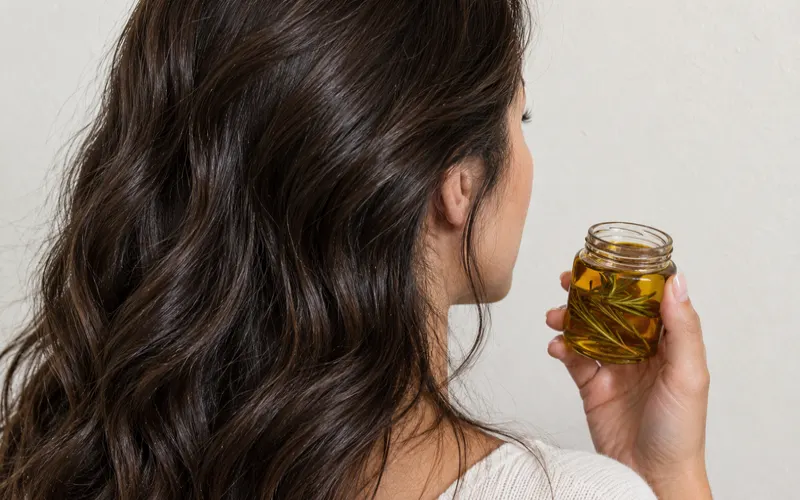
Rosemary oil for hair gets made two ways. They are not the same thing. One is an infusion. Rosemary, steeped in carrier oil at low heat. The other is essential oil, steam-distilled, then diluted. Homemade means the first. The research used the second.
That gap runs through everything below.
What You Need to Make Rosemary Oil for Hair
Four things. No equipment worth buying. Rosemary, a carrier oil, low heat, a clean glass jar. That is all rosemary oil for hair requires.
| Item | Amount | Why it matters |
| Dried rosemary | 1/2 cup | No water in it. Water is what spoils infused oil |
| Carrier oil | 1 cup | Sets the weight. Sets how easily it washes out |
| Castor oil | 2 tbsp, optional | Thick and tacky. Cut it with the carrier |
| Amber glass jar | 8 oz | Light accelerates rancidity |
| Cheesecloth or fine strainer | 1 | Debris left behind molds |
Fresh or Dried Rosemary
Dried wins. Not for potency. The University of Maine Cooperative Extension calls dried herbs “the safest way to make infused oils”. Fresh produce holds moisture. Oil has no oxygen in it. Bacteria grow.
Most recipes say to wash fresh sprigs. Then pat them dry. Patting is not drying. Water sits in the needle axils. A towel cannot reach it. Spoilage follows weeks later.
Use dried. If fresh is all you have, dry it fully first. Several days, not an afternoon.
Which Carrier Oil to Use
The carrier does more work than the rosemary does. Soaks in, or sits on top. One wash, or three.
| Carrier | Best for | Washes out |
| Jojoba | Fine hair, oily scalps | Easily |
| Grapeseed | Straight hair that greases fast | Easily |
| Olive | Coarse, dry, thick strands | Needs a second pass |
| Coconut | Coily and tightly curled hair | Stubborn below 76°F |
| Castor | Blended only, never neat | Hardest |
Match the carrier to texture. Not to whatever is trending. Jojoba suits fine hair. One wash clears it. Coconut and olive suit type 4 hair, which carries weight that would flatten anything finer. Type 1 hair greases fastest of all. Grapeseed is safer there.
Porosity shifts it again. Low porosity resists absorption. Heavy oils pool on top. The hair porosity guide has the test.
How to Make Rosemary Oil for Hair in an Hour
The heat method is the fast one. Rosemary oil for hair comes together in about an hour. Most versions online use it.
- Strip the needles. Mince them. More surface, more extraction.
- Rosemary and oil, in a heat-safe bowl. Over simmering water.
- Heat low. Extension guidance says 180°F. Above that, the oil degrades.
- Warm 20 to 30 minutes. Stir now and then.
- Kill the heat. Cover it. An hour at room temperature, or longer.
- Cool it completely.
- Through cheesecloth, into the jar. Press the herbs.
- Label it with the date.
Step 6 gets skipped constantly. Hot oil burns hands.
Can You Make Rosemary Oil Without Heat?
Yes. A cold infusion needs no stove. It trades an hour of work for six weeks of waiting.
Pack dried rosemary into a jar. Cover with carrier oil. Seal it. A warm windowsill, a month or more. Shake every few days. Strain the same way.
Cold infusion is gentler on the oil. Nothing gets heated. It also hands mold six weeks to appear. That is the second argument for dried rosemary.
Neither method produces essential oil. Steam distillation does that. It needs equipment no kitchen has.
Can I Use Coconut Oil to Make Rosemary Oil?
Coconut works as the carrier for rosemary oil. One quirk first.
Coconut is solid below roughly 76°F. Melt it. Infuse as normal. Expect it to set hard again. Store it in a wide-mouth jar. A dropper bottle is useless once it firms up.
Coconut suits tightly curled textures. On straight and wavy patterns it reads greasy. For days.
Rosemary Oil or Rosemary Water for Hair?
Rosemary water is a different product. Different job too. Needles simmered in water, cooled, strained, decanted.
No residue. No shampoo afterward. Almost nothing fat-soluble either. Refrigerated, a week. Oil keeps for months, and coats the strand.
Dry, coarse and coily hair does better with oil. Fine or fast-greasing hair does better with water. Not everyone needs oil.
Diluting Rosemary Essential Oil Instead of Infusing
Skip the infusion. Dilute rosemary essential oil instead. It is closer to what the research used.
Rosemary essential oil is concentrated. A 2025 review in Natural Product Communications records two commercial chemotypes under ISO 1342. Tunisian and Moroccan: 38.0 to 55.0% 1,8-cineole. Spanish: 16.0 to 23.0% cineole, 12.5 to 22.0% camphor.
Those numbers explain why neat application burns. The same review advises diluting in a carrier. Test on the forearm first.
A few drops per tablespoon of carrier. Blend it. Patch test. Wait a day.
Does Rosemary Oil for Hair Actually Work?
Evidence for rosemary oil for hair rests on one randomized trial. The paper reads better than the headlines about it.
Panahi and colleagues randomized 100 people with androgenetic alopecia . Rosemary oil, or minoxidil 2%. Fifty per arm. Six months. Month 3: no change either side. Month 6: hair count up in both. No significant difference. Either checkpoint. Scalp itching rose in both arms, and more often on minoxidil.
Read that again before repeating it. Rosemary matched minoxidil 2%. It did not beat it. And 2% is the weaker of the two standard strengths.
Here is the part the recipe blogs leave out. That 2025 review tabulates the protocol. One ml, twice daily, on the frontoparietal and vertex scalp, measured, every day, for six months. The abstract never states what preparation the rosemary oil was.
So a weekly kitchen infusion is not what anyone studied. It may still help. Nobody has tested it.
When Rosemary Oil Starts Showing Results
Nothing. That is what rosemary oil produced at three months. The gain appeared at six.
Hair grows half an inch a month. A follicle disturbed today reports back a season later. Week four reads noise. Six months is the honest minimum.
Thinning that is actively progressing needs a dermatologist. Not a jar of oil. The thinning hair guide covers that line.
How to Use Rosemary Oil for Hair
Scalp, not lengths. That is most of the technique for using rosemary oil for hair. The rest is frequency.
Part the hair. Apply to the scalp. Massage a few minutes. Thirty minutes, or overnight. Then shampoo.
Fine and straight hair: once a week. Thick, coarse, coily: two or three. The hair types chart places you quickly. The hair type quiz reads texture, porosity and density at once.
Washing matters as much as applying. Oil left sitting traps flakes. Odor too. A clarifying or natural shampoo clears a heavy carrier. A creamy one will not.
Will Rosemary Oil Help Dandruff?
Sometimes. The carrier decides it. Rosemary oil for hair can calm an irritated scalp. It can also make flaking worse.
Malassezia feeds on scalp lipids. Adding oil adds substrate. Some find rosemary soothing. Others find any oil worsens flaking within days.
Try one small section first. If flaking increases, stop. Zinc pyrithione and ketoconazole hit the organism itself. The dandruff guide pairs each with a texture.
What Are the Downsides of Rosemary Oil on Hair?
Two downsides of rosemary oil deserve naming. Camphor is the one nobody mentions.
The 2025 review flags topical use beyond one month. It may route to contact dermatitis. The Spanish chemotype runs 12.5 to 22.0% camphor. Indefinite daily use is not obviously safe.
Allergy is the second. Case reports describe allergic contact dermatitis to rosemary, confirmed by patch testing. Anaphylaxis is rare. Rosemary is Lamiaceae. So are mint, basil and thyme. A known reaction to any of them matters here.
Patch test inside the forearm. Wait 24 to 48 hours. Pregnancy needs medical sign-off. Keep it off broken skin.
Shelf Life of Homemade Rosemary Oil
Three months. Almost no recipe answers this. Homemade rosemary oil has a real number attached.
Extension guidance sets that limit. After that, discard it. Cool, dark, sealed. Amber glass over clear.
Rancid oil announces itself. Crayon or putty smell. Cloudiness. Growth. Throw it out. Make 8 oz quarterly, not 32 oz once.
Frequently Asked Questions
Which oil is best to make rosemary oil for hair?
ojoba for fine hair and oily scalps. Grapeseed for straight hair that greases fast. Olive for coarse, dry, thick strands. Coconut for coily. Match the carrier to your hair’s weight, not to the recipe you happened to find. Castor goes in blended. Never neat.
Can I use coconut oil to make rosemary oil?
Yes. Melt it first, then infuse as normal. Coconut solidifies below about 76°F. The finished oil sets hard. Wide-mouth jar, not a dropper bottle. It suits tightly curled hair. On straight hair it reads greasy. For days.
How long should rosemary sit in oil? Twenty to thirty minutes over low heat. Then an hour off it, or longer. Longer steeping goes deeper. No heat at all means four to six weeks on a warm windowsill, shaken every few days. Both get strained through cheesecloth.
What are the downsides of using rosemary oil on hair?
Camphor makes daily use past a month questionable. The Spanish chemotype runs 12.5 to 22.0% of it. Allergic contact dermatitis to rosemary shows up in case reports. Heavy carriers can worsen flaking on a dandruff-prone scalp. Patch test the forearm. Wait 24 to 48 hours.
Should castor oil go in the recipe?
Only blended. Two tablespoons per cup of carrier is plenty. Neat castor is very hard to wash out. On fine hair, two or three washes. It adds thickness to an infusion. The rosemary extracts the same either way.

Beauty Lies Truth publishes hair and personal color guides for readers in the US. Updated guides are checked against published sources, such as the American Academy of Dermatology, and those sources are linked in the text.