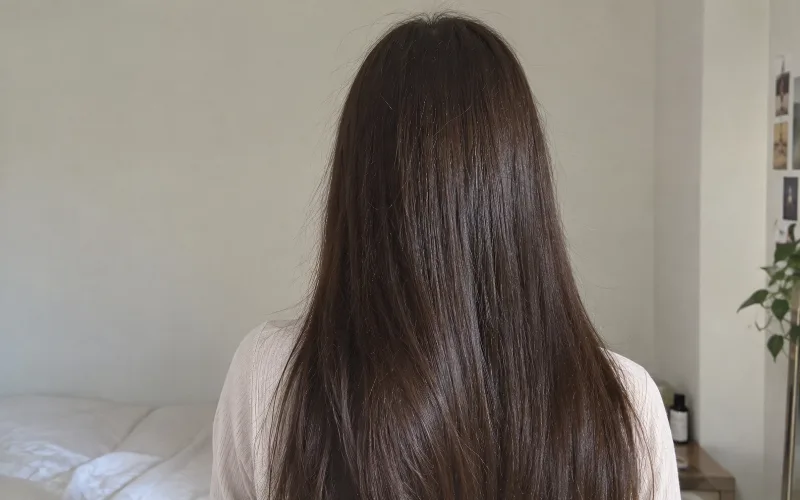
Hair botox contains no botulinum toxin and involves no needle. It is a deep conditioning and smoothing treatment, usually built on proteins, amino acids and oils, sealed in with a flat iron. The name is marketing. The thing actually worth checking before you book is not the botox part, it is whether the formula releases formaldehyde when that iron goes over it.
The name has done its job. People book this expecting something medical, or avoid it expecting something invasive, and both are reacting to a word a brand borrowed because it tested well. What you are buying is a hair mask with a good publicist.
Hair Botox is a Conditioning Treatment, Not an Injectable
Hair botox is a product applied to the outside of the strand, left on for twenty minutes or so, then rinsed, blow-dried and flat-ironed to seal it in. No injection, no needle, nothing going into the scalp.
Formulas vary enormously between brands, but most are built on some combination of hydrolyzed proteins, amino acids, vitamin B5 and oils such as argan or caviar. Those ingredients sit in the gaps along a roughened cuticle and temporarily fill them, which is why hair comes out shinier, smoother and easier to comb. It is a coating, not a repair. Knowing how your hair is actually structured tells you more about the result you will get than the brand name on the bottle does.
Real Botox and Hair Botox Share a Name and Nothing Else
Hair botox borrowed its name from an injectable it has no chemical relationship to. Botulinum toxin therapy works by temporarily relaxing targeted facial muscles, which softens the lines those muscles fold into the skin. The American Academy of Dermatology puts the effect at about three to four months, and is firm that it belongs with a licensed medical professional, warning specifically against salons, parties and private homes.
That is the real dividing line. The salon treatment is a cosmetic you buy over a basin. The injectable is a prescription drug administered in a clinical setting, by providers such as NUIQ Med Spa & Wellness Lounge in Cleveland, where treatment happens under medical supervision rather than in a styling chair. Neither does the other’s job, and no amount of hair botox touches a frown line. If what you are weighing is a cosmetic procedure rather than a hair treatment, that is a separate decision.
Hair Botox and Keratin Treatments Differ in What Seals the Hair
Hair botox and a keratin treatment look almost identical in the chair. Both are applied, processed and finished with a flat iron. The difference sits in what that heat is activating.
| Hair botox | Keratin treatment | |
|---|---|---|
| What it does | Fills gaps in the cuticle with proteins, amino acids and oils. | Relaxes the bonds that hold the curl pattern. |
| Effect on curl | Softens frizz. You keep most of your pattern. | Visibly straighter. The pattern loosens. |
| The chemistry to check | Varies by brand. Some formulas release formaldehyde under heat. | Commonly built on an ingredient that releases formaldehyde under heat. |
| Usually sold as lasting | Two to four months. | Three to five months. |
| What to ask for | The product name and safety data sheet, before you sit down. | The same. Neither is FDA-approved, because both are cosmetics. |
Hair Botox Labeled Formaldehyde-free is Not Always Formaldehyde-free
Hair botox is sold as the gentler alternative, and sometimes it is. The problem is that the label alone does not settle it. The FDA warns that hair smoothing products can release formaldehyde gas when heated, and names three things to look for on an ingredient list: formaldehyde, formalin and methylene glycol. Above roughly 0.1 parts per million in the air, some people get burning eyes, nose and throat, coughing, wheezing, nausea and skin irritation. Prolonged high exposure is linked to certain cancers.
The gap that catches people is procedural rather than chemical. The FDA also notes that products sold only to salon professionals may carry no ingredient list at all, which is exactly what a hair botox treatment is. You cannot read a label that was never printed. What professional products do have is a safety data sheet, and asking to see it is the most useful thing you can do before booking.
Regulation has not caught up. A proposed federal ban on formaldehyde in hair straightening products was first due in October 2023 and has missed every deadline since, including April 2024, November 2024, March 2025, July 2025 and the end of 2025. The FDA says the rule remains a priority. As of now it still has not been published, which means the checking is still yours to do.
Hair Botox Results Fade in Weeks Rather Than Months
Hair botox is usually sold as lasting two to four months. For most people it does not. The treatment is a coating, and coatings wash off, so the realistic figure is somewhere between six and ten washes depending on how porous your hair is and whether you are using a sulfate shampoo.
That is not a reason to skip it, but it changes the math. A treatment repeating every six weeks is a standing cost and a standing heat exposure, and both belong in the decision. If you have color to protect too, the two schedules share one head of hair.
Hair Botox Suits Some Hair Types Far Better Than Others
Hair botox works on the surface of the strand, so what it gives you depends on what your strand is like to begin with. Fine straight hair and curly hair get genuinely different outcomes from the same tub, and coily hair gets a third. The hair types chart covers where you sit.
| Hair type or state | What it does | Worth knowing |
|---|---|---|
| Fine and straight | Adds shine and smooths flyaways. | The coating can flatten roots. The type most likely to feel weighed down. |
| Wavy to curly | Cuts frizz and loosens the pattern slightly. | You may lose definition you actually liked. |
| Coily | Softens the strand and adds slip for detangling. | It will not straighten. Scrutinize the flat iron pass, not the product. |
| Bleached or highlighted | The most visible change, because a porous cuticle has the most to fill. | Also least able to take repeated heat. Space treatments out. |
| Already heat-damaged | Masks roughness and makes the hair behave for a few weeks. | Nothing here repairs anything. The damage is still under the coating. |
.
Questions People Ask About Hair Botox
Does Hair Botox Contain Actual Botox?
No. There is no botulinum toxin in it, and there is no injection involved. It is a topical conditioning treatment that borrowed a recognizable name, in the same way a product can be called a facelift cream without involving surgery.
Is Hair Botox Safer Than a Keratin Treatment?
Often, but not automatically. Keratin treatments more commonly rely on a formaldehyde releaser, while hair botox formulas vary by brand. Some are genuinely free of it and some are not. Safer is a property of the specific product, not of the category.
How Long Does Hair Botox Last?
Two to four months is the usual claim. Six to ten washes is closer to what most people see, sooner on porous or bleached hair, and sooner again with sulfate shampoo.
Can Hair Botox Cause Hair Loss?
The product itself is not a known cause of shedding. The flat iron pass at the end is what damages hair, and repeated high heat on fragile strands causes breakage that can look like loss. Shedding that starts at the scalp is a different problem and belongs with a dermatologist.
What to Ask Before You Book Hair Botox
Hair botox is only ever as safe as the specific tub your salon opens.
- The product name and brand, in advance, not when you are already gowned up.
- The safety data sheet. Professional products must have one, and a salon that cannot produce it has answered your question.
- Whether formaldehyde, formalin or methylene glycol appear anywhere on it.
- What temperature the flat iron runs at, and how many passes.
None of this makes hair botox a bad treatment. It makes it a cosmetic product with a misleading name and uneven formulation, which is a thing you can buy well or badly. If you are not sure which row of the table applies to you, the hair type quiz sorts it quickly, and a treatment chosen for your actual hair beats one chosen for its branding.
BeautyLiesTruth publishes hair and personal color guidance built on primary research. Color claims are tested by draping under controlled daylight, and every figure is traced to a published source rather than to another blog.