You’ve already done the hard part. You know your undertone, you know your season, and you’ve probably rebuilt at least part of your wardrobe around the palette that actually works for you. Then you get to glasses, and somehow the rules you apply to everything else disappear. If you’ve ever stood at a frame wall asking “what color glasses should I get?”, the answer is the same one that guides your clothes: pick the frame color that matches your season. Most people skip that step, and a frame gets picked because it looked nice on a mannequin, or because a friend has the same one.
What color glasses should I get?
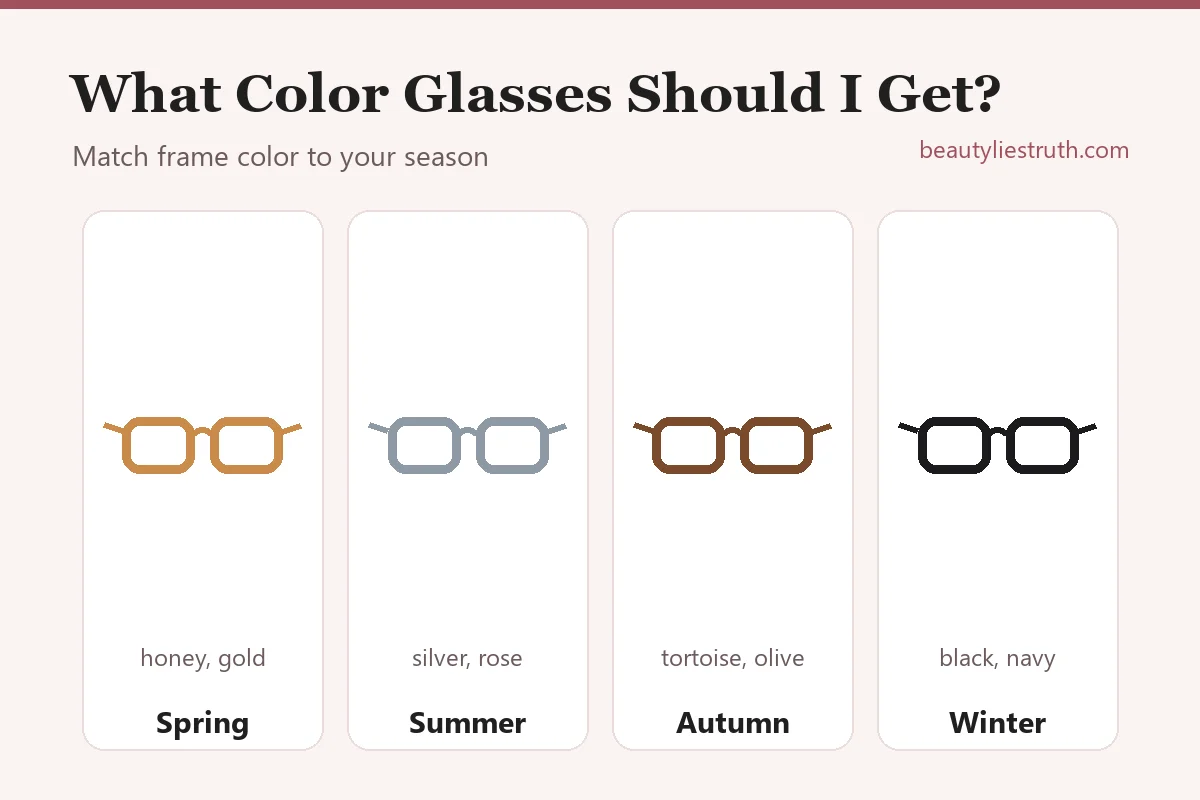
The best glasses color for you is one that matches your undertone and your color season. Warm undertones (Spring and Autumn) suit honey, warm tortoise, gold and olive frames. Cool undertones (Summer and Winter) suit black, silver, gray, cool tortoise and berry tones. Light seasons need softer, lighter frames, and deep seasons can carry dark, rich ones.
If you don’t know your season yet, the free color season quiz takes about two minutes and works from your skin, hair and eye coloring. The rest of this guide shows how to turn that result into a frame choice.
Why glasses break the usual color rules
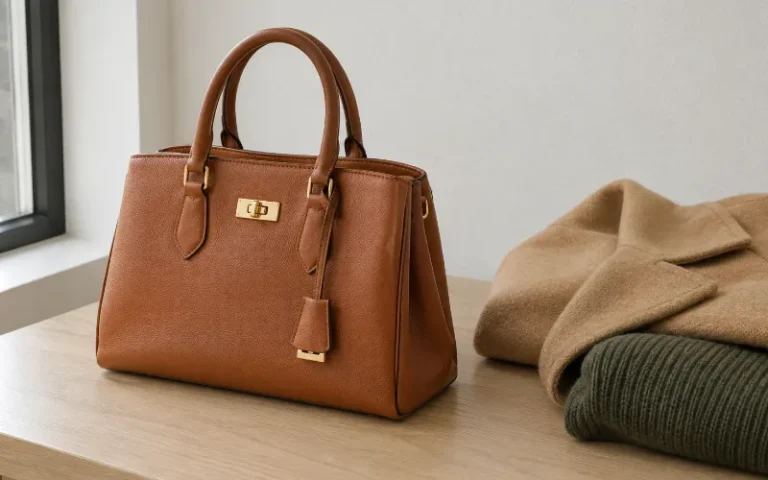
A handbag never gets near your face. That one fact changes how color rules apply to it, which is exactly the logic behind how color analysis outfit ideas treat different parts of your wardrobe depending on how close they sit to your features. Glasses sit at the opposite extreme from a handbag. They frame your eyes directly, overlap with your eyebrows, and sit inches from your skin all day. If anything you own deserves careful color treatment, it’s the one accessory that lives on your face.
Why frame color affects your skin tone
Glasses color matters for your skin tone for the same reason a top or a lipstick does. Seasonal color analysis works on a simple premise: certain hues harmonize with your natural coloring, and others fight against it, making skin look sallow, washed out or oddly flat. Analysis describes this as determining which colors “harmonize with the appearance of a person’s skin complexion, eye color… and hair color,” a method used across fashion and cosmetics for exactly this reason.
A frame color works through the same mechanism as a lipstick shade or a top color. It either lifts your complexion or quietly works against it, and because it sits so close to your face, the effect is more noticeable than almost anything else you wear. It’s the same reason some colors make teeth look whiter while others make them look dull.
A quick history, because context helps
This system has real depth behind it, not just a trend cooked up for social media. A detailed history of how seasonal color analysis developed traces the method back to Bauhaus color theory in the 1920s, through its mainstream popularization in the 1980s, to today’s twelve-season systems built around temperature, value and chroma working together. That’s the same framework already guiding your clothing and makeup choices, and the full set of 12 color seasons maps onto frames just as neatly. Applying it to frame color isn’t a stretch. It’s just finishing the job.
Matching frame undertone to your season
Glasses color for your skin tone starts with temperature. Warm seasons, Spring and Autumn, tend to look best in frames with golden, honey or warm tortoise undertones, the same family of tones that already flatters your skin in clothing and jewelry. Cool seasons, Summer and Winter, lean toward frames with silver, black or cool-toned tortoise undertones, mirroring the logic that makes silver read as more flattering than gold on cool-toned faces. If you’re unsure which way you lean, the guide to jewelry metals for skin undertones uses the same test, and metal frames follow it directly. Neutral undertones get the most flexibility and can pull off either direction depending on the rest of an outfit.
Depth matters just as much as temperature. A Deep Winter or Deep Autumn generally wants richer, more saturated frame colors: deep tortoise, true black or a jewel-toned frame rather than anything pastel or washed out. Light seasons, by contrast, tend to get overwhelmed by frames that are too heavy or too dark, the same way an overly deep lipstick shade can look harsh against lighter coloring. Soft seasons sit in between and look best in muted, slightly grayed frame colors rather than glossy, high-contrast ones.
Frame colors for each of the 12 seasons
The table below turns each season’s palette into frame and lens choices. Use it as a shortlist, then check the frame in daylight against your face, because screens and store lighting both shift color.
| Season | Frame colors to try | Colors to skip | Sunglass lens tint |
|---|---|---|---|
| Light Spring | Light honey, champagne, peach, light gold metal, clear warm crystal | Black, heavy dark tortoise | Light brown, amber |
| True Spring | Golden tortoise, honey, coral, warm green, gold metal | Cool gray, icy pastels | Brown, amber |
| Bright Spring | Bright tortoise, warm red, turquoise, clear crystal with color | Dusty, muted frames | Brown, green |
| Light Summer | Soft silver, pale rose, light gray, clear frames, lavender | Black, orange tortoise | Light gray, blue-gray |
| True Summer | Cool tortoise, slate blue, rose, gunmetal, soft navy | Gold, warm brown | Gray, blue-gray |
| Soft Summer | Gray-brown, muted rose, smoky taupe, brushed silver | Glossy black, bright colors | Gray |
| Soft Autumn | Soft tortoise, olive, mushroom, muted gold, warm taupe | Black, icy silver | Brown, soft green |
| True Autumn | Classic tortoise, amber, rust, olive, bronze metal | Cool gray, bright pink | Brown, amber, green |
| Deep Autumn | Dark tortoise, espresso, deep olive, burgundy brown | Pastels, clear frames | Dark brown, green |
| Deep Winter | True black, deep burgundy, dark cool tortoise, navy | Honey, pale beige | Dark gray |
| True Winter | Black, crisp silver, royal blue, cool red | Warm tortoise, gold | Gray, blue-gray |
| Bright Winter | Black, clear crystal, bold jewel tones, high-shine silver | Muted browns | Gray |
Where to actually start looking
Once you know which direction to shop in, the next step is finding a retailer with enough range to actually act on it. Being able to explore a wide range of glasses online matters more here than it would for a simpler accessory decision, since frame undertone isn’t something most brick-and-mortar stores stock in real depth. A shop with a handful of frame colors in person might only carry one or two options in your actual palette, while a larger online selection lets you compare several shades within your season side by side before committing.
Beyond frame color: shape still matters too
Color is the piece most people skip, but it’s not the only variable worth thinking through. Face shape still plays a role in which silhouettes flatter your features: rounder faces often read better in more angular frames, while angular faces tend to soften nicely in rounder shapes. The face shape quiz narrows that down in a few questions, and your eye shape helps with where the top line of the frame should sit.
The useful approach is layering the two decisions. Narrow down shape first based on your face, then narrow down color within that shape based on your season. Trying to solve both at once usually means settling for whichever frame happened to be in stock, rather than the one that’s right on both counts.
What this looks like in practice
Picture a Warm Autumn shopping for a new everyday pair. Shape-wise, a slightly rounded cat-eye might suit their face well. Color-wise, instead of grabbing whatever rounded cat-eye happens to be in a display case, this person would look for that silhouette in a honey tortoise, warm amber or rich caramel tone, colors that already show up in their clothing and makeup palette for good reason. The shape solves one problem. The color solves the other. Together, they produce a pair that looks intentional rather than accidental.
Hair plays into this too. A frame that echoes your hair color, or sits one step darker, tends to look settled on the face, which is one reason the right short hairstyles with glasses are planned around the frame rather than the other way round.
A note on lens tint, not just frame color
For anyone also shopping for sunglasses rather than clear prescription frames, lens tint deserves a quick mention. Warm seasons generally do well with brown, amber or green-tinted lenses, while cool seasons often look more balanced in gray or blue-gray tints. It’s a smaller detail than frame color, but it follows the exact same temperature logic, and it’s worth a glance once the frame itself is settled.
What color eyeglasses go with everything?
The glasses color that goes with the most outfits is a tortoise in your own temperature: warm honey tortoise for warm undertones, cool or gray-brown tortoise for cool undertones. Tortoise mixes several tones, so it sits easily with most clothes. Black works with everything too, but it only flatters deep and bright seasons.
What color glasses frames make you look younger?
Frames make you look younger when they add a little color and lift near the eyes without overpowering your coloring. Soft tortoise, warm rose, burgundy or a clear frame with a tint usually look fresher than heavy black on lighter or graying coloring. As hair turns silver, many people move toward cooler, lighter frames that match it.
Why this is worth the extra step
It would be easy to treat this as overthinking an accessory that mostly serves a practical purpose. But the same logic that makes a well-matched lipstick or blouse color feel effortless applies just as directly here, arguably more directly, given how close glasses sit to your face. A frame in your season reads as a natural extension of your coloring. A frame outside it reads as a slightly off note, even to people who couldn’t explain exactly why something feels mismatched.
Final thoughts
You’ve already put in the work to understand your season. Extending that same logic to the one accessory that sits closest to your face, rather than treating it as a purely functional purchase, is a small step that makes a real difference. Shape first, color second, and a retailer with enough range to shop your specific palette rather than settling for whatever’s available: that’s really the whole formula. If you’d like your full palette in one place to shop frames and clothes against, a printable color season palette keeps every shade on your phone.

Beauty Lies Truth publishes hair and personal color guides for readers in the US. Updated guides are checked against published sources, such as the American Academy of Dermatology, and those sources are linked in the text.